
📊 Full opportunity report: The Future Of Food Safety Compliance: Monitoring Pesticide Residues Efficiently on IdeaNavigator AI — validation score, market gap, and execution plan.
TL;DR
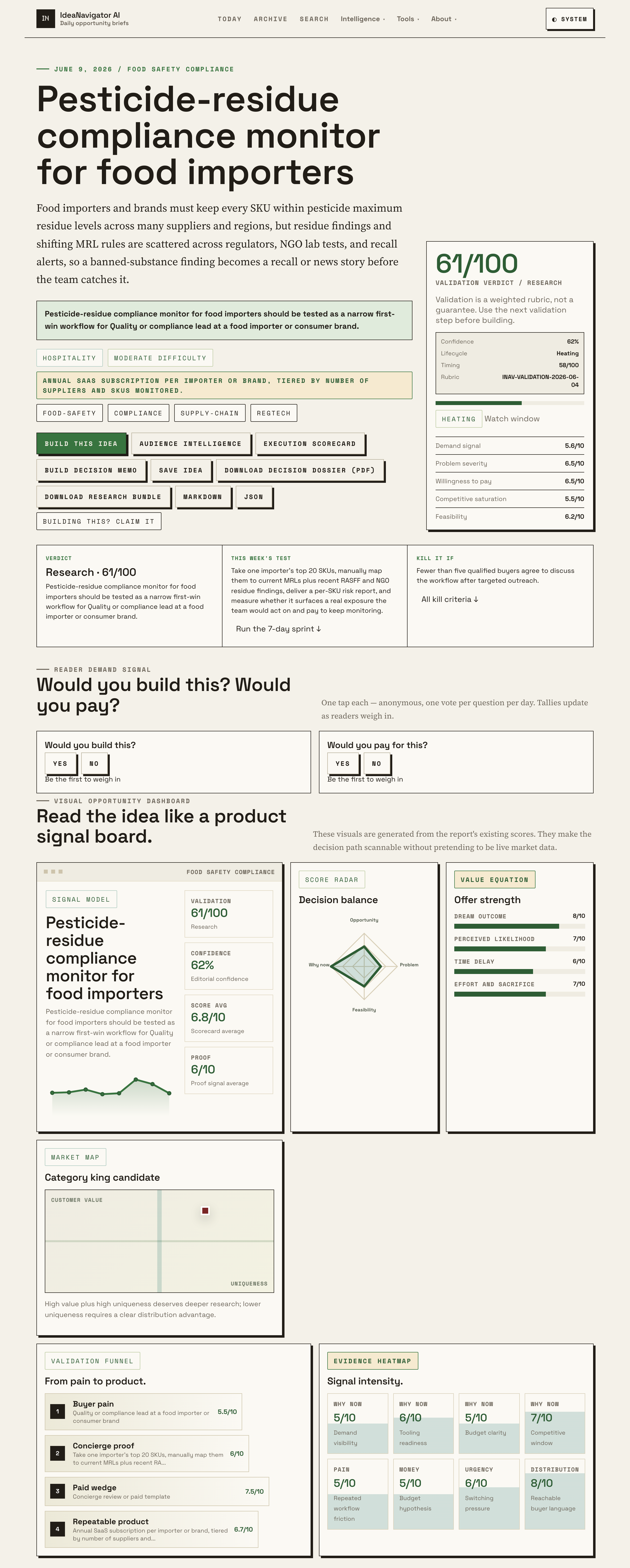
A new pesticide residue monitoring system is being tested for food importers, offering real-time mapping of compliance risks. It aims to reduce recalls and improve safety oversight. The tool is in early validation stages.
A new pesticide-residue compliance monitoring tool for food importers is in the early testing phase, aiming to streamline risk detection and ensure adherence to evolving maximum residue levels (MRLs). This development addresses a pressing need for faster, more accurate residue tracking amid increasing regulatory and consumer demands for food safety.
The proposed system maps a food brand’s suppliers and SKUs to current EU and regional pesticide MRLs, integrating public residue findings from sources like RASFF alerts and NGO tests. It flags products at risk of exceeding legal limits and generates audit-ready compliance reports, enabling importers to proactively manage risks.
Initial validation involves analyzing a top 20 SKU sample from an importer, manually aligning these products with the latest MRLs and residue alerts. The goal is to verify whether the tool can identify real exposure risks that would influence supply chain decisions and compliance efforts. This process will determine if the system provides actionable insights that justify its adoption and subscription model.
Implications for Food Importers and Regulatory Compliance
This development could significantly improve how food importers manage pesticide residue risks, reducing the likelihood of product recalls and regulatory violations. As NGO testing and regulatory scrutiny increase, having a real-time, comprehensive monitoring system can provide a competitive advantage by ensuring transparency and compliance. It also addresses the challenge of keeping pace with tightening MRL rules across multiple markets, potentially lowering legal and reputational risks for brands.
As an affiliate, we earn on qualifying purchases.
Growing Regulatory Pressure and Testing for Pesticides
Recent years have seen a rise in NGO and regulator testing revealing EU-banned pesticides in staples such as rice, tea, and spices. These findings often lead to recalls or negative publicity before brands can respond. Meanwhile, EU and regional MRLs are tightening, creating a complex landscape for food importers to navigate. Currently, compliance relies heavily on manual mapping and reactive measures, which are often slow and incomplete.
“The proposed monitor could transform compliance workflows by providing real-time risk assessments based on current residue findings and regulations.”
— an anonymous researcher
food safety compliance monitoring system
As an affiliate, we earn on qualifying purchases.
As an affiliate, we earn on qualifying purchases.
Uncertainties About System Validation and Adoption
It is not yet clear how effectively the system will identify actual residue risks during testing, or how quickly it can be scaled for broader use. The success depends on accurate mapping, timely data integration, and user adoption among compliance teams, which are still being evaluated.
pesticide residue analyzer for food importers
As an affiliate, we earn on qualifying purchases.
As an affiliate, we earn on qualifying purchases.
Next Steps for Validation and Market Deployment
The next phase involves testing the system with multiple importers’ top SKUs, collecting feedback, and refining risk detection accuracy. If successful, the developers plan to offer it as a SaaS subscription, with tiered pricing based on monitored SKUs and suppliers. Broader rollout and integration with existing compliance tools are expected over the coming months.
regulatory compliance food testing tools
As an affiliate, we earn on qualifying purchases.
As an affiliate, we earn on qualifying purchases.
Key Questions
How will this system improve food safety compliance?
It will provide real-time mapping of pesticide MRLs and residue findings, enabling importers to identify and address risks proactively before products reach consumers.
What data sources does the system use?
The system integrates EU and regional MRL databases, RASFF alerts, NGO testing results, and recall notices to generate comprehensive risk reports.
Is this system ready for commercial use?
It is currently in early testing with selected importers. Broader commercial deployment is expected after validation and refinement over the next few months.
What are the main challenges for adoption?
Ensuring accurate, up-to-date data mapping and convincing compliance teams to integrate the tool into their workflows are key hurdles at this stage.
Could this system reduce food recalls?
Potentially, by providing early risk detection, it can help brands address issues before products are shipped or recalled, improving overall safety management.
Source: IdeaNavigator AI