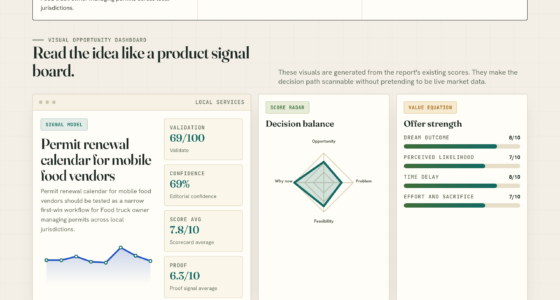

📊 Full opportunity report: Glasspane: When Transparency Itself Becomes the Product on ThorstenMeyerAI.com — validation score, market gap, and execution plan.

Get business pricing on monitors, keyboards and dev gear
- Business-only prices and quantity discounts
- Tax-exempt purchasing
- Multiple users, one account, clear invoices
TL;DR
Glasspane has launched new features emphasizing role-specific data views and AI transparency, reinforcing its core thesis that transparency builds trust across stakeholders. The platform now supports personalized workforce insights and AI telemetry, enhancing infrastructure visibility.
Glasspane has unveiled a new platform release that emphasizes role-aware data presentation and AI transparency, aiming to redefine how organizations build trust in their infrastructure.
The core innovation of Glasspane lies in its ability to present the same underlying data differently for various stakeholders—such as CFOs, engineers, and business managers—based on their specific needs. This role-aware approach ensures relevant information is accessible without overwhelming users with irrelevant details. The platform also introduces AI features that generate natural-language summaries, flag anomalies, and forecast risks, supporting decision-making and operational transparency. Notably, the AI layer supports multiple providers, including OpenAI, Google Gemini, and local options like LM Studio, with automatic fallback chains to ensure reliability. Additionally, the latest release adds capabilities for workforce growth insights, allowing managers to view individual engineer development data and receive AI-generated recommendations. It also enhances AI model transparency by recording telemetry on AI calls, success/error rates, and model drift, with alerting for degraded performance. These features reinforce Glasspane’s thesis that transparency and trust are interconnected and that making data accessible and understandable for diverse roles is essential for effective management of complex infrastructure.When transparency itself becomes the product
The infrastructure is healthy — but nobody can see it. Static PDFs and “trust us” status calls don’t scale. Glasspane replaces them with real-time, role-aware transparency, and an AI layer that explains what’s happening, why it matters, and what to do next.
“It’s healthy — trust us” doesn’t scale
MSPs and enterprise IT share the same problem from opposite sides of the table: the same question, asked over and over in different words — how do I know?
- Monthly PDF reports, already out of date
- Screenshots pasted into slide decks
- “Trust us, it’s fine” status calls
- Real-time status, not last month’s
- The right view for each audience
- AI that says what to do next
One dataset, three audiences
The CFO, the account manager, and the on-call engineer look at the same infrastructure — but need completely different things from it. A dashboard that forces a CFO to read latency histograms is a dashboard the CFO closes. Switch the role and watch the same data re-present itself.
Role-aware presentation
The data underneath is identical. Only the framing changes — fitted to whoever’s asking.
Model-agnostic — and inspectable by design
The AI turns what is happening into why it matters and what to do next. Two architectural choices keep that layer from becoming a liability.
Eight providers · assign per task · automatic fallback
If a primary provider fails, the next takes over transparently. Run a local model and sensitive infrastructure data never leaves your network.
Per-task + fallback chains
A different provider per task with one env var each; define a chain so a failure fails over, not down.
AGPL-3.0 · self-hostable
A transparency tool that can’t be audited would be a contradiction. Every line is inspectable.
Each feature extends the same thesis
None is really standalone. Each pushes transparency onto a new surface — the people, the AI itself, and the outsiders who need to see in.
Transparency for the people who run it
Career-ladder progression, growth signals, skills & goals — with AI generating evidence-backed development recommendations grounded in the next rung. Turns reviews from anecdote into evidence.
The tool that watches itself
Telemetry on every AI call — latency, errors, fallback events, version drift — across 1h / 24h / 7d. Alerts on degradation or version drift; every result footnotes the exact provider, model, version & latency.
Trust, delivered safely
Time-limited, role-based public links. Choose an audience, curate widgets from a public-safe whitelist, set an expiry. A read-only “Transparency Center” — no login, nothing you didn’t share.
Transparency compounds
Each layer is only as valuable as the one beneath it is credible — which is exactly why one coherent system beats bolting any single piece onto a tool that hasn’t earned the layers below.
The compounding stack
Infrastructure data
earns a customer’s trust — SLAs, security, cost, operations
Model Transparency
earns trust in the AI interpreting that data — no unaccountable black box
Public Sharing
delivers that trust directly & safely to the people who need it
Workforce Growth
extends the same evidence-based philosophy to the team behind it
Role-Specific Data Presentation Reinforces Trust
By tailoring data views to different roles, Glasspane addresses a key barrier to effective infrastructure monitoring: information overload and irrelevance. This approach increases the likelihood that stakeholders will actually use and trust the platform, leading to better decision-making, improved operational confidence, and stronger relationships between technical teams and business leaders. The platform’s emphasis on transparency—both in data and AI operations—further supports compliance, security, and accountability, which are critical for enterprise and managed service provider (MSP) environments. Ultimately, this shift toward role-aware transparency could set new standards for how organizations communicate and act on infrastructure data, fostering a culture of trust and informed decision-making.
Products Worth Considering

LG UltraGear 32GX850A-B 32-Inch 4K UHD Glossy OLED Gaming Monitor

Samsung 27 Odyssey OLED G5 (G50SF) QHD QD-OLED Gaming Monitor

Samsung 27-Inch Odyssey QD-OLED G8 4K 240Hz Gaming Monitor
As an affiliate, we earn on qualifying purchases.
From Static Reports to Dynamic, Role-Based Transparency
Traditional infrastructure monitoring relies on static reports, screenshots, and trust-based calls, which do not scale or inspire confidence. Glasspane’s approach builds on the recognition that different stakeholders need different perspectives on the same data. Its design decision to support role-specific views stems from the understanding that effective transparency must be accessible, relevant, and actionable for each user type. The recent release expands this philosophy, integrating AI-driven insights and telemetry to make transparency more comprehensive and self-aware. The platform’s open-source nature under AGPL-3.0 aligns with its commitment to auditability and trustworthiness, especially in sensitive environments where data sovereignty and transparency are paramount.
“Glasspane’s role-aware presentation transforms how organizations build trust in their infrastructure, making data relevant and actionable for everyone from engineers to executives.”
— Thorsten Meyer, CEO of ThorstenMeyerAI.com
Unclear Impact of Role-Based Views on User Engagement
While the platform’s design logically addresses known barriers to transparency, it is not yet clear how widely or effectively these role-specific views will be adopted in practice. User feedback and real-world testing are still forthcoming, and it remains to be seen whether this approach significantly increases platform usage or trust among diverse stakeholder groups.
Next Steps for Adoption and Validation
Glasspane is expected to roll out further integrations and gather user feedback over the coming months. Monitoring how organizations implement role-aware dashboards and AI transparency features will be key to assessing their impact. The company may also develop case studies demonstrating improved trust, operational efficiency, and compliance, helping to establish these features as industry standards.
Key Questions
How does role-aware presentation improve infrastructure monitoring?
It ensures each stakeholder sees relevant data tailored to their responsibilities, increasing engagement and trust in the platform.
What makes Glasspane’s AI transparency different from other tools?
Glasspane records telemetry on AI calls, success rates, and model drift, providing real-time alerts and ensuring the AI layer is itself transparent and auditable.
Can organizations run the AI layer locally?
Yes, the platform supports local deployment of models like LM Studio, enabling data sovereignty and privacy.
Will these new features reduce the need for manual oversight?
While AI insights assist decision-making, they are intended as inputs to human judgment, not replacements for human oversight.
What are the main benefits for managed service providers?
Enhanced transparency, role-specific data views, and AI telemetry can improve client confidence, support compliance, and help attract and retain talent.
Source: ThorstenMeyerAI.com