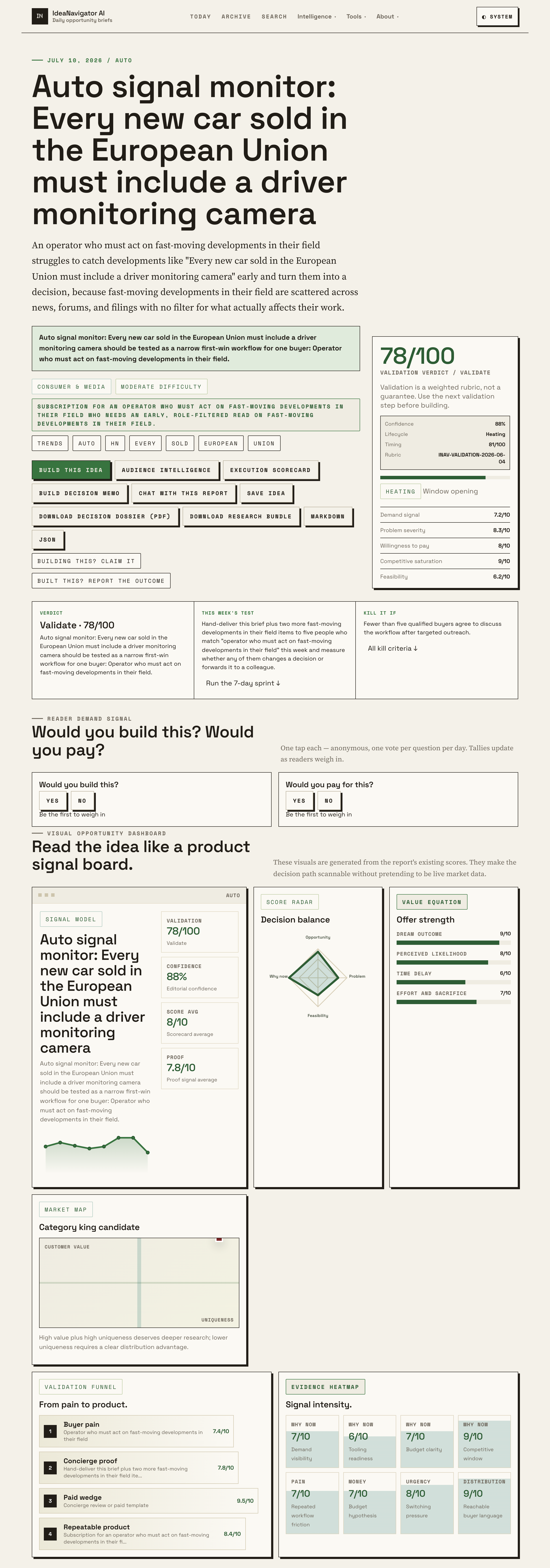
📊 Full opportunity report: Every New Car Sold In The EU: Driver Monitoring Cameras Now The Law on IdeaNavigator AI — validation score, market gap, and execution plan.

Get business pricing on monitors, keyboards and dev gear
- Business-only prices and quantity discounts
- Tax-exempt purchasing
- Multiple users, one account, clear invoices
TL;DR
Under the EU’s General Safety Regulation, all new cars sold in the European Union must now be equipped with driver monitoring — systems that detect drowsiness and distraction, most commonly using interior cameras. The mandate is being phased in, with camera-based systems becoming the standard approach among major automakers.
Every new car sold in the European Union must now be fitted with a driver monitoring system capable of detecting drowsiness and distraction, under the EU’s General Safety Regulation (GSR2), with interior cameras emerging as the technology most automakers are using to comply. The requirement, which entered into force through a phased schedule beginning in July 2024, makes the EU the largest market to date to mandate some form of continuous driver-state monitoring across its entire new-car fleet. For drivers, fleet operators, and privacy advocates alike, the change puts a camera inside the cabin of nearly every new vehicle sold in the bloc.
The legal basis is Regulation (EU) 2019/2144, adopted in late 2019 and applied in stages. From July 2022, the rule applied to new vehicle type approvals; from July 2024, it extended to driver drowsiness and attention warning on newly approved models; and by July 2026, all new vehicles registered in the EU must carry the full suite of required safety systems, including advanced driver distraction warnings. The regulation does not name cameras specifically — it mandates the outcome: the vehicle must detect driver fatigue and distraction and issue a warning.
In practice, most manufacturers have settled on infrared interior cameras that track eye movement, eyelid closure, head position, and gaze direction as the most reliable way to meet the requirement. Steering-input-based systems, which infer drowsiness from how erratically a driver turns the wheel, remain in use on some models but are widely seen as less accurate for detecting distraction such as phone use. Vehicles sold in the EU from major brands including Volkswagen, Mercedes-Benz, BMW, Stellantis, Renault, and Ford now commonly ship with camera-based monitoring as standard or optional equipment tied to driver-assistance packages.
According to a signal brief published by IdeaNavigator AI, the development was surfaced via Hacker News with a high relevance score, reflecting how quickly regulatory changes in the automotive sector now propagate to operators who need same-day awareness rather than weekly digests. The brief frames the mandate as an example of a fast-moving development that demands role-filtered monitoring.
What the Mandate Means for Drivers and Carmakers
For drivers, the most visible change is that new cars will increasingly watch them back. Camera-based systems can trigger audible and visual warnings, and in some configurations escalate by tightening seatbelts or preparing emergency braking if a driver appears to be falling asleep or looking at a phone. Road-safety bodies, including the European Commission and the EU’s road-safety advocacy organisations, have pointed to driver distraction and fatigue as among the leading contributors to serious crashes, and the regulation forms part of the EU’s Vision Zero goal of eliminating road deaths by 2050.
For automakers and suppliers, the mandate effectively guarantees a market for interior sensing hardware and software across tens of millions of vehicles annually. It also creates a compliance and engineering burden: systems must work across diverse drivers, lighting conditions, and eyewear, and must satisfy regulators that warnings are timely and effective. Similar rules are advancing elsewhere — the US NHTSA has been evaluating driver-monitoring requirements for vehicles with partial automation, and Euro NCAP, the European crash-test body, has said it will reward camera-based monitoring in its rating scheme.
The change also carries a privacy dimension. Privacy campaigners and data-protection authorities, including Europe’s national regulators coordinated through the European Data Protection Board, have raised questions about how long cabin footage is stored, whether it is processed on-device or transmitted, and whether insurers or police could obtain it. Manufacturers state that their systems process images locally and do not record or transmit video under normal operation, but these assurances are self-declared and vary by brand.
How the EU Phased In the Requirement
The General Safety Regulation was adopted in December 2019 as part of a broader EU push to cut road deaths. It bundled more than a dozen mandatory safety measures, including intelligent speed assistance, event data recorders, emergency lane-keeping systems, tyre-pressure monitoring, and reversed detection — alongside the driver drowsiness and attention warning requirements at the centre of the current rollout.
The July 2024 / July 2026 phasing was designed to give manufacturers time to redesign vehicle platforms. Type-approved models had to comply first, with the obligation extending to all newly registered vehicles afterward, meaning cars already in dealers’ stock and sold after the deadline are covered by transitional provisions. Because EU rules are often mirrored in the EEA and by non-EU countries that adopt UN vehicle regulations, the requirement’s reach extends well beyond the bloc itself.
Open Questions on Cameras and Data
It is not strictly accurate that the law mandates a camera as such — the regulation requires driver drowsiness and attention warning, and cameras are the compliance path most manufacturers have chosen. Some models may use steering-behaviour-based systems instead, though these are becoming rarer.
How the systems perform in real-world conditions — with sunglasses, at night, or for drivers with atypical facial features — remains uneven, and independent evaluations of warning accuracy are limited. Data-handling practices also differ by manufacturer: it is not yet clear how the European Data Protection Board or national authorities will harmonise enforcement over cabin-sensing data, nor whether footage could be accessed in litigation or criminal investigations. Enforcement of the 2026 all-vehicles deadline, including how member states handle transitional stock, is still being worked through.
Enforcement Deadlines and Industry Response
The key upcoming milestone is the July 2026 date, after which all new vehicles registered in the EU must carry the full mandated safety suite with no transitional exemptions. Watch for Euro NCAP incorporating camera-based driver monitoring more heavily into its rating protocols, which historically has pushed adoption faster than regulation alone, and for NHTSA rulemaking in the United States that could align US requirements with the European approach. Expect continued debate in the European Parliament and among data-protection authorities over storage limits and access rules for cabin-camera data. A review of the GSR by the Commission, assessing how the mandated systems perform in practice, is also anticipated in the years following full application.
Source: IdeaNavigator AI
Key Questions
Does the EU law specifically require a camera inside the car?
No. The General Safety Regulation requires a driver drowsiness and attention warning system. Cameras are the solution most automakers have adopted because they reliably detect distraction, but some vehicles use steering-input analysis instead.
When did the requirement take effect?
The regulation was adopted in 2019 and phased in: new type approvals from 2022, drowsiness warning on newly approved models from July 2024, and all newly registered vehicles by July 2026.
Does the camera record video of me?
Manufacturers state that monitoring systems process images locally and do not store or transmit video under normal operation. These practices are not uniform across brands, and regulators have not yet issued harmonised rules on cabin data retention.
What happens if the system detects I am drowsy or distracted?
Typically the system issues visual and audible warnings and may escalate by tightening seatbelt pretensioners or preparing emergency braking, depending on the vehicle and its driver-assistance configuration.
Does this apply outside the EU?
The mandate applies to the EU and, through related agreements, broadly to the EEA. Other markets, including the US, are evaluating similar requirements but have not adopted an equivalent blanket mandate as of now.
Source: IdeaNavigator AI
Halloween Picks
halloween
As an affiliate, we earn on qualifying purchases.