
📊 Full opportunity report: Making Sense Of GLP-1 Access And Pricing Data on IdeaNavigator AI — validation score, market gap, and execution plan.

Get business pricing on monitors, keyboards and dev gear
- Business-only prices and quantity discounts
- Tax-exempt purchasing
- Multiple users, one account, clear invoices
TL;DR
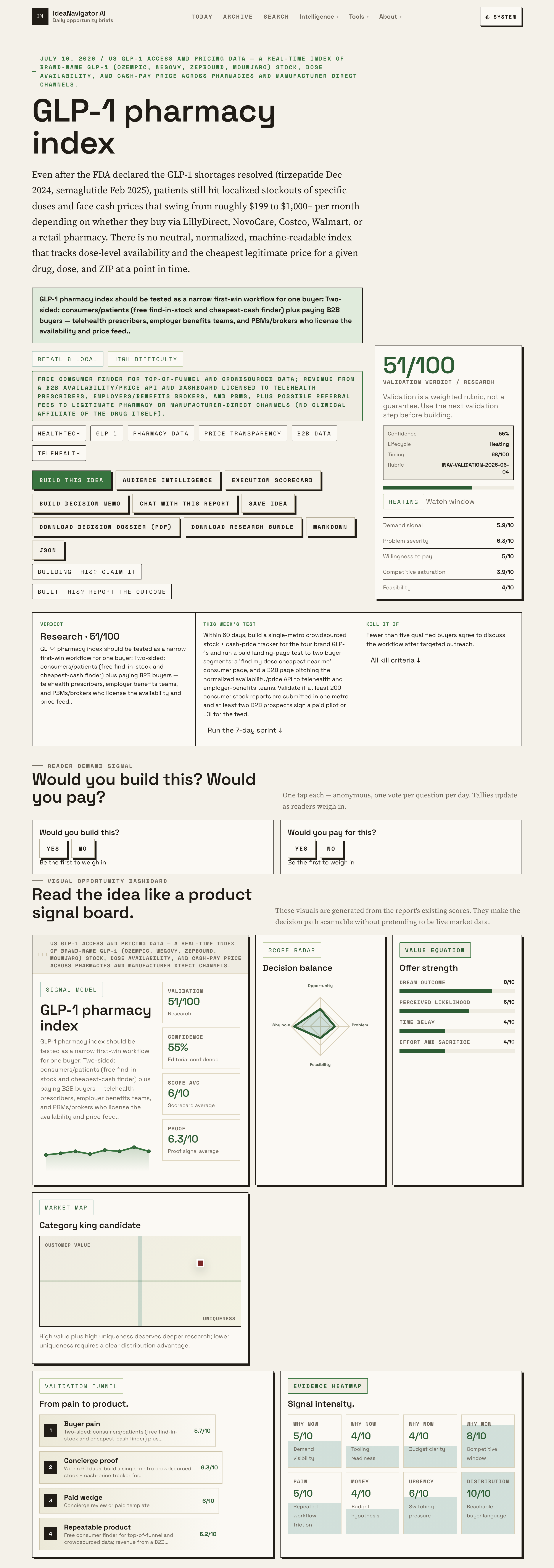
A new market analysis from IdeaNavigator AI argues the US GLP-1 market has shifted from a shortage problem to a fragmentation problem, and proposes a dose-level, ZIP-code-specific index of availability and cash prices. The analysis notes monthly cash prices range from roughly $199 to over $1,000 across channels.
A market analysis published by IdeaNavigator AI proposes building a GLP-1 pharmacy index — a machine-readable tracker of dose-level availability and cheapest legitimate cash prices for the four brand-name GLP-1 drugs (Ozempic, Wegovy, Zepbound, Mounjaro) across US pharmacies and manufacturer-direct channels. The analysis argues that even though the FDA declared GLP-1 shortages resolved — tirzepatide in December 2024 and semaglutide in February 2025 — patients still face localized stockouts of specific doses and monthly cash prices that swing from roughly $199 to more than $1,000 depending on where they buy.
The core problem identified is fragmentation rather than scarcity. According to the analysis, the end of FDA shortage designations in 2024 and 2025, combined with compounding deadlines that pushed compounders out of the market, coincided with manufacturers launching competing direct cash-pay channels: Eli Lilly’s LillyDirect, Novo Nordisk’s NovoCare, plus Costco and Walmart cash programs and the TrumpRx portal launched in February 2026. The result is a sprawl of prices and dose-specific supply gaps that no single neutral source currently normalizes.
The proposed product would have two sides. A free consumer tool would let patients search by drug, dose, and ZIP code to find in-stock pharmacies and the cheapest legitimate cash price, seeded with crowdsourced stock reports and normalized public pricing from manufacturer-direct sites, Costco, Walmart, and a GoodRx-style price layer. On the business side, the normalized availability and price dataset would be licensed as an API or dashboard to telehealth prescribers, employer benefits teams, and PBMs or brokers.
The business model outlined in the analysis: the consumer finder serves as top-of-funnel and generates crowdsourced data, while revenue comes from B2B licensing of the availability and price feed, with possible referral fees to legitimate pharmacy or manufacturer-direct channels. The analysis sets a 60-day validation plan — a single-metro stock and cash-price tracker plus paid landing-page tests targeting both consumers and B2B buyers, with success defined as at least 200 consumer stock reports in one metro and at least two B2B prospects signing a paid pilot or letter of intent.
Why Employers and Prescribers Need This Data
The analysis cites employer reports that GLP-1s now account for roughly 20% of pharmacy spend, creating demand for cost-steering data that benefits teams and PBMs currently lack at the dose and ZIP-code level. Telehealth prescribers, who increasingly write GLP-1 prescriptions without a pharmacy relationship, would use a live availability feed to route patients to pharmacies that actually have the prescribed dose in stock.
For patients, the stakes are direct. Someone paying cash for a weekly injectable faces a price spread that can exceed $800 per month between channels for the same drug and dose, according to the price ranges cited in the analysis. Dose-level stockouts matter because GLP-1s are titrated — a patient on a mid-titration dose cannot simply substitute another strength, making localized availability data more useful than drug-level listings.
How the Market Shifted After the Shortages
: “During the GLP-1 shortage period, FDA rules allowed compounding pharmacies to produce copies of semaglutide and tirzepatide, supplying many cash-pay patients at substantially lower prices. Once the FDA declared the shortages resolved — tirzepatide in December 2024 and semaglutide in February 2025 — compounders were forced to wind down, pushing patients back toward brand-name products.
Manufacturers responded by building their own cash-pay channels. LillyDirect and NovoCare sell directly to patients at listed cash prices, while Costco and Walmart run their own discount pharmacy programs. The TrumpRx portal, launched in February 2026, added a government-linked pricing channel. Each channel prices independently and updates stock separately, which is why the analysis describes the current landscape as a fragmentation problem rather than a shortage problem.
What the Analysis Does Not Establish
The document is a product proposal, not a launched service. No consumer tool, B2B API, or design-partner agreements are confirmed to exist; the 60-day validation plan is a recommendation, not a report of completed results.
Several data questions remain open. It is unclear how reliable crowdsourced stock reports would be in practice, how frequently manufacturer-direct prices change and whether public scraping would be permitted, and whether telehealth or employer buyers would pay for a feed that overlaps with existing pharmacy benefit data. The $199-to-$1,000+ price range is presented as a rough market observation without a specified comparison date, drug, or dose basis. Employer reports that GLP-1s are roughly 20% of pharmacy spend are cited without a named survey or dataset.
The 60-Day Validation Test
If the proposal proceeds as outlined, the next step is a single-metro pilot: a crowdsourced stock and cash-price tracker for the four brand GLP-1s, paired with paid landing-page tests aimed at two audiences — a consumer page pitched as “find my dose cheapest near me” and a B2B page pitching the availability and price API to telehealth and employer-benefits teams.
The analysis defines go/no-go thresholds: at least 200 consumer stock reports in one metro and at least two signed paid pilots or letters of intent within the 60-day window. Broader market developments to watch include whether the TrumpRx portal expands its price listings and whether manufacturers adjust cash pricing in response to competitive pressure, both of which would affect the value of a neutral index.
Source: IdeaNavigator AI
Key Questions
Does a GLP-1 pharmacy index like this exist today?
According to the IdeaNavigator AI analysis, no. There is no neutral, normalized, machine-readable index tracking dose-level availability and cheapest legitimate cash price by drug, dose, and ZIP code. Existing tools show drug-level prices but not dose-level stock, the analysis argues.
Why do GLP-1 prices vary so much between pharmacies?
Manufacturers launched competing cash-pay channels — LillyDirect, NovoCare, Costco, Walmart, and the TrumpRx portal — each pricing independently. The analysis cites monthly cash prices ranging from roughly $199 to over $1,000 for the same drugs depending on the channel, though the exact comparison basis for that range is not specified.
Are GLP-1 shortages over?
The FDA declared shortages of tirzepatide resolved in December 2024 and semaglutide in February 2025. However, the analysis reports that patients still encounter localized stockouts of specific doses, which is why dose-level availability data is a core part of the proposal.
How would the proposed index make money?
The consumer finder would be free, serving as top-of-funnel and generating crowdsourced data. Revenue would come from licensing the normalized availability and price feed to telehealth prescribers, employer benefits teams, and PBMs or brokers, with possible referral fees to legitimate pharmacy or manufacturer-direct channels.
What would prove the idea works?
The analysis sets a 60-day validation test: at least 200 crowdsourced consumer stock reports submitted in one metro area, and at least two B2B prospects — telehealth or employer-benefits buyers — signing a paid pilot or letter of intent for the data feed.
Source: IdeaNavigator AI
Halloween Picks
halloween
As an affiliate, we earn on qualifying purchases.