📊 Full opportunity report: A New Platform For Small-Town Businesses And Commercial Space on IdeaNavigator AI — validation score, market gap, and execution plan.

Get business pricing on monitors, keyboards and dev gear
- Business-only prices and quantity discounts
- Tax-exempt purchasing
- Multiple users, one account, clear invoices
TL;DR
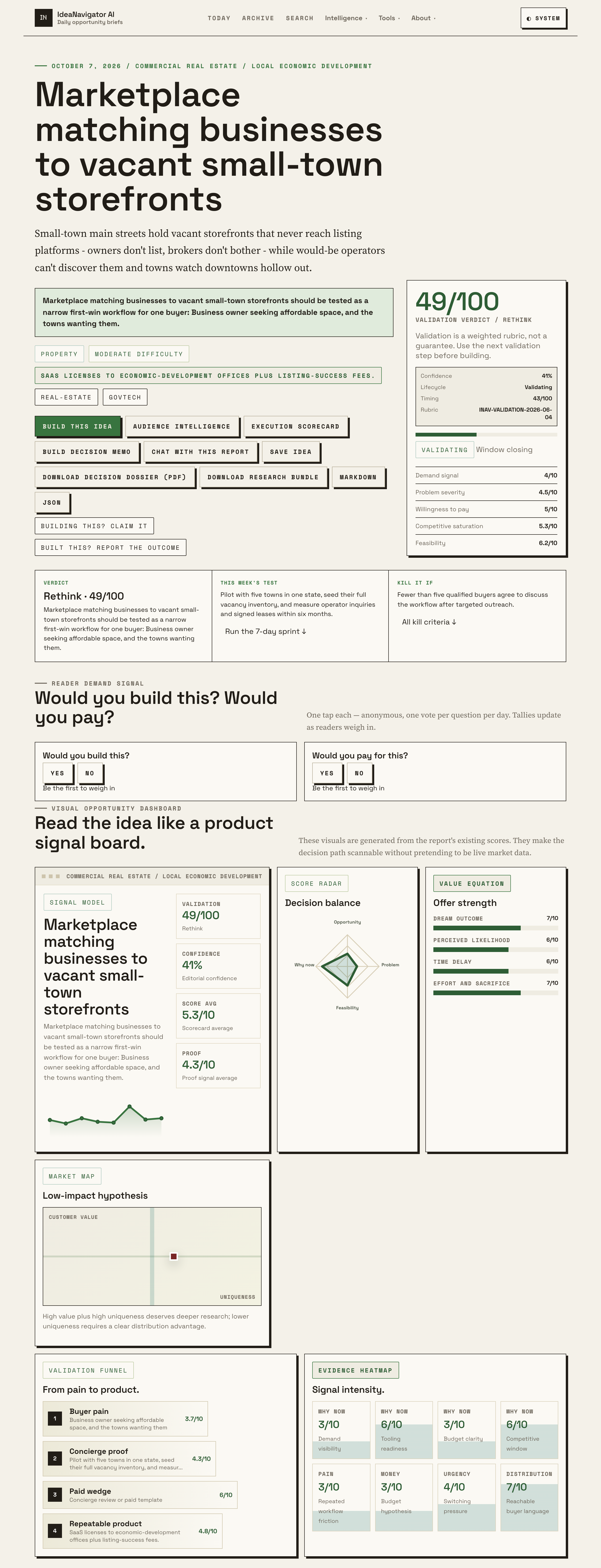
IdeaNavigator AI outlines a proposed marketplace for matching business operators with vacant small-town storefronts and routing interested operators to local economic-development offices. The concept remains a proposal: it recommends testing the service in five towns and tracking inquiries and signed leases over six months.
IdeaNavigator AI has proposed a marketplace to match business operators with vacant small-town storefronts, aiming to make spaces easier to discover and direct prospective tenants to local economic-development offices. The concept would also surface available grants and incentives, but it has not been described as a launched service, and no participating towns or measured results have been reported.
The proposed platform would let towns and property owners post storefront listings with photos, size, rent and incentive programs. Business operators could browse by town profile and foot-traffic data, then express interest in a space. The concept would route those matches to a local development office, with relevant grant information attached.
IdeaNavigator AI frames the intended users as business owners seeking affordable space and towns trying to attract businesses to empty commercial properties. Its proposed revenue model combines software licenses for economic-development offices with fees tied to successful listings. No pricing, fee structure, product availability or operator commitments are specified.
The suggested validation plan is a six-month pilot in five towns in one state. Organizers would first assemble each town’s vacancy inventory, then track operator inquiries and signed leases. These are proposed measures, not reported outcomes; the proposal does not identify a state, towns, a launch date or a party responsible for conducting the pilot.
The idea addresses a practical information gap: available commercial spaces may not appear on listing platforms, while owners may not list them and brokers may not pursue them. If operators cannot find those spaces, towns can have vacant properties alongside businesses looking for affordable locations. A shared inventory could make the search process more visible to both sides.
For towns, the proposed connection to development offices could put grant and incentive information in front of operators while they consider a location. That may help local officials identify interested businesses and connect them with programs. Whether those connections lead to leases, sustained business activity or reduced vacancies is not established by the proposal; the recommended pilot is intended to test early indicators.
The business model also puts a question of public value alongside commercial viability. Economic-development offices would pay for software, while success fees would depend on listings producing results. The proposal provides no evidence yet about willingness to pay, the cost of keeping listings current, or how a fee would be defined and collected.
Products Worth Considering

Logitech MX Mechanical Wireless Illuminated Keyboard, Tactile Quiet, Graphite

Bose TV Speaker (2nd Gen) Compact Soundbar with Bluetooth and HDMI Connectivity

Apple iPad Air 13-inch (M4), 128GB, Wi-Fi 7, Space Gray
As an affiliate, we earn on qualifying purchases.
The Proposed Marketplace Model
The concept is presented against two stated conditions: remote-work migration has renewed interest in small-town commercial locations, and economic-development offices have access to grant funding aimed at matching businesses with space. Those points are part of the proposal’s rationale; no local migration figures, grant programs or funding amounts are supplied.
The suggested service would bring property information, town profiles and foot-traffic data into one browsing experience. It would then direct interested operators to local development staff rather than treating a listing as the end of the process. That local handoff is a central feature of the idea, since offices may know about available assistance or town-specific programs.
The proposal is deliberately narrow in its suggested first test: five towns in one state, with vacancy inventories gathered before performance is measured. This would make it possible to count inquiries and leases over a defined period, though the proposal does not set a comparison group or specify how it would attribute a lease to the platform.
Pilot, Data and Costs Still Open
No launch or pilot is confirmed. The proposal does not name participating towns, a state, a launch date, a platform operator or the development offices that might take part. It also gives no evidence that property owners or business operators have agreed to use the service.
Several operating details remain unspecified: how listing information would be checked and updated, how foot-traffic data would be sourced, what towns would pay, and how listing-success fees would work. The proposal also does not define a successful match or explain how it would distinguish leases generated by the platform from deals that would have happened without it.
The rationale refers to renewed small-town commercial interest and grant availability, but supplies no supporting figures or named programs. Until a pilot produces results, it is unclear whether the marketplace would materially increase inquiries or signed leases, or whether its data and administration costs would be manageable for towns.
A Five-Town Test Would Measure Results
The next step described in the proposal is to recruit five towns in one state and compile a full inventory of vacant storefronts. Listings would include basic property details and available incentives, while operators would be able to browse town information and foot-traffic data.
Over six months, the suggested test would record operator inquiries and signed leases. Those measures could indicate whether the service generates interest and whether any interest advances to a lease. A clearer evaluation would also need to explain how inquiries and leases are counted, whether participating towns pay to take part, and how results are compared with activity before the pilot.
For now, the proposal does not announce a launch or set a date for further updates. The central developments to watch are whether towns and owners join a test, how complete their listings are, and whether the pilot reports measurable leasing outcomes.
Source: IdeaNavigator AI
Key Questions
Has the storefront marketplace launched?
No launch is confirmed. IdeaNavigator AI presents a proposed marketplace concept and recommends a pilot; it does not identify an operating platform.
How would the proposed service work?
Towns and owners would post storefront details, including photos, size, rent and incentives. Operators could browse by town profile and foot-traffic data, with interested matches routed to a local development office.
How would the marketplace make money?
The proposed model combines software licenses for economic-development offices with fees tied to successful listings. Prices and the terms for those fees have not been provided.
How would the idea be tested?
The proposal recommends a five-town pilot in one state, with vacancy listings gathered and operator inquiries and signed leases tracked over six months. No towns or start date have been announced.
What is not yet known?
It is not clear who would build or operate the platform, which towns would participate, how listing and foot-traffic data would be maintained, or whether the service would lead to more leases.
Source: IdeaNavigator AI