
📊 Full opportunity report: How To Review Repetitive Work Before Automating It on IdeaNavigator AI — validation score, market gap, and execution plan.

Get business pricing on monitors, keyboards and dev gear
- Business-only prices and quantity discounts
- Tax-exempt purchasing
- Multiple users, one account, clear invoices
TL;DR
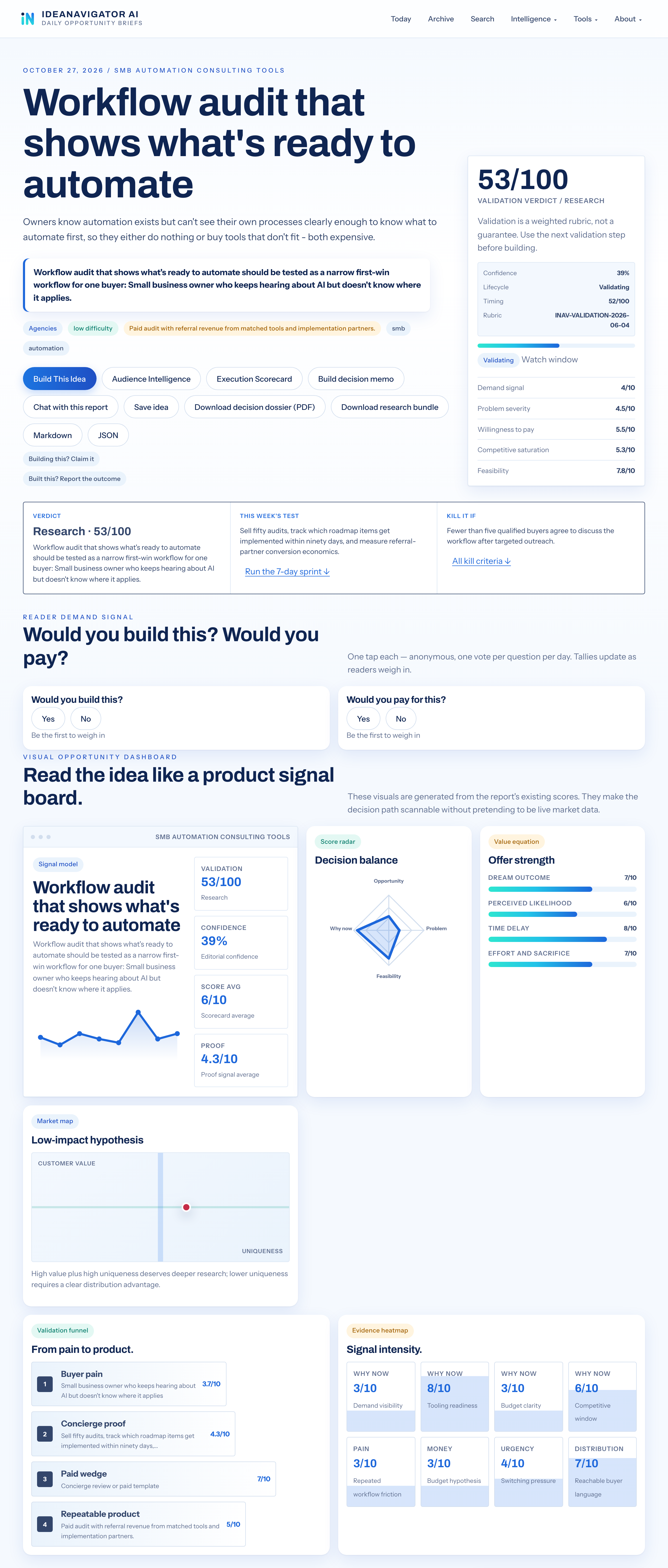
IdeaNavigator AI outlines a proposed workflow-audit product for small-business owners unsure where automation fits. Its suggested test is to sell 50 audits and track whether owners implement recommendations within 90 days and whether tool referrals convert.
IdeaNavigator AI has proposed a paid workflow audit to help small-business owners identify which repetitive processes may be suitable for automation, with a suggested test of selling 50 audits and tracking implementation over 90 days. In its proposal, the company presents the audit as a product to validate, rather than assuming businesses will adopt tools simply because they are available.
According to IdeaNavigator AI’s proposal, the service would guide an owner through questions about day-to-day operations and produce a process map. The proposal says each process would be assessed for automation readiness, potential return on investment and difficulty, then organized into a sequenced 90-day roadmap with suggested tools for individual steps.
IdeaNavigator AI identifies the intended customer as a small-business owner who is aware of AI tools but unsure where they apply. The proposal describes two risks for that customer: delaying action because existing work is hard to assess, or paying for tools that do not fit the business’s actual processes. These are the proposal’s stated customer problems; it provides no research figures or customer interviews to quantify them.
The proposed business model combines a paid audit with possible referral revenue from recommended software vendors and implementation partners. To test demand and commercial viability, IdeaNavigator AI proposes selling 50 audits, then recording which recommendations are implemented within 90 days and measuring conversion economics for referral partners.
How To Review Repetitive Work Before Automating It
IdeaNavigator AI proposes a guided workflow audit to help small-business owners identify processes that may be ready for automation. The idea is still untested: its suggested validation is to sell 50 audits and track adoption for 90 days.
Will owners pay for a roadmap—and put its recommendations into practice?
Proposed test · no results reportedMap the work before picking tools
IdeaNavigator AI says the audit would guide an owner through day-to-day operations, then prioritize candidate processes by readiness, expected return and difficulty. These are proposed features, not verified capabilities of a launched service.
Guided operations interview
Questions about routine work would help surface recurring tasks and how each process currently runs.
Readiness and effort
Each workflow would be assessed for automation readiness, potential return on investment and implementation difficulty.
Prioritized 90-day roadmap
A process map, an ordered plan and suggested tools for individual steps would give owners a starting point.
Turn tool overload into a decision
The intended customer is a small-business owner who knows AI tools exist but is unsure where they fit. The proposal names two concerns, but provides no interviews or figures to show how common they are.
Delay because work is hard to assess
Without a clear view of their processes, owners may struggle to decide what to change first.
Pay for a poor-fit tool
A software purchase may not address the business’s actual workflow or constraints.
Start with the process
Map and prioritize work first; recommend software only after identifying candidate steps.
Ask
Explore day-to-day operations with the owner.
Map
Document processes and recurring steps.
Prioritize
Rate readiness, expected return and difficulty.
Sequence
Suggest tools and a 90-day implementation order.
Measure action after the sale
The bars show what the proposal intends to measure, not achieved performance. It sets no conversion target, success threshold or detailed method for verifying implementation.
Trust depends on the details
The proposal offers a rationale and a validation plan, but little evidence about product quality, demand or how recommendations would be governed.
What the test could reveal
Whether owners will pay for a guided audit.
Whether roadmap recommendations are implemented within 90 days.
Whether referrals to software vendors or implementation partners convert economically.
- Audit price, launch date and whether the service has been built.
- How recommendations are checked for accuracy and ROI.
- How sensitive operational information would be handled.
- How referral relationships would be disclosed and kept from biasing advice.
- What counts as implementation, and how it would be verified.
Key questions, answered
What is the proposed workflow audit?
A guided interview to map operations and identify processes that may suit automation.
What would an owner receive?
A process map, readiness and difficulty ratings, potential ROI, a sequenced roadmap and suggested tools.
Has it launched or been tested?
No launch, pilot results or completed sales are reported. The proposal recommends testing with 50 audits.
How might the business make money?
Through paid audits and possible referral revenue from software vendors or implementation partners.
How would success be measured?
Track recommendation implementation over 90 days and referral conversion economics. No thresholds or methods are given.
What should readers conclude?
This is a proposed validation experiment. Demand, outcomes and the accuracy of AI-generated advice remain unproven.
Testing Automation Advice With Owners
IdeaNavigator AI’s proposal focuses on a practical hurdle in small-business automation: deciding which task to address first. A list of available tools does not show whether a company’s process is repetitive, well-defined or worth changing. The company argues that mapping workflows before recommending software could make the decision more concrete for owners with limited time and resources.
The suggested 90-day tracking period also gives the product a way to test more than interest at the point of purchase. Completed audits would not by themselves prove value; the proposal identifies whether owners act on the roadmap and whether suggested tools or partners generate results as more consequential questions. Those outcomes could help distinguish useful guidance from recommendations that look persuasive but are not adopted.
The referral component creates a commercial question as well as a customer one. Recommendations could connect owners to suitable providers, but referral revenue may also create an incentive to favor tools or partners. IdeaNavigator AI’s proposal does not explain how recommendations would be selected or how commercial relationships would be disclosed, leaving those issues relevant to trust in the service.
Products Worth Considering

Jackery HomePower 3600 Plus Portable Power Station, 3584Wh, 3600W

DJI Osmo Mobile 8 Gimbal with Mic Mini Transmitter, Infinity Black

Sonos Era 100 SL Compact Microphone-Free Speaker, Black
As an affiliate, we earn on qualifying purchases.
From AI Tool Overload to Process Mapping
IdeaNavigator AI frames the idea against the spread of AI and automation products, which it says has left some business owners unsure how to choose among them. Its proposed response is not to begin with a particular software package, but to ask about the owner’s operations and identify candidate workflows first.
That distinction shapes the product as described in the proposal: it would combine a guided interview, process mapping and prioritization, rather than function only as a directory of tools. The roadmap would rank potential work by readiness, expected returns and difficulty, then suggest an order for implementation over three months. These are proposed minimum viable product features, not verified capabilities of a service currently on the market.
IdeaNavigator AI says guided process-mapping interviews are work that large language models could help automate. Its material provides no technical details, test results or evidence that an AI-generated audit would produce accurate recommendations. The proposal therefore presents an opportunity and a validation plan, not a demonstrated product outcome.
Demand and Results Still Untested
IdeaNavigator AI reports no completed pilot or sales results. Its proposal does not say whether the audit has been built, whether 50 customers have been approached, or what price would be charged. It also does not identify specific tools, implementation partners, referral rates or a method for calculating return on investment.
The proposed 90-day measure leaves practical questions unanswered: what counts as implementation, how the service would verify it, and how it would account for changes in a business’s workload or circumstances. IdeaNavigator AI’s material also does not explain how recommendations would be checked for accuracy, how sensitive operational information would be handled, or whether owners would receive independent advice when referrals generate revenue.
The proposal includes no customer quotations, named experts or independent evaluations. Its claims about decision paralysis and the suitability of AI for process mapping should therefore be read as the rationale for a test, not as findings established by one.
The Proposed 50-Audit Test
IdeaNavigator AI describes the next step as selling 50 audits and following recommended roadmap items for 90 days. The company says this would provide an initial indication of whether small-business owners will pay for the service and whether they carry out its recommendations.
The proposed test is also intended to measure referral-partner conversion economics, although IdeaNavigator AI specifies no target conversion rate or assessment criteria. The company has announced no timetable for starting or completing the test, and no results are available. Until those details emerge, the concept remains a proposed product-validation experiment rather than an established automation service.
Source: IdeaNavigator AI
Key Questions
What is the proposed workflow audit?
IdeaNavigator AI describes it as a proposed guided interview for small-business owners that would map their operations and identify processes that may be suitable for automation.
What would an owner receive?
According to IdeaNavigator AI’s proposal, the output would include a process map, ratings for automation readiness, potential return on investment and difficulty, plus a sequenced 90-day roadmap and suggested tools.
Has the audit launched or been tested?
IdeaNavigator AI reports no launch, pilot results or completed sales. Its proposal recommends testing the concept by selling 50 audits.
How would the proposed business make money?
IdeaNavigator AI proposes combining payment for the audit with possible referral revenue from recommended software tools and implementation partners.
How would the proposal measure success?
The proposal suggests tracking which roadmap recommendations are implemented within 90 days and measuring referral-partner conversion economics. It provides no specific thresholds or measurement methods.
Source: IdeaNavigator AI