
Selecting the right continuous integration tools determines how quickly your team ships reliable code. My analysis highlights Azure DevOps as the best overall choice for enterprises needing robust, integrated pipelines, while GitHub Actions stands out for developers seeking native integration with their existing repositories. The primary tradeoff in this category lies between setup complexity and ecosystem flexibility; open-source options like Jenkins offer endless customization but demand significant maintenance, whereas managed services simplify operations at the cost of vendor lock-in. This roundup evaluates both the platforms themselves and the essential literature required to implement them effectively. Continue reading to discover which solution aligns with your infrastructure goals and skill level.

Get business pricing on monitors, keyboards and dev gear
- Business-only prices and quantity discounts
- Tax-exempt purchasing
- Multiple users, one account, clear invoices
Key Takeaways
- Managed platforms like Azure DevOps and GitHub Actions drastically reduce maintenance overhead compared to self-hosted Jenkins.
- The most effective learning resources bridge the gap between theoretical CI concepts and practical pipeline configuration.
- Containerization, specifically using Docker, has become a standard requirement for modern CI/CD pipelines to ensure environment consistency.
- Security integration is no longer optional; top-tier tools and guides now prioritize secure pipeline practices from the start.
- Beginners benefit more from platform-specific guides that offer step-by-step implementation than from abstract theoretical texts.




| continuous integration tool | Edition | Subject |
|---|---|---|
| Azure DevOps for Beginners: Im | Not provided | — |
| Learning Continuous Integratio | 2nd Edition | — |
| Learning Continuous Integratio | — | — |
| Building CI/CD Pipelines with | — | — |
| Mastering GitHub Actions: Adva | — | — |
| Continuous Integration and Con | — | Continuous integration |
| Jenkins: The Definitive Guide: | Not specified | Continuous integration |
| Continuous Delivery with Docke | 3rd Edition | — |
| GitHub Actions in Action: Cont | Not specified | Continuous integration |
| Bitbucket Automation Guide: Ma | English Edition | — |
| Continuous Integration: Improv | — | Continuous integration |
More Details on Our Top Picks
Azure DevOps for Beginners: Implement Continuous Integration and Delivery
Azure-focused and beginner-oriented, this guide suits readers who want an introduction to implementing continuous integration and delivery within the Azure DevOps environment. That focus gives it a different starting point from Learning Continuous Integration with Jenkins: A Beginner’s Guide, which centers on Jenkins 2 rather than Microsoft’s toolset. The title signals practical implementation, but the available product information does not specify coverage depth, examples, format, or particular Azure DevOps services, so I would not choose it expecting a defined syllabus beyond its stated subject. Its main tradeoff is that a tool-specific introduction may be less useful to teams standardizing on Jenkins or GitHub Actions. For a newcomer whose workplace already uses Azure DevOps, the platform alignment is the clearest reason to pick it; readers comparing CI systems may prefer a resource with broader detail.
Pros:- Explicitly focused on Azure DevOps rather than CI concepts alone
- Aimed at beginners implementing continuous integration and delivery
- Platform-specific focus can help readers align learning with an Azure DevOps workplace
Cons:- Provided information does not describe chapters, examples, or specific Azure DevOps services
- Tool-specific scope offers less direct value to teams using Jenkins or GitHub Actions
- No format or edition details are supplied
Best for: New developers or team members who need an introductory guide to implementing CI and delivery with Azure DevOps.
Not ideal for: Teams committed to Jenkins or GitHub Actions, or readers seeking a clearly documented advanced syllabus and technical specifications.
- Topic:Continuous integration and delivery
- Platform:Azure DevOps
- Audience:Beginners
- Stated focus:Implementing continuous integration and delivery
- Product type:Guide
- Edition:Not provided
Our verdict“Choose this guide if you are new to CI/CD and your team uses Azure DevOps; skip it if you need a documented advanced or cross-platform resource.”
Learning Continuous Integration with Jenkins: A Beginner’s Guide to Implementing Continuous Integration and Continuous Delivery Using Jenkins 2, 2nd Edition
For readers beginning with Jenkins, this book has the clearest entry-level positioning in this group: it names Jenkins 2 and covers both continuous integration and continuous delivery. That makes it a more direct choice for a Jenkins newcomer than Learning Continuous Integration with Jenkins: An End-to-End Guide, whose stated emphasis is broader operational concerns such as security and resilience. The beginner focus may make core pipeline ideas easier to approach, but the available information does not describe its chapter structure, examples, or how its Jenkins 2 coverage maps to current setups. It is also less suited to readers who want Azure DevOps or GitHub Actions guidance. I would select it as a tool-specific starting point, not as a reference for comparing CI platforms or planning a mature production system.
Pros:- Explicitly written for beginners
- Covers both continuous integration and continuous delivery
- Names Jenkins 2 as its specific tool focus
- Second edition is identified in the product information
Cons:- Provided details do not establish the depth or currency of its technical examples
- Jenkins-specific material is less relevant to teams using Azure DevOps or GitHub Actions
- No further description is available to clarify its pipeline topics
Best for: Developers and operations newcomers who need an introductory path to CI/CD built around Jenkins 2.
Not ideal for: Experienced DevOps engineers seeking detailed security, resilience, and cost-optimization guidance, or teams using another CI platform.
- Tool:Jenkins 2
- Topic:Continuous integration and continuous delivery
- Audience:Beginners
- Edition:2nd Edition
- Product type:Beginner’s guide
- ASIN:1788479351
Our verdict“Pick this as a Jenkins 2 introduction if you are new to CI/CD, but choose the end-to-end Jenkins guide for a stronger stated focus on production operations.”
Learning Continuous Integration with Jenkins: An End-to-End Guide to Creating Operational, Secure, Resilient, and Cost-Effective CI/CD Processes
This Jenkins guide is the most operations-oriented choice in the set: its stated scope reaches beyond getting a pipeline running to security, resilience, cost control, and operational efficiency. That makes it a better fit for engineers responsible for dependable delivery than Learning Continuous Integration with Jenkins: A Beginner’s Guide, which is explicitly aimed at newcomers. The end-to-end framing also gives it a distinct role for readers who need to think about the pipeline as a maintained system, not just a sequence of build steps. The tradeoff is the same breadth that gives it value: the product information warns that it may be too detailed for readers after a quick overview. It also centers on Jenkins, so GitHub Actions users may get more relevant workflow-specific guidance from Mastering GitHub Actions.
Pros:- Addresses the CI/CD process end to end
- Includes stated focus on security and resilience
- Covers cost-effectiveness and operational efficiency
- Positioned for both beginners and experienced DevOps engineers
Cons:- May be too detailed for readers seeking a quick overview
- Jenkins focus limits direct relevance to teams using other CI tools
- Provided information does not identify a Jenkins version or specific examples
Best for: DevOps engineers and software teams building or improving Jenkins pipelines with production operations, security, and resilience in mind.
Not ideal for: Readers seeking a short CI/CD introduction or teams whose automation is based on GitHub Actions or Azure DevOps.
- Tool:Jenkins
- Topic:CI/CD processes
- Coverage:End-to-end pipeline practices
- Operational focus:Operational efficiency
- Security focus:Secure CI/CD processes
- Reliability focus:Resilient CI/CD processes
- Audience:Beginners and experienced DevOps engineers
Our verdict“Choose this Jenkins guide when production reliability and operational practices matter more than a brief introduction.”
Building CI/CD Pipelines with Jenkins
Where the beginner-focused Jenkins book emphasizes learning CI/CD fundamentals, Building CI/CD Pipelines with Jenkins frames Jenkins around a team workflow: its stated aim is to help agile teams build pipelines and streamline development. That makes it the more directly team-oriented pick for readers interested in how CI supports iterative software delivery, rather than a broad guide to operational security like the end-to-end Jenkins guide. The product information is limited, though; it does not identify a Jenkins version, pipeline techniques, or the level of detail, so buyers cannot tell how much hands-on implementation it covers. Its narrow agile-team positioning is a useful distinction, but it also means readers seeking a general Jenkins introduction or advanced reliability guidance have better-matched alternatives in this roundup.
Pros:- Directly focuses on building CI/CD pipelines with Jenkins
- Connects Jenkins CI to agile team development
- Targets workflow streamlining rather than only tool fundamentals
Cons:- Provided details do not state the Jenkins version or pipeline methods covered
- No audience level or chapter-level scope is specified
- Less clearly suited to readers seeking the end-to-end operational topics named by the other Jenkins guide
Best for: Agile development teams and team leads looking for Jenkins-focused guidance on building CI/CD pipelines.
Not ideal for: Readers needing a clearly scoped beginner curriculum, version-specific Jenkins instructions, or extensive security and resilience practices.
- Tool:Jenkins
- Topic:Continuous integration and continuous delivery
- Stated focus:Building CI/CD pipelines
- Team context:Agile teams
- Intended outcome:Streamlining agile development
- Product type:Book
Our verdict“Choose this book if your agile team wants Jenkins pipeline guidance, but favor a more fully specified resource when you need version details or advanced operations coverage.”
Mastering GitHub Actions: Advance Your Automation Skills with the Latest Techniques for Software Integration and Deployment
This is the only pick in this batch centered on GitHub Actions, making it the natural option for teams automating integration and deployment in GitHub rather than building around Jenkins. Its emphasis is advancing automation skills, so it appears better suited to readers who already know the basics than to those seeking the beginner-first approach of Learning Continuous Integration with Jenkins. The product description confirms software integration and deployment as its subject but does not name particular workflow features, examples, or a specific technical level. That limits how confidently I can judge its depth. The tradeoff is platform specialization: GitHub Actions context may be directly relevant to GitHub-based repositories, while Jenkins-oriented teams will find the other books more aligned with their existing CI setup.
Pros:- Focuses specifically on GitHub Actions automation
- Covers software integration and deployment
- Its advanced-skills framing suits readers seeking to extend their automation knowledge
Cons:- GitHub Actions focus makes it less useful for Jenkins-based pipelines
- Provided information does not specify workflow features or examples
- The stated advanced orientation may be less accessible to first-time CI learners
Best for: Developers who already work with GitHub and want to build their automation skills for software integration and deployment.
Not ideal for: Teams using Jenkins or Azure DevOps, and readers who need a clearly described beginner curriculum or specific workflow coverage.
- Tool:GitHub Actions
- Topic:Software workflow automation
- Coverage:Software integration and deployment
- Stated level:Advance automation skills
- Format:Book
- ASIN:1805128620
Our verdict“Choose this book if your team uses GitHub Actions and you want to advance workflow automation; pick a Jenkins guide if Jenkins is your CI platform.”
Continuous Integration and Continuous Delivery: A Practical Guide to Designing and Developing Pipelines
This guide is the most tool-neutral choice in this group: its focus is designing and developing CI/CD pipelines, rather than centering the lessons on Jenkins, GitHub Actions, or Bitbucket Cloud. That makes it a useful fit for readers who want to reason about pipeline structure before committing to a particular platform. Compared with Continuous Delivery with Docker and Jenkins, it does not advertise a Docker-and-Jenkins implementation or a security focus, so it may offer less concrete direction for teams already building around that stack. The tradeoff is that the available description gives few specifics about its examples or technical depth. I’d choose it for general pipeline-design learning, but readers seeking platform-specific instructions may get more from GitHub Actions in Action or the Jenkins-focused titles.
Pros:- Focuses on practical pipeline design and development
- Covers both continuous integration and continuous delivery
- Tool-neutral framing can help readers evaluate pipeline concepts across platforms
Cons:- Product details do not identify specific tools, sample projects, or implementation depth
- Does not advertise a dedicated focus on security or a particular platform
- May be less actionable for readers who need step-by-step instructions for an existing toolchain
Best for: Developers and team leads who want a practical foundation in CI/CD pipeline design without starting from one named automation platform
Not ideal for: Readers who need detailed, platform-specific instructions for Jenkins, GitHub Actions, or Bitbucket Cloud
- Series:Professional and Applied Computing
- Subject:Continuous integration
- Subject:Continuous delivery
- Focus:Designing pipelines
- Focus:Developing pipelines
- Format:Book
Our verdict“Choose this guide for practical, platform-neutral pipeline-design coverage; pick a tool-specific title when you need implementation instructions for a particular CI system.”
Jenkins: The Definitive Guide: Continuous Integration for the Masses
This title puts Jenkins at the center, making it a direct fit for teams that have already chosen that automation server and want a dedicated CI reference. Its focus contrasts with Continuous Integration and Continuous Delivery: A Practical Guide to Designing and Developing Pipelines, which emphasizes pipeline design without naming a platform. That distinction matters: a Jenkins-specific guide can help readers connect CI concepts to their chosen tool, while a general pipeline book may travel better across systems. The supplied details do not describe the guide’s coverage, examples, or version alignment, so I would not assume it matches current Jenkins workflows without checking the edition. It is also less suitable for teams choosing GitHub Actions or Bitbucket Cloud, which have separate platform-specific books in this roundup.
Pros:- Dedicated focus on Jenkins and continuous integration
- Its Jenkins-specific scope gives learners a clear tool focus
- The title positions it as a guide for a broad range of software development teams
Cons:- Provided product data does not specify topics, examples, or technical depth
- No edition or version information is supplied to judge alignment with current Jenkins
- Less relevant to teams building around GitHub Actions or Bitbucket Cloud
Best for: Developers and build engineers whose teams have selected Jenkins and want a Jenkins-centered CI learning resource
Not ideal for: Teams evaluating several CI platforms or readers seeking documented coverage of Docker, security, or current Jenkins versions
- Primary tool:Jenkins
- Subject:Continuous integration
- Audience:Software development teams
- Format:Guide
- Edition:Not specified
- Additional product details:Not provided
Our verdict“Pick this when Jenkins is already your team’s CI choice, but verify its version and coverage before relying on it for current implementation details.”
Continuous Delivery with Docker and Jenkins: Create Secure Applications by Building Complete CI/CD Pipelines, 3rd Edition
This is the most stack-specific option here, pairing Docker and Jenkins with complete CI/CD pipelines and an explicit focus on secure applications. That combination makes it more targeted than Jenkins: The Definitive Guide: instead of covering Jenkins alone at a broad level, its stated scope connects containerization, automation, delivery, and security. The third edition is a useful edition detail, though the supplied data does not say which software versions or security practices it addresses. That leaves a practical verification step for teams using newer environments. Readers whose repositories and automation are built around GitHub Actions may prefer GitHub Actions in Action; this book’s value is greatest when Docker and Jenkins are already part of the intended pipeline.
Pros:- Connects Docker and Jenkins in a single CI/CD resource
- Covers building complete continuous integration and delivery pipelines
- Explicitly addresses secure applications
- Identified as the third edition
Cons:- Its Docker-and-Jenkins scope is less useful for teams using other CI platforms
- Provided details do not identify the software versions or security practices covered
- The product description does not specify the level of prior Docker or Jenkins knowledge expected
Best for: Development and platform teams building containerized applications with Jenkins that want CI/CD guidance with a stated security focus
Not ideal for: Teams using GitHub Actions or Bitbucket Cloud, or readers who need confirmation of specific current Docker, Jenkins, or security-tool versions
- Edition:3rd Edition
- Primary tools:Docker and Jenkins
- Topics:Secure applications
- Topics:CI/CD pipelines
- Coverage:Continuous integration
- Coverage:Continuous delivery
Our verdict“Choose this for a Docker-and-Jenkins pipeline with security in scope; look to GitHub Actions in Action if your workflow is built around GitHub’s automation platform.”
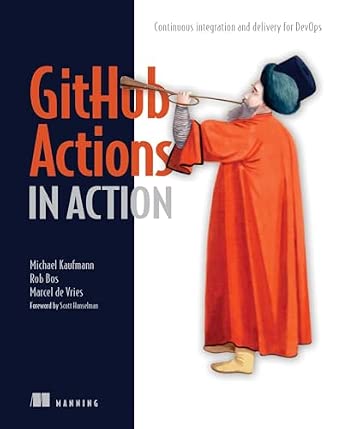
GitHub Actions in Action: Continuous Integration and Delivery for DevOps
For teams that keep their code and workflow inside GitHub, this book offers the clearest platform match in the lineup: GitHub Actions for continuous integration and delivery. Its DevOps framing makes it more specific than the pipeline-design focus of Continuous Integration and Continuous Delivery: A Practical Guide to Designing and Developing Pipelines, while avoiding that book’s tool-neutral approach. The benefit is a direct focus on the automation environment a GitHub-based team may already use; the tradeoff is narrower transfer to Jenkins or Bitbucket Cloud. The provided product data confirms the subject and book format but gives no details about workflow examples, feature coverage, or version alignment. I’d select it for GitHub Actions learning, while checking that its coverage fits the team’s current setup.
Pros:- Focused specifically on GitHub Actions
- Covers both continuous integration and delivery
- Connects automation to DevOps workflows
- Offers a more platform-specific learning path than a tool-neutral pipeline guide
Cons:- Its GitHub Actions focus may not transfer directly to Jenkins or Bitbucket Cloud
- Product data does not specify examples, workflow topics, or technical depth
- No edition or version information is supplied
Best for: Developers and DevOps practitioners who manage code in GitHub and want a focused resource on automating CI and delivery with GitHub Actions
Not ideal for: Teams standardizing on Jenkins or Bitbucket Cloud, or readers who need confirmed details about examples and platform-version coverage
- Primary tool:GitHub Actions
- Subject:Continuous integration
- Subject:Continuous delivery
- Context:DevOps workflows
- Format:Book
- Edition:Not specified
Our verdict“Choose this if GitHub Actions is your intended CI platform; opt for a tool-neutral pipeline guide if you need concepts that span several systems.”
Bitbucket Automation Guide: Master Git, Secure Code Quality, and Supercharge CI/CD (English Edition)
This guide is the most specific choice for teams automating CI/CD in Bitbucket Cloud, with stated coverage of Git, code quality, custom apps, and security practices. That breadth gives it a different role from GitHub Actions in Action: each focuses on automation within a particular code-hosting platform, so the right fit depends on where your team’s repositories and workflows live. The description also points to practical examples and step-by-step instructions, which may help readers apply automation patterns rather than stop at concepts. The limits are clear: its Bitbucket Cloud scope excludes self-hosted Bitbucket options, and the supplied details warn that it may challenge absolute beginners. For a broad foundation, the tool-neutral pipeline guide is a better starting point.
Pros:- Focuses on Bitbucket Cloud workflow automation and CI/CD
- Includes custom apps and advanced automation techniques
- Addresses Git, code quality, and security practices
- Description identifies practical examples and step-by-step instructions
Cons:- Limited to Bitbucket Cloud and does not cover self-hosted options
- May be too advanced for absolute beginners
- Its platform-specific approach is less useful for teams standardizing on Jenkins or GitHub Actions
Best for: Developers and platform engineers using Bitbucket Cloud who want guided workflow automation, Git practices, and secure code-quality processes
Not ideal for: Absolute beginners or teams using self-hosted Bitbucket, GitHub Actions, or Jenkins rather than Bitbucket Cloud
- Language:English
- Edition:English Edition
- Platform:Bitbucket Cloud
- Topics:Git
- Topics:Secure code quality
- Topics:Custom apps and workflow automation
- Coverage:CI/CD techniques
Our verdict“Choose this for advanced CI/CD automation in Bitbucket Cloud; skip it if you need a beginner introduction or self-hosted Bitbucket coverage.”
Continuous Integration: Improving Software Quality and Reducing Risk
This book is the strongest fit in the lineup for readers who want to understand why continuous integration reduces delivery risk, rather than learn one platform’s commands. Its practical guidance and real-world examples connect CI habits to code quality and fewer defects reaching production. Compared with Learning Continuous Integration with Jenkins: A Beginner’s Guide to Implementing Continuous Integration and Continuous Delivery Using Jenkins 2, 2nd Edition, it is less tied to a specific tool, which makes its lessons more portable across teams and CI systems. The tradeoff is that readers seeking a step-by-step setup for Jenkins, GitHub Actions, or Azure DevOps will need a more platform-focused guide. It also assumes familiarity with software development processes, so nontechnical managers may find its implementation detail harder to apply directly.
Pros:- Offers actionable guidance on continuous integration practices.
- Uses real-world examples to connect CI concepts with team workflows.
- Focuses on improving software quality and reducing defect risk.
- Presents principles that are less tied to one CI platform than Jenkins-specific guides.
Cons:- Assumes some prior knowledge of software development processes.
- Does not serve as a platform-specific setup manual for tools such as Jenkins or GitHub Actions.
- Its technical implementation detail may be difficult for nontechnical managers to use directly.
Best for: Software developers and team leads who understand basic development workflows and want practical, tool-independent CI guidance focused on quality and risk reduction.
Not ideal for: Nontechnical managers seeking an executive overview, or beginners who need step-by-step instructions for configuring a specific CI platform.
- Format:Book
- Subject:Continuous integration
- Primary focus:Improving software quality and reducing risk
- Guidance:Practical CI implementation techniques
- Examples:Real-world examples and case studies
- Intended audience:Software development teams
Our verdict“Choose this book for practical, platform-independent CI principles; pick a Jenkins or GitHub Actions guide instead if you need tool-specific setup instructions.”

How We Picked
I evaluated these resources by focusing on their ability to solve specific implementation challenges and the clarity of their instructional design. For the tools, I prioritized ecosystem integration, scalability, and the ease of maintenance required to keep pipelines running smoothly. I also examined how well each platform supports modern practices like containerization and automated security scanning. For the accompanying guides, I looked for authors who provided actionable code examples rather than just high-level concepts, ensuring the material could be applied immediately in real-world scenarios.
The ranking logic favors solutions that balance power with accessibility. While Jenkins remains a powerful standard, its steep learning curve often hinders rapid adoption for smaller teams. Consequently, I placed higher value on resources that demystify this complexity or offer streamlined alternatives like GitHub Actions. The final order reflects a hierarchy where operational efficiency and learning curve are weighted heavily, acknowledging that a tool is only as good as the team’s ability to maintain it.
| continuous integration tool | Subject |
|---|---|
| Azure DevOps for Beginners: Im | — |
| Learning Continuous Integratio | — |
| Learning Continuous Integratio | — |
| Building CI/CD Pipelines with | — |
| Mastering GitHub Actions: Adva | — |
| Continuous Integration and Con | Continuous integration |
| Jenkins: The Definitive Guide: | Continuous integration |
| Continuous Delivery with Docke | — |
| GitHub Actions in Action: Cont | Continuous integration |
| Bitbucket Automation Guide: Ma | — |
| Continuous Integration: Improv | Continuous integration |
Factors to Consider When Choosing Continuous Integration Tools
Choosing between continuous integration options requires looking beyond feature lists to understand the operational burden and learning curve involved.Hosted Vs. Self-Managed Infrastructure
The first decision you must make is whether to use a managed service or host your own CI/CD server. Managed platforms like GitHub Actions and Azure DevOps handle the underlying infrastructure, patching, and scaling for you, which frees up engineering time for feature development. However, this convenience comes with potential vendor lock-in and less granular control over the execution environment. Self-hosted solutions like Jenkins offer complete control and can be customized extensively to fit unique workflows, but they require dedicated resources to maintain uptime and security. Small teams often find that the operational overhead of self-hosting outweighs the benefits of customization, whereas large enterprises may prefer the control to meet strict compliance requirements.
Integration With Existing Code Repositories
Friction in the development workflow increases when your CI tool is disconnected from your version control system. Native integration means that pipelines trigger automatically on commits, and status checks appear directly in pull requests without additional configuration. GitHub Actions excels here for teams already using GitHub, as the configuration files live in the same repository as the code. If your team uses Bitbucket or Azure Repos, selecting the corresponding native CI tool reduces the need for complex webhook setups and external plugin management. Evaluating how seamlessly a tool communicates with your existing repository reduces the initial setup time and minimizes the chance of misconfigured triggers.
The Learning Curve and Documentation Quality
Complexity is the enemy of adoption, and some CI tools require specialized knowledge to configure correctly. YAML-based configurations are common, but the syntax and available actions vary widely between platforms. Guides that provide end-to-end examples, such as those focusing on Jenkins or GitHub Actions, help mitigate this barrier by offering copy-pasteable templates. If your team lacks a dedicated DevOps engineer, prioritize tools with extensive, well-maintained documentation and active community support. A tool might be technically superior but practically unusable if the learning materials are sparse or outdated, leading to stalled implementations.
Support for Containerized Workflows
Modern applications rarely run on bare metal servers, making container support a baseline requirement for any CI tool. You need a platform that can build, test, and deploy Docker images efficiently without excessive latency. Some tools treat containers as a first-class citizen, offering optimized caching layers for image layers, while others require manual script management to achieve similar results. If your deployment strategy relies on Kubernetes or other orchestration tools, verify that your chosen CI platform integrates smoothly with these systems. Lack of robust container support can lead to slow build times and inconsistent test environments, undermining the reliability of your pipeline.
Security and Compliance Features
As CI pipelines gain access to production environments, they become high-value targets for attackers. Secure pipeline practices involve managing secrets, scanning dependencies for vulnerabilities, and enforcing code quality gates. Managed platforms often include built-in security features like secret storage and automated scanning, whereas self-hosted tools may require third-party plugins that introduce additional maintenance risks. When choosing a tool, assess how easy it is to audit who has access to your pipelines and what secrets they can retrieve. Neglecting security in the CI phase can expose your entire infrastructure to compromise, making this a non-negotiable factor for regulated industries.
Frequently Asked Questions
Is Jenkins still relevant for new projects in 2027?
Jenkins remains highly relevant, particularly for organizations with complex, legacy workflows or strict on-premise requirements. Its vast plugin ecosystem allows for customization that managed services cannot match, making it ideal for enterprises with unique infrastructure needs. However, for new projects, especially those in cloud-native environments, managed solutions often provide a faster path to value. The decision should hinge on whether you have the team capacity to maintain a self-hosted server; if not, the operational burden of Jenkins may outweigh its flexibility.
How do I choose between GitHub Actions and Azure DevOps?
The choice largely depends on your existing repository host and organizational structure. GitHub Actions is the natural choice for teams already hosting code on GitHub, offering seamless integration and a massive marketplace of community actions. Azure DevOps is better suited for enterprises that need deep integration with Microsoft ecosystems, advanced project management features, and robust compliance controls. If your team uses GitHub, switching to Azure DevOps for CI/CD introduces unnecessary context switching, whereas if you are a Microsoft shop, Azure DevOps provides a more cohesive experience.
Do I need to read a book to learn continuous integration?
While not strictly necessary, structured guides can significantly accelerate your understanding of best practices and common pitfalls. Online documentation often covers syntax but may lack the architectural context needed to design resilient pipelines. Books that focus on end-to-end implementations, such as those covering Jenkins or GitHub Actions, provide curated examples that help you avoid trial-and-error approaches. For beginners, a comprehensive guide can prevent the formation of bad habits that are difficult to unlearn later in a production environment.
Can I use multiple CI tools in one organization?
Yes, many organizations use different CI tools for different teams or projects, though this increases management overhead. For example, you might use GitHub Actions for open-source projects and Jenkins for internal, highly customized applications. The key is to establish clear governance around which teams use which tools to avoid fragmentation. However, maintaining multiple CI platforms requires separate security protocols, monitoring setups, and training, so this approach should only be adopted if the benefits of specific tooling for specific teams outweigh the complexity of managing multiple systems.
What is the biggest mistake teams make when setting up CI?
The most common mistake is building fragile pipelines that fail due to environmental inconsistencies rather than actual code errors. Teams often neglect to containerize their test environments, leading to ‘works on my machine’ scenarios that erode trust in the CI system. Another frequent error is ignoring build caching, which results in unnecessarily long feedback loops. Prioritizing environment consistency and optimization from the start ensures that the CI system serves as a reliable source of truth rather than a bottleneck.
Conclusion
Choosing the right continuous integration tools depends on your team’s size, existing infrastructure, and maintenance capacity. For most modern teams, GitHub Actions offers the best balance of ease of use and power, particularly if you are already using GitHub for version control. Azure DevOps remains the best overall choice for large enterprises needing robust project management and compliance features. If you are committed to open-source flexibility and have the resources to manage it, Jenkins remains the industry standard, supported by excellent guides like Learning Continuous Integration with Jenkins. For beginners, start with a platform-specific guide that offers concrete, step-by-step instructions to build confidence before tackling complex pipeline architectures.