
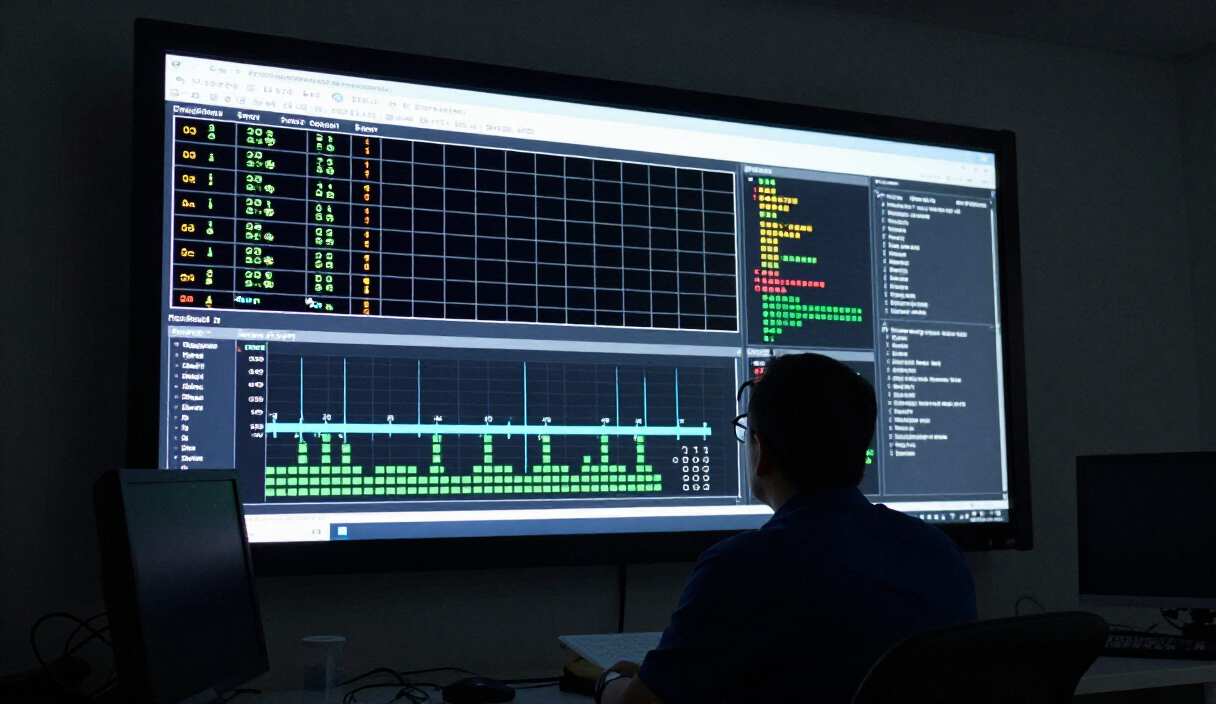
Twenty-one software packages, shipped in a single night. Not sketched, not scaffolded — shipped. The engineering team was one founder directing a fleet of coding agents, Codex and Claude working in parallel, and by morning the repository held twenty-one pieces of software that had all been run through negative controls and mutation tests. The product being built this way is Gewerkton, a voice-first construction documentation and defect management platform, born in the German market and built for sites worldwide. It is in beta now, with a public beta planned for fall 2026 — and the team says so plainly, which turns out to be consistent with everything else about how they work.
Software & QA — Gates, Not Vibes
“It compiles” is not a verdict.
One founder directed a fleet of coding agents — Codex and Claude working in parallel — and by morning the repository held twenty-one shipped packages. The speed is not the story. The story is the evidence: the founder does not review the packages line by line. He reviews the gates every package had to survive.
The Failure Modes
What agent-written code gets wrong
- An interface that drifts half a degree from the package it talks to
- An edge case resolved with a confident guess
- An error path that exists — and swallows the error
- A test file that restates the implementation and passes beautifully
Ask an agent for tests and you will get tests that pass. Tests that cannot fail are the cheapest kind to generate.
Gate 01 · Negative Controls
The tests that must fail
A test asks: does the code do the right thing? A control asks: would we even notice if it didn’t? So a known fault is seeded on purpose — a validation rule inverted, a required field dropped, an output corrupted — and the suite must fail in the predicted way, at the predicted place.
IF THE PIPELINE STAYS GREEN,
THE VERIFICATION IS DECORATIVE
Gate 02 · Mutation Testing
Ask the suite to kill something
A mutation tool generates dozens or hundreds of small mechanical sabotages — a comparison flipped, a method call removed, a boundary nudged by one — and the suite runs against every mutant. Tests that merely mirror the implementation pass against its mutants, too; mutation scores are rude about that in a way line coverage never is.
A SURVIVOR IS A BEHAVIOR THAT CAN
CHANGE WITHOUT ANY TEST CARING
The Morning After
A ledger, not a green checkmark
A passing suite is often just the absence of bad news.
Why the QA story is the product story
Gewerkton’s output is evidence, too
The voice-first construction documentation and defect management platform turns a site manager’s spoken words — at the base of a wind turbine or in a tunnel with no reception — into defects with photo and deadline, daywork reports, a signature captured at handover. Those records feed invoices and change orders, where “probably works” is a liability. Born in the German market, in beta now.
— “On site, what counts is what’s proven.”
If you have ever shipped software for a living, the speed is not the interesting part. The interesting part is the question waiting for you the next morning: how do you know any of it works?
“It compiles” is not an answer. Neither, on its own, is “the tests pass” — not until you have asked some pointed questions of the tests themselves. What follows is the quality story behind Gewerkton’s build discipline, and it doubles as a field manual for the situation a growing number of engineers and QA professionals now find themselves in: reviewing code they did not write, produced by a machine that never gets tired and never gets embarrassed.
As an affiliate, we earn on qualifying purchases.
What agent-written code actually gets wrong
Code written by a large language model fails in characteristic ways, and none of them look like failure. The syntax is clean. The naming is plausible. The comments are confident. The failure modes live a level deeper: an interface that drifts half a degree from the package it is supposed to talk to; an edge case resolved with a confident guess; an error path that exists but swallows the error; a test file that restates the implementation back to itself and passes beautifully.
That last one deserves emphasis. Ask an agent for tests and you will get tests that pass — that is, in a very literal sense, what the agent is optimizing for. Tests that cannot fail are the cheapest kind to generate. A suite built this way will hand you a green checkmark on every single run, right up until the moment production data arrives in a shape nobody prompted for.
Now multiply that by twenty-one packages in one night. No human being reads that much code with real attention between dinner and breakfast. The review surface has outgrown the reviewer, and pretending otherwise is how teams end up “supervising” their agents the way a smoke detector supervises a fire — by beeping after the fact.
So the unit of trust has to move. You stop asking “have I read this code?” and start asking “what evidence exists about this code, and how hard was that evidence to fake?” That is the pivot at the heart of Gewerkton’s process: the founder does not review the twenty-one packages line by line. The founder reviews the gates every package had to survive.
As an affiliate, we earn on qualifying purchases.
Negative controls: the tests that must fail
Start with an uncomfortable truth about test suites: a suite that passes against everything proves nothing. If your tests would also pass against broken code, then “all green” is a property of your test runner, not of your software. The only way to know a suite can go red is to watch it go red.
That is what a negative control is. You deliberately introduce a known fault — you break something on purpose — and you demand that the pipeline catches it. If the pipeline stays green, you have learned something far more valuable than “the tests pass”: you have learned that your verification is decorative, and you have learned it before your users do.
A control is not a test
The distinction matters. A test asks: does the code do the right thing? A negative control asks: would we even notice if it didn’t? In practice this looks like seeding a wrong implementation — a validation rule quietly inverted, a required field dropped, an expected output corrupted — and requiring the suite to fail in the predicted way, at the predicted place. The control is not checking the feature. It is checking the checks.
QA veterans will recognize the pattern from other disciplines. It is the calibration weight on the scale, the seeded defect on an inspection line, the fire drill rather than the fire policy. Software teams have historically skipped this step because it feels wasteful to break things on purpose. When your code is being written by agents at 3 a.m., it stops feeling wasteful and starts feeling like the entire point.
software testing control platforms
As an affiliate, we earn on qualifying purchases.
As an affiliate, we earn on qualifying purchases.
Mutation testing: asking the suite to kill something
Mutation testing takes the same instinct and industrializes it. Instead of one deliberate fault, a mutation tool generates dozens or hundreds of small, mechanical sabotages — a comparison flipped, a method call removed, a boundary condition nudged by one. Each sabotaged copy is a mutant. The suite runs against every mutant, and the outcome is binary: either some test notices the behavior changed (the mutant is killed) or nothing notices (the mutant survives).

A survived mutant is the most precise complaint a codebase can receive. It is not a vague feeling that coverage looks thin. It is a concrete, falsifiable statement: here is a behavior that can change without any test caring. Either the missing assertion matters, in which case you write the test that kills the mutant, or it genuinely doesn’t, in which case you accept the survivor with your eyes open.
Why mutants are the natural enemy of generated tests
Agents tend to write characterization tests — tests that enshrine what the code currently does rather than what it ought to do. Mutation testing punishes exactly that habit. A test that merely mirrors the implementation will pass against the implementation and against a remarkable number of its mutants, because it was never asserting anything independent in the first place. Mutation scores are rude about this in a way that line coverage never is.
This is why the morning-after report at Gewerkton is not “all green”. It is a ledger: these mutants died, these survived, and the survivors were triaged one by one. Confidence built from killed mutants is a different substance from confidence built from a passing suite. The first is evidence. The second is often just the absence of bad news.
There is a discipline to that triage worth stealing. A surviving mutant is not automatically a defect; sometimes the mutated behavior genuinely makes no difference, and the honest answer is to note it and move on. But the decision is made mutant by mutant, in the open, with a reason attached. Compare that with the more common ritual of glancing at a coverage percentage and feeling vaguely reassured.
voice-first construction documentation software
As an affiliate, we earn on qualifying purchases.
As an affiliate, we earn on qualifying purchases.
Gates, not vibes: how one person supervises a fleet
Put the pieces together and you get the verification gate: nothing gets to call itself “done” because it looks done, compiles, or passed once on someone’s machine. Done means the package went through a process that was designed — adversarially, by someone expecting to be fooled — to catch it being wrong. Each of the twenty-one packages from that night shipped verified this way, with negative controls proving the suites could fail and mutation tests proving the suites could kill.
For a one-person company this is not ceremony; it is survival. The founder cannot out-read the fleet, but the founder can out-design it. You point the agents at the code, and you point the gates at the agents. Supervision stops being an eyesight problem and becomes a process problem — and process, unlike attention, scales to twenty-one packages a night.
This is, quietly, an answer to the question hanging over every team adopting coding agents: what does senior review even mean now? Gewerkton’s approach suggests it means designing the ordeal the code must survive, then letting the ordeal do the supervising. The founder’s job that night was less like an editor reading every line and more like a QA lead managing tireless juniors — setting the bar, proving the bar works, and refusing to lower it just because the output arrived quickly.
Why this QA story is the product story
Gewerkton’s domain makes the discipline feel less like ideology and more like inevitability. This is a platform whose output is evidence: a site manager dictates at the base of a wind turbine or in a tunnel with no reception, and the spoken word becomes structured documentation and defect management records — defects with photo and deadline, daywork reports, a signature captured on the device at handover. Those records feed commercial machinery: born in the German market, the platform carries the deepest German commercial integration — GAEB, REB, XRechnung, DATEV — across 27 content languages. When the output of your software ends up in invoices, change orders and handover documents, “probably works” stops being a personality quirk and becomes a liability.
The company’s own line is: “On site, what counts is what’s proven.” It is hard to miss that the same standard is being applied inward, to the code itself. A platform that sells provable records is being built on provable checks. The verification gates are not adjacent to the product; they are the product’s argument, made in the build pipeline.

You can see the shape of that argument across the three product lines. Gewerkton Field is the voice-first construction site app — dictation to evidence, defects, daywork reports, takt and the portal. Gewerkton Studio is the browser workspace for plans and models — and, for the common case where no model exists at all, the place where the site team simply creates one in the browser rather than waiting for a model that may never arrive. Gewerkton Cloud runs operations and the coordination of models and data between Field, Studio and third parties. One brand, three lines, a single claim running through them: captured on site, proven in the record.
Studio in particular deserves a second look from QA people. Putting the plan-and-model workspace in the browser — and letting site teams build the model themselves when none exists — is a bet that the people closest to the evidence should also own its structure. That is the same bet the verification gates make about the code: push the proof to where the work happens.
An honest status report
Gewerkton is in beta. Not “coming soon”, not a waitlist page with a render — a working product in beta, with a public beta planned for fall 2026. If you kick the tires today, you are kicking an early version, and the team frames it that way on purpose.
A few facts worth knowing before you do. The platform runs on a bring-your-own-AI model: 13 AI providers, your own keys, region selectable across the EU, the US and Asia including mainland China — no vendor lock-in. Data residency is your call: EU cloud or your own infrastructure. The marketing site itself is run as a statement of intent — 27 languages, zero trackers, no cookie banner, a fully egress-free architecture — and the media bank is 51-plus self-produced clips and posters rather than stock gloss.
Where it is meant to earn its keep:
- Wind farms and renewables — distributed sites, rotating crews, field acceptance, offline capture in dead zones.
- Data centers and industrial plants — many trades in parallel on tight deadlines, meeting decisions turned into trade-sorted task lists.
- Housing and building construction — defects with photo and deadline, dictated daywork reports, signature on the device at handover.
- Infrastructure and tunnels — long durations, many change orders, instructions backed by the original audio.
- Cross-border teams — EU, US and APAC on the same project, each in their own language, the evidence original staying unambiguous.
- Projects in Asia — Chinese, Korean and Vietnamese crews, multilingual from capture to report, data residency by choice.
The bottom line
Twenty-one packages in a night makes a good headline, but headlines are cheap — agents can write those too. The durable story is that a one-person team looked at the most seductive sentence in modern software — it compiles, the tests pass — and treated it as the beginning of the conversation rather than the end. Negative controls to prove the suite can fail. Mutation tests to prove the suite can kill. Gates so that “done” means survived-the-process, not looks-fine-to-me.
On site, what counts is what’s proven. Apparently the same is true in the repository.