
TL;DR

Get business pricing on monitors, keyboards and dev gear
- Business-only prices and quantity discounts
- Tax-exempt purchasing
- Multiple users, one account, clear invoices
IdeaClyst offers a local, structured space where founders can rigorously test, refine, and plan their ideas with AI-driven debate and research. It helps prevent costly market mistakes by grounding ideas in real data and disagreement, all on your own machine.
Ever sat in front of your screen, juggling three half-baked ideas, feeling that knot tighten in your stomach? That’s the founder’s dilemma—knowing some ideas are worth pursuing, but unsure which one will truly hit. The biggest challenge isn’t building; it’s deciding what to build. Learn more about how technology influences decision-making.
Most of us rely on gut feelings, a quick chat, or a spreadsheet to pick our next move. But that’s not strategy—it’s hope dressed up in a blazer. Enter IdeaClyst, a tool designed to turn that hope into conviction. It’s a war room—a focused space—where your ideas get sharpened, tested, and validated with real research and healthy disagreement. It’s about making smarter decisions, faster. Discover how structured idea spaces boost innovation.
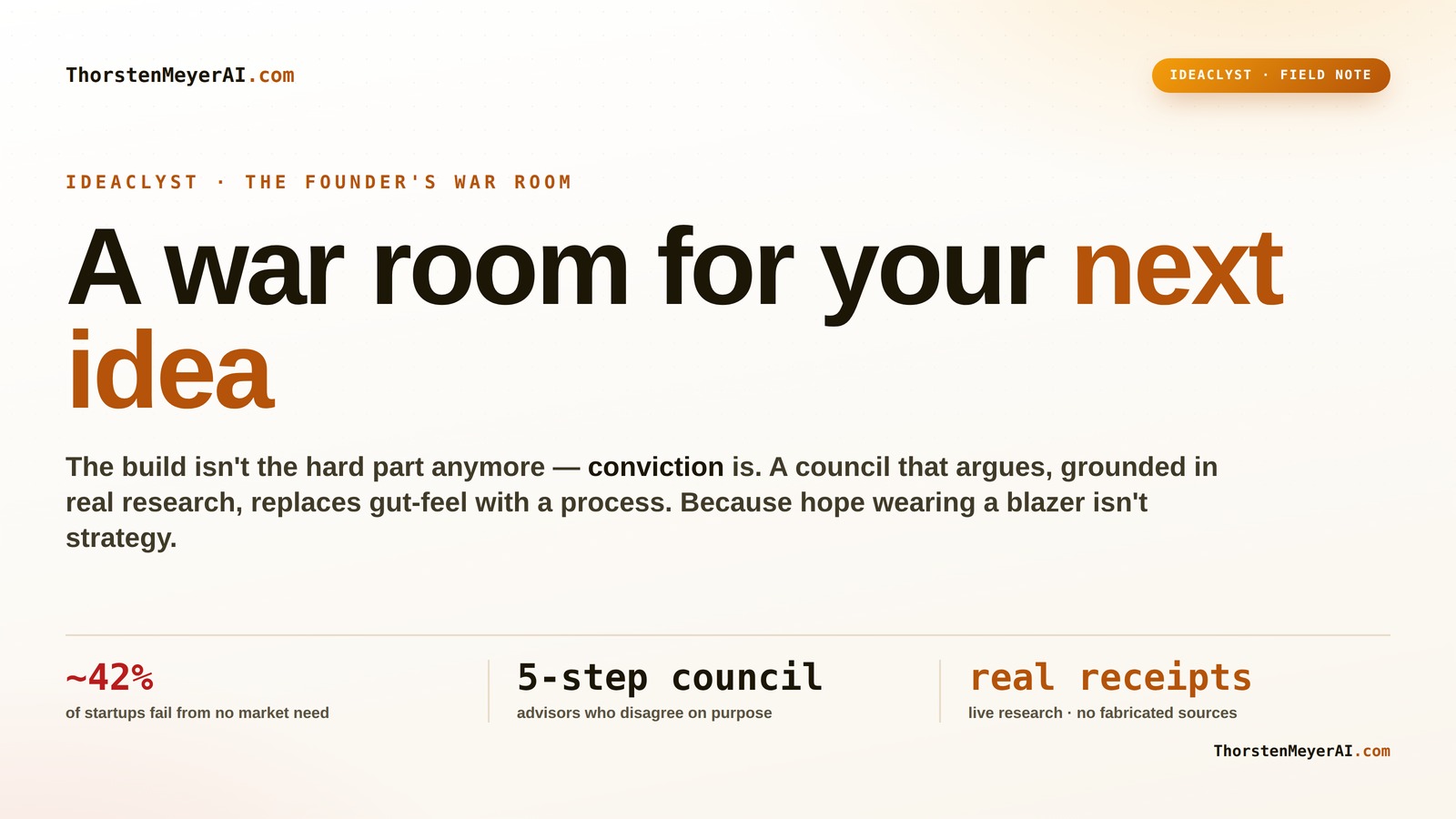
A war room for your next idea
The build isn’t the hard part anymore — conviction is. Knowing which idea deserves the next six months, and being able to defend it. Most founders answer with gut feel and optimistic math. That’s hope wearing a blazer. IdeaClyst replaces it with a process.
The most expensive decision is what to build
The single most valuable thing a tool can do is talk you out of the wrong six months. The numbers make the case better than any pitch.
Three tools in one — on your own machine
Strip away the framing and IdeaClyst is three things at once, all running locally with nothing leaving your laptop.
An AI council
Pressure-tests an idea you bring it — advisors who argue on purpose.
A discovery engine
Finds ideas you didn’t know to look for by hunting real demand signals.
A founder’s workspace
Carries winners from “interesting” all the way to “ready to build.”
Advisors who disagree on purpose
Not one confident, agreeable answer — a structured five-step deliberation where models play different roles and turn on their own work. The disagreement is the feature.
The five-step deliberation
A council that leads with the bad news surfaces the objections you’d otherwise find the expensive way, on month five.
Product strategy
Who’s it for, what’s the wedge, why now, what’s the business model.
Technical architecture
What would it actually take to build — and where’s the risk.
Critique pass
The council turns on its own work. Where’s the hand-waving? What kills this?
Second, independent critique
A different voice, a different angle — so blind spots don’t survive.
Final synthesis
Everything into one coherent founder packet: strategy, architecture, validation, plan.
When IdeaClyst cites a source, it actually fetched it
The hard departure from “ask an AI what it thinks of my startup.” It runs in a strict, real-data-only mode — if it can’t gather genuine evidence, it says so plainly rather than inventing a plausible paragraph.
Confidence with receipts
No fabricated statistics, no imaginary competitors, no made-up citations. The packet survives a skeptical co-founder or a sharp investor because the reasoning has receipts.
Market research first
Scouts the landscape before the council reasons about anything.
Competitor read
Real positioning, pricing signals, feature claims — differentiation vs. reality.
Validation with links
Not “talk to customers” — concrete signals & sources you can click.
From the blank page to build-ready
Evaluation is half the problem; the blank page is the other half. And a plan is worthless if it dies in a tab you never reopen.
Bring a space, not an idea
“AI for accountants,” “tools for indie game studios” — plus your goal and real capacity. It hunts demand signals across HN, Reddit, Product Hunt, GitHub, pricing pages.
- An honest market read — leads with the bad news when a space is hard
- An opportunity map — high pain, thin competition
- Ranked candidates — wedge, who pays, effort, risk, confidence
- each with KILL CRITERIA — when to walk away
A home and a forward path
Every promising idea gets carried forward, with every artifact in plain files on your disk.
- Validation tooling — sprint board, interview list, evidence browser
- Founder profile — a personal-fit lens; same discovery, different advice
- Build workspaces — funnel, personas, landing draft, version history
- “Build this idea” → a PRD + task queue, ready for a coding agent
Key Takeaways
- A structured idea war room like IdeaClyst helps founders make faster, more confident decisions by grounding ideas in live research and diverse critique.
- Running entirely on your own machine protects your ideas from leaks and gives you full control over your data.
- Using a multi-model council that disagrees on purpose surfaces flaws early, saving time and money.
- Turning vague ideas into detailed plans involves a step-by-step process: input, debate, research, critique, and synthesis.
- Whether you’re a startup, nonprofit, or creator, a dedicated war room turns scattered thoughts into impactful action.
As an affiliate, we earn on qualifying purchases.
What Is an Idea War Room, and Why You Need One
An idea war room is a dedicated space—physical or digital—where your team or yourself come together to develop, test, and challenge ideas. It’s like a bunker, but for sparking clarity instead of chaos. Think of it as a cockpit where every decision is scrutinized, debated, and refined before launch. See how war rooms facilitate better decision-making.
For example, imagine a startup founder sitting alone, trying to decide whether to build a new app feature. In their war room, they’d gather insights from different perspectives—product, tech, market—and let opposing views clash. That’s how ideas become robust, not just wishful thinking.
In practice, an idea war room streamlines your thinking process. It prevents endless debate and helps you reach clear, evidence-based conclusions. The goal? Cut through the noise, avoid costly mistakes, and build with confidence.
As an affiliate, we earn on qualifying purchases.
How IdeaClyst Turns Vague Ideas Into Actionable Plans
IdeaClyst is more than a brainstorming tool—it’s a structured process that guides your idea from vague notion to a concrete plan. It’s like having a team of advisors debating your concept, pointing out flaws, and sharpening your strategy—without leaving your laptop. Learn how structured processes improve project outcomes.
Here’s how it works:
- Input your idea: Write a sentence, paragraph, or ambition.
- AI council debate: Different models argue the idea’s strengths and weaknesses—covering market fit, technical risks, and strategic fit.
- Research grounding: The tool pulls live web data, ensuring debates are based on current facts, not just memory or guesswork.
- Critique and refine: Multiple perspectives challenge assumptions, exposing blind spots.
- Final plan: The tool consolidates everything into a clear, Markdown-based document ready for action or presentation.
This step-by-step process is crucial because it transforms fuzzy ideas into precise, actionable strategies. When you rely solely on intuition or outdated research, you risk building on shaky ground—leading to costly pivots or failures. By grounding each step in live data and diverse critique, IdeaClyst helps you identify potential flaws early, weigh tradeoffs objectively, and make decisions that are both bold and well-informed. The tradeoff, of course, is that this process requires discipline and honest critique—qualities that often challenge founders who prefer quick wins. But in the long run, the clarity and confidence gained from this structured approach outweigh the effort, dramatically increasing your chances of success.
As an affiliate, we earn on qualifying purchases.
Why Grounding Ideas in Real Research Matters More Than Ever
Many founders lean on optimistic assumptions or outdated market reports. But in today’s fast-moving landscape, relying on static ideas is a recipe for failure. IdeaClyst’s secret sauce? It grounds every debate in live web research, making sure your assumptions are backed by current facts. Explore how real-time data impacts decision-making.
For example, instead of guessing whether a market is ‘growing rapidly,’ the tool pulls recent data—say, a 15% growth rate over the last year—helping you decide if the timing is right. This real-time validation prevents you from chasing illusions or investing in a shrinking niche.
The importance of this approach cannot be overstated. In a landscape where markets shift overnight, relying on outdated or anecdotal information can lead to misinformed decisions that cost time and money. By constantly updating your understanding with live data, IdeaClyst ensures your strategies are relevant and adaptable. This capacity for real-time validation means founders can pivot quickly, avoid sunk costs, and seize emerging opportunities. Learn about tools for real-time market intelligence.
market research data analysis tools
As an affiliate, we earn on qualifying purchases.
As an affiliate, we earn on qualifying purchases.
The Power of Disagreement: Why Multiple Perspectives Make Better Ideas
Imagine a room where everyone agrees with you—that’s comforting but dangerous. The real magic happens when different models—or voices—disagree and challenge your assumptions. That’s what makes IdeaClyst’s council so valuable.
For instance, one model might argue your product targets a niche that’s too small, while another highlights an underserved segment you hadn’t considered. These disagreements surface flaws early, saving months of potential missteps.
Research shows that diverse perspectives in decision-making increase the chance of success by up to 50%. It’s like assembling a miniature board of critics—each holding a piece of the truth—before you commit to building. This diversity of thought forces you to confront blind spots and consider tradeoffs you might otherwise overlook. The tradeoff, however, is that managing multiple perspectives can be complex and time-consuming. It requires openness to critique and the willingness to adjust your assumptions. But the payoff—more robust, validated ideas—is well worth the effort. Ultimately, embracing disagreement in your idea process leads to more resilient strategies and reduces the risk of failure due to overlooked flaws or biases.
Local-First, No Data Leaks: Why Your Ideas Stay Yours
Many founders worry about their ideas leaking or being stolen when using cloud-based tools. IdeaClyst offers a different approach—it runs entirely on your machine. No cloud accounts, no API keys, just your own storage.
Imagine working late at night on a revolutionary app idea. With IdeaClyst, everything stays on your laptop—your drafts, critiques, and plans. It’s your private war room, shielded from prying eyes.
This local-first approach isn’t just about privacy; it’s about control. You own your ideas—no data sharing, no third-party access. That peace of mind lets you focus on refining your vision, not worrying about leaks. In an era where intellectual property theft is a real threat, this architecture offers a significant advantage: it minimizes exposure and ensures your proprietary ideas remain confidential. The tradeoff is that this setup might limit seamless collaboration or cloud-based integrations, but for many founders, the priority is safeguarding their innovation. The implication? For those valuing privacy and control, a local-first environment isn’t just a feature—it’s a strategic necessity.
Who Should Use an Idea War Room? Startups, Nonprofits, and Creators
Anyone with a big idea—whether you’re launching a startup, running a nonprofit, or building a community project—can benefit from a dedicated war room. It’s especially useful when decisions carry high stakes or involve complex trade-offs.
For example, a nonprofit planning a new social initiative can use IdeaClyst to vet ideas, gather community input, and plan execution—all in one place. Similarly, a solo founder with limited resources can avoid costly mistakes by validating ideas quickly and confidently.
The core advantage? It transforms scattered brainstorming into a disciplined, evidence-based process that accelerates impact. The deeper implication is that any initiative—regardless of scale—can achieve greater clarity and strategic alignment when using a dedicated, structured environment for decision-making. The tradeoff is that setting up and maintaining such a space requires discipline and commitment, but the payoff is a more focused, validated path forward—essential for high-stakes or resource-constrained projects.
Avoid the Endless Loop: How to Keep Your Idea War Room Productive
It’s easy to get stuck in endless debate—discussing without doing. The key to a productive idea war room is setting clear goals, ownership, and timelines. Otherwise, you risk spending months chasing perfect perfection.
Here are some tips:
- Define clear objectives: What decision are you trying to make?
- Assign roles: Who researches, critiques, or synthesizes?
- Set deadlines: Limit time for each phase to maintain momentum.
- Prioritize actions: Focus on high-impact ideas first.
For example, an early-stage startup might spend a week debating market fit, then move on to prototyping based on the final validated idea. The key is to keep the process lean, focused, and time-bound. Without these boundaries, the process can spiral into analysis paralysis, draining resources and delaying progress. The tradeoff here is balancing thorough critique with decisive action. Too much delay kills momentum; too little risks overlooking critical flaws. The best approach? Establishing clear milestones and accountability ensures that your war room remains a tool for progress, not just discussion.
Frequently Asked Questions
What exactly is an idea war room?
An idea war room is a dedicated space, digital or physical, where you develop, challenge, and refine ideas through structured debate and research. It helps turn vague concepts into clear, actionable plans.How does IdeaClyst help me make better decisions?
IdeaClyst combines an AI council that argues different perspectives with live web research, grounding your ideas in current facts. This dual approach reduces risk and builds confidence in your choices.Is IdeaClyst suitable for solo founders?
Absolutely. It’s designed to be a private, local-first tool that helps solo founders validate ideas efficiently without sharing sensitive info online. It’s like having a board of critics in your pocket.Can this process replace traditional market research?
It accelerates and complements traditional research by providing real-time data and structured critique. However, direct customer conversations and field testing remain essential for final validation.What’s the main advantage of running IdeaClyst locally?
Running on your own machine keeps your ideas private, prevents leaks, and gives you full control over your data—an important advantage when dealing with proprietary concepts.Conclusion
In a world saturated with noise and endless options, your best move is clarity—grounded in real data and honest disagreement. An idea war room like IdeaClyst turns messy brainstorming into disciplined decision-making, all while keeping your ideas private and under your control.
Next time you’re stuck in the fog of too many ideas, remember: a focused space for debate, backed by real research, can be the difference between building something that matters and chasing shadows. Your next breakthrough might just start with a simple click.
Halloween Picks
halloween
As an affiliate, we earn on qualifying purchases.