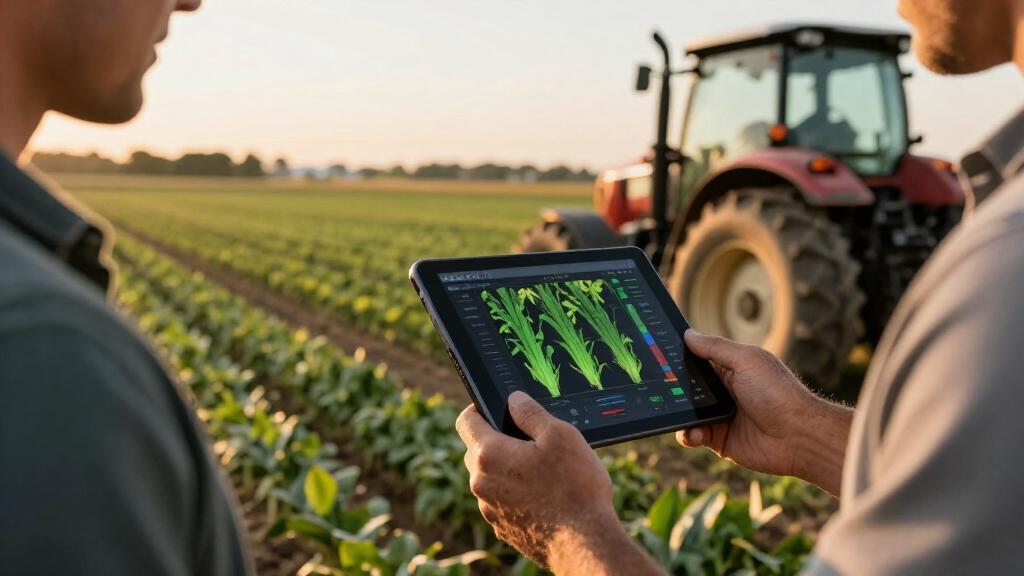
🔍 Read the full analysis: The Past Of Farming, The Future Of AI on ThorstenMeyerAI.com

Get business pricing on monitors, keyboards and dev gear
- Business-only prices and quantity discounts
- Tax-exempt purchasing
- Multiple users, one account, clear invoices
TL;DR
A November 3 essay on ThorstenMeyerAI.com traces how farming’s share of U.S. work fell from about 74% around 1800 to roughly 1.5% today as tools, fertilizers and improved crops raised output. The author uses that history to argue that AI could automate a large share of work, but presents that projection as a thesis, not an established forecast.
Thorsten Meyer published an essay November 3 arguing that farming’s transformation offers a historical test case for debates about AI and employment. Drawing on historical labor estimates, the piece describes how agriculture’s share of U.S. workers fell from about three in four around 1800 to roughly 1.5% today, while food production expanded.
Meyer’s account puts the change in a long timeline rather than attributing it to a single invention. The essay identifies improved tools, including John Deere’s 1837 steel plough, industrial production of ammonia fertilizer after Fritz Haber’s 1908 patent, and higher-yield crops associated with the Green Revolution. Together, such developments helped raise agricultural output while fewer workers were needed relative to the rest of the economy.
The essay cites a U.S. Census Bureau-published historical series based on economist Stanley Lebergott’s estimates: in 1800, about 1.4 million of a 1.9 million-person labor force worked in agriculture. The source cautions that early figures are estimates, not census counts, and that the series includes enslaved people. It also notes that the U.S. farm-worker headcount continued to rise until about 1910, reaching an estimated 11.8 million, even as agriculture’s share of the workforce eventually declined.
Meyer points to present-day differences between countries: the International Labour Organization estimate cited in the essay says 928 million people worked in agriculture worldwide in 2025, about one in four workers. The article’s central AI projection—that automation could affect as much as 90% of a sector within a decade or a few decades—is explicitly presented as Meyer’s thesis, not as a verified forecast or a measured outcome.
Farm Labor’s Lessons for AI
The historical comparison matters because it distinguishes workforce share from the number of people employed. The essay says the U.S. farm-worker count rose for decades before its share of total work fell. A similar shift in other industries would not necessarily mean jobs disappear immediately; employment levels, output, and the composition of work can change on different timelines.
Farming also shows that productivity gains need not reduce food supply. Meyer cites data showing global cereal production increased 4.2-fold between 1961 and the period covered by the source, while population grew 2.7-fold. He also reports that U.S. farm output in 2023 was nearly three times its 1948 level, with only a small increase in total inputs. These figures illustrate the sector’s production gains, but they do not establish that AI will produce comparable results in other industries.
For readers weighing AI’s labor effects, the essay offers a historical analogy rather than a prediction with a defined probability. Farming’s transformation unfolded over roughly two centuries in the United States, and the experience varied by country. The pace and distribution of any AI-driven change remain open questions.
Products Worth Considering

Apple Watch SE (2nd Gen) GPS 40mm with Starlight Aluminum Case and Sport Band (S/M)

Bose SoundLink Plus Portable Bluetooth Speaker, Wireless Outdoor Speaker, Up to 20 Hours Battery Life, Waterproof and Dustproof, Black

Apple Watch Series 8 GPS, 41mm, Midnight Aluminum Case with Midnight Sport Band (S/M)
As an affiliate, we earn on qualifying purchases.
How Agriculture’s Workforce Changed
The source traces early agricultural employment to an economy in which food production depended heavily on human and animal labor. It reports that historical estimates put agriculture at about 85% of Japan’s gainfully occupied population in 1872, while India’s 1951 census counted cultivators and agricultural laborers as about 70% of workers. The measures and dates differ, so the figures should not be treated as directly comparable census results.
Mechanization was only one part of the shift. The essay describes the steel plough as an improvement for working sticky Midwestern soil, then discusses fertilizers and crop breeding. It cites Indian statistics showing wheat production rose from 12.3 million tonnes in 1964–65 to 26.4 million tonnes in 1971–72, in the period when dwarf wheat varieties were introduced. The author links the yield gains to improved seeds alongside fertilizer and irrigation, rather than to one cause alone.
The piece is Episode 2 of Meyer’s “Work After Work” series, which examines how economic activity moved from fields to factories and offices. Its focus here is the historical path of agriculture and how that history might inform discussion of automation elsewhere.
““The farm is the best test case this season has for its big question, because here a whole sector of human work has already been almost completely automated.””
— Thorsten Meyer, in the essay
AI’s Pace and Reach Remain Open
The essay does not establish how many jobs AI will replace, which occupations will be affected, or how quickly adoption will occur. Its projection about automation reaching up to 90% of a sector is an argument for discussion, not a finding supported by a cited labor-market forecast.
The agricultural figures also have limits. Some early workforce totals are historical reconstructions, and the source notes that German counts underrepresented women working on family farms. International figures refer to different years and definitions of agricultural work. The comparison between past farming and future AI therefore offers context, not a direct measure of what will happen to other workers.
It is also unclear from the supplied material how benefits and costs would be distributed if AI raises productivity: the essay does not quantify possible wage effects, new job creation, or the transition support workers might need.
The Series Turns to Machinery
Meyer says the next episode will cover mechanical reapers, threshers, and tractors, extending the account of agricultural mechanization. That installment may add detail on how machinery changed farm work beyond the tools, fertilizers, and crop varieties discussed here.
For the broader AI question, the next evidence to watch is not a single historical parallel but measured adoption and its effects on employment, wages, output, and job creation across specific industries. The current essay sets out Meyer’s comparison; it does not resolve those questions.
Key Questions
What is the essay’s main argument?
Meyer argues that agriculture’s long shift toward fewer workers and higher output can help frame discussion of AI and work. He treats it as a historical analogy, not proof that other sectors will follow the same path.
How many people work in agriculture worldwide?
The essay cites an International Labour Organization estimate of 928 million agricultural workers in 2025, about one in four workers worldwide. The figure is an estimate for that year, not a count of people whose jobs AI has affected.
Not at first. The essay says the U.S. farm-worker headcount continued to grow until about 1910, reaching an estimated 11.8 million, even as agriculture’s share of the workforce changed over the longer term.
Does Meyer predict AI will automate 90% of jobs?
No. Meyer describes automation reaching up to 90% of a sector within a decade or a few decades as his thesis. The essay does not present it as a confirmed prediction, nor does it specify that 90% of all jobs will be automated.
Source: ThorstenMeyerAI.com