🔍 Read the full analysis: Run Fast, Private Agents On-device With LFM2.5-24B-A2B on ThorstenMeyerAI.com

Get business pricing on monitors, keyboards and dev gear
- Business-only prices and quantity discounts
- Tax-exempt purchasing
- Multiple users, one account, clear invoices
TL;DR
Liquid AI has introduced LFM2.5-24B-A2B, a reasoning model designed for tool-using agents and local deployment. The company reports strong results on several agent and instruction-following benchmarks, but the figures are its own evaluations and the model scores lower than some rivals on other tests.
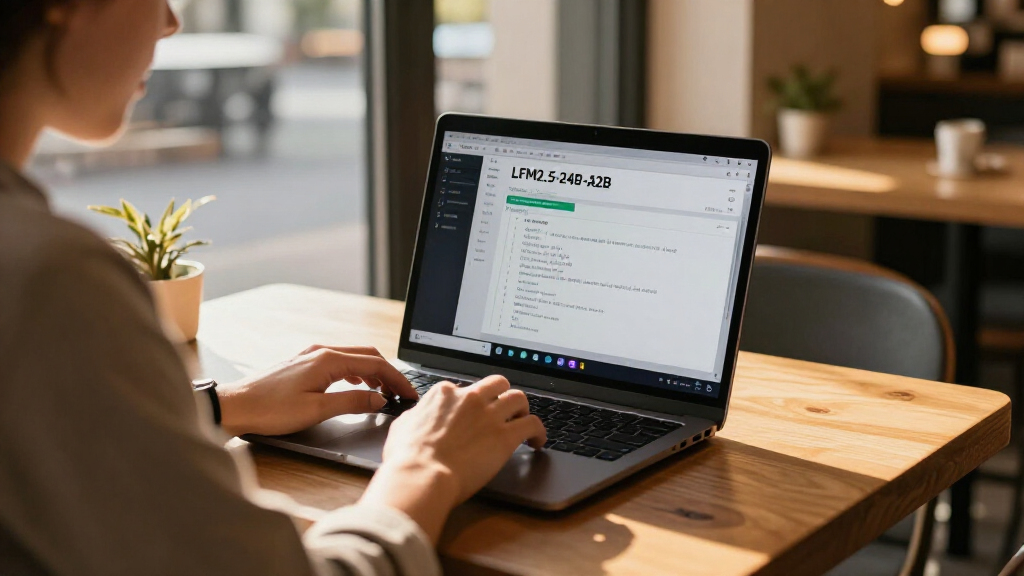
Liquid AI has introduced LFM2.5-24B-A2B, a reasoning model designed for agents that call tools and can run on local hardware. The company says the model has 24 billion total parameters but activates 2 billion per token, a design intended to reduce the compute cost of repeated inference; its published benchmark and speed figures have not been independently verified in the supplied material.
Liquid AI describes LFM2.5 as a reasoning-only model that generates a reasoning phase before its final answer and supports tool calls across multiple turns. The company says it trained the model within agent harnesses including OpenClaw, Hermes Agent, Pi and OpenCode. Its context window is 131,000 tokens, up from 32,000 in the preceding LFM2-24B-A2B.
In results Liquid AI reports across 16 benchmarks, LFM2.5 scored 48.09 on LiveClaw, compared with 38.19 for Qwen3.6-35B-A3B, and 27.69 on AutomationBench, more than three times the next-highest listed result of 8.72. Liquid AI says the model led or matched the comparison group on five of eight agent and tool-use tests and led on all three instruction-following tests.
The results were not uniformly in LFM2.5’s favor. Qwen scored higher on WebArena Verified, GPQA Diamond and SWE-Bench Verified, among other evaluations; Gemma-4-26B-A4B-it led on HLE, while Nemotron-3.5-Lightning had the least negative score on AA-Omniscience. Liquid AI says it used vLLM and each benchmark’s recommended generation settings.
Liquid AI also reports decoding speeds of 184 tokens per second on an Apple M5 Max and 114 on a Ryzen AI Max+ 395. A separate result of more than 21,000 output tokens per second was measured on one NVIDIA B300 at high concurrency. The company has not provided enough detail in the supplied material to treat that figure as a typical single-user speed.
Local Inference for Tool-Using Agents
Agents that reason, make tool calls and repeat the process can generate substantial inference workloads. Liquid AI’s 2-billion-parameter active path is intended to lower the per-token compute burden compared with activating all 24 billion parameters, potentially making frequent local use more practical. The model’s longer context window could also help agents retain more material during extended tasks.
Running a model locally may let users keep prompts and outputs on their own device or infrastructure, depending on how the system is configured. That can matter for privacy, control and deployment choices. It does not, by itself, establish that data stays local in every setup, or that the model will be cheaper overall: hardware, memory, power use and the surrounding agent software also affect cost.
The benchmark pattern points to a model worth testing for tool use and instruction following, not a clear all-purpose winner. Teams will need to compare it on their own tasks and weigh completion quality, latency, memory requirements and deployment conditions. Liquid AI’s results are a starting point, rather than independent evidence of performance in production.
Products Worth Considering

DJI Mini 3 Drone with DJI RC and 3‑Axis Mechanical Gimbal

Apple MacBook Air 13-inch with M5 Chip, 16GB Memory, 512GB SSD, Silver

Amazon Kindle Scribe Colorsoft 64GB with 11-Inch Color Display and Premium Pen, Graphite
As an affiliate, we earn on qualifying purchases.
What Changed From LFM2
LFM2.5 retains the architecture of LFM2-24B-A2B, which Liquid AI describes as a 40-layer mixture-of-experts model with 64 experts per block and top-four routing. The company says the architecture combines gated short convolutions with grouped-query attention. The main reported changes include a larger context window and expanded training.
According to Liquid AI, pre-training grew from about 17 trillion to 33 trillion tokens, followed by mid-training focused on reasoning, mathematics, code, instruction following, multilingual text and long-context material. The company says the vocabulary expanded from about 65,000 to 128,000 tokens to improve non-Latin tokenization. Post-training included supervised fine-tuning, teacher specialization, two rounds of multi-domain on-policy distillation and agentic reinforcement learning.
The model is listed for use with llama.cpp, MLX, vLLM, SGLang and ONNX, with a Transformers loading example also provided in the source material. Liquid AI says it is competitive with Qwen3.6-35B-A3B on agentic and tool-use tasks despite that model having about 50% more total and active parameters. That is the company’s characterization of its comparison, not an independently established conclusion.
““Competitive with Qwen3.6-35B-A3B, a model with ~50% more total and active parameters, on agentic and tool-use tasks.””
— Liquid AI
Benchmark and Deployment Gaps
The supplied release information does not include independent replications, confidence intervals or full hardware configurations for the benchmark and speed results. It also does not specify the quantization, memory footprint, power consumption or quality settings associated with each speed test. The high-concurrency B300 result should not be taken as a typical rate for one user.
It remains unclear how results will vary across agent harnesses, tool configurations and other locally available hardware. The supplied material also gives no price, license terms or like-for-like estimate of total cost for running a complete agent workflow. Those factors will shape whether the model is suitable for individual devices, organizational deployments or hosted services.
Independent Tests Will Clarify Use
The next useful evidence will come from developers testing LFM2.5 in their own agent setups and publishing comparable figures for task completion, latency, memory and power use. Liquid AI says the model has day-one support in several inference frameworks and describes serving it through a local, OpenAI-compatible endpoint for agent harnesses such as Hermes Agent.
Readers evaluating the release will need further details on availability, licensing and benchmark settings, alongside independent results on the hardware they intend to use. Until those are available, the company’s benchmarks indicate where the model may perform well, but do not settle how it will compare in sustained real-world deployments.
Key Questions
What is LFM2.5-24B-A2B?
It is a reasoning model from Liquid AI designed for tool-using agents and local deployment. The company says it has 24 billion total parameters and activates 2 billion per token.
Does the model run on local hardware?
Liquid AI positions it for local use and lists support for inference systems including llama.cpp, MLX, vLLM, SGLang and ONNX. The hardware requirements and performance will depend on the deployment and configuration.
Is LFM2.5 better than the other models tested?
Not across every test reported. Liquid AI reports leading results on several agent and instruction-following benchmarks, while Qwen scored higher on some web, knowledge and coding evaluations and Gemma led on HLE.
Are the reported speeds independently verified?
The speed figures in the supplied material are reported by Liquid AI. Independent replication and complete configuration details are not provided, and the 21,000-plus tokens-per-second result was measured on one NVIDIA B300 at high concurrency.
Primary source: Hugging Face · via ThorstenMeyerAI.com