📊 Full opportunity report: Preparing For IEP Talks: Rehearsal Simulators Parents Can Trust on IdeaNavigator AI — validation score, market gap, and execution plan.

Get business pricing on monitors, keyboards and dev gear
- Business-only prices and quantity discounts
- Tax-exempt purchasing
- Multiple users, one account, clear invoices
TL;DR
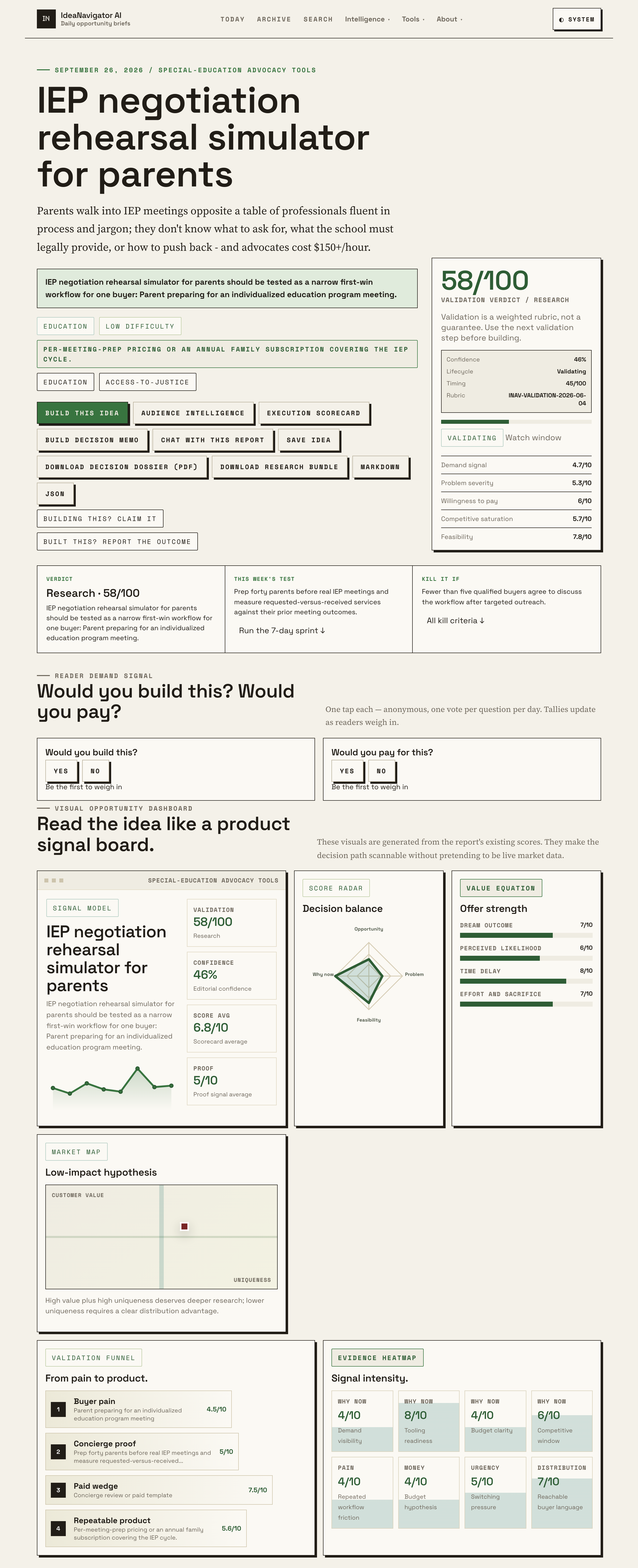
A product proposal from IdeaNavigator AI outlines an AI-powered simulator that rehearses parents for individualized education program (IEP) meetings, generating legally grounded request lists and simulating staff pushback. The concept remains unvalidated and would be tested with 40 parents against prior meeting outcomes.
A newly published product concept from IdeaNavigator AI proposes building an AI rehearsal simulator that trains parents for individualized education program (IEP) meetings, letting them practice against realistic pushback from a simulated school team before walking into the real room. The proposal frames the tool as a narrowly scoped first product aimed at one buyer: a parent preparing for an IEP meeting, a situation the analysis describes as an uneven negotiation between families and districts.
According to the IdeaNavigator AI concept, the core problem the simulator addresses is informational asymmetry. Parents typically enter IEP meetings facing a table of education professionals fluent in process and jargon, while the parents themselves may not know what to ask for, what the school is legally required to provide, or how to push back when requests are declined. Professional advocates who can fill that gap charge $150 or more per hour, a cost the analysis identifies as a barrier for many families.
The proposed minimum viable product works in three stages. First, a parent uploads their child’s current IEP and evaluation reports. The tool then explains the family’s entitlements in plain language and generates a request list with legal grounding attached to each item. Finally, the simulator role-plays the meeting itself, including realistic resistance from simulated school staff, repeating the exercise until the parent can hold their positions under pressure.
The concept proposes two monetization models: a per-meeting-prep fee or an annual family subscription covering the full IEP cycle, which typically includes annual reviews and reevaluations. The target market is identified as special-education advocacy tools, a category the analysis says is gaining urgency as identification rates for special education climb while district resources tighten, making meetings more adversarial.
Why Parent Rehearsal Tools Matter
IEP meetings determine the services, accommodations, and placement a child with a disability receives, and the outcomes of those meetings can shape a student’s education for years. If a rehearsal tool works as proposed, it could shift a portion of negotiating power toward families who cannot afford paid advocates, by giving them advance practice, plain-language explanations of entitlements, and legally grounded request lists before the meeting occurs.
The timing argument in the concept rests on two converging trends: large language model role-play has improved enough to simulate a realistic multi-party meeting, and special-education caseloads are growing against tightening district budgets. Together, these trends make contested IEP meetings more common and make preparation more valuable to families, according to the analysis.
Top picks for "prepar talk rehearsal"
As an affiliate, we earn on qualifying purchases.
The Advocate Gap in Special Education
Under U.S. special-education law, parents are entitled to participate as equal members of the IEP team, and districts must provide a free appropriate public education. In practice, families often face informational and procedural disadvantages when negotiating with school staff who handle these meetings routinely. The traditional remedy has been hiring a special-education advocate or attorney, with hourly rates that the IdeaNavigator AI analysis cites as starting around $150 per hour. Digital preparation tools have historically been limited to checklists and informational guides; the concept’s premise is that conversational AI now enables practice-based preparation rather than static content.
What Is Unproven About the Concept
The simulator exists only as a concept — no product has been built or tested, according to the IdeaNavigator AI analysis itself. The claim that LLM role-play is realistic enough to prepare parents for actual meetings is an assertion, not a demonstrated result. The proposed legal grounding for request lists raises open questions about accuracy, since AI-generated legal explanations can contain errors, and no information in the concept addresses how legal accuracy would be verified or what disclaimers would apply.
The proposed validation study — forty parents, measured against their own prior meeting outcomes — has not been run, so there is no evidence yet on whether rehearsal improves requested-versus-received service outcomes. Pricing sensitivity and whether families would pay per meeting or subscribe annually are also untested. The analysis does not specify how sensitive documents such as IEPs and evaluation reports would be stored or protected.
Validation Before Any Launch
Under the concept’s own plan, the next step would be building the minimum viable product — document upload, entitlement explanations, request-list generation, and role-play — and then running the forty-parent validation study comparing requested-versus-received services against each family’s prior meeting. Whether any builder acts on the concept, and on what timeline, is not determined by the analysis. Readers should treat the tool as a proposal until a tested product and published outcomes exist.
Source: IdeaNavigator AI
Key Questions
Does an IEP meeting rehearsal simulator actually exist yet?
No. It is a product concept published by IdeaNavigator AI. No working simulator has been built, and the proposed validation study with forty parents has not been conducted.
How would the simulator prepare parents?
According to the concept, a parent would upload the current IEP and evaluation reports, receive plain-language explanations of entitlements and a legally grounded request list, and then role-play the meeting against simulated pushback until they can hold their positions.
How much would it cost?
The concept proposes either per-meeting-prep pricing or an annual family subscription covering the IEP cycle. No prices have been set. For comparison, the analysis cites professional advocates charging $150 or more per hour.
Could an AI tool give legally wrong advice about special-education rights?
That risk is not addressed in the concept and remains an open question. AI-generated legal explanations can contain errors, and any real product would need verification mechanisms and disclaimers.
How would anyone know the tool actually works?
The proposed test is to prepare forty parents before real IEP meetings and compare requested-versus-received services against each family’s prior meeting outcomes. That study has not yet been run.
Source: IdeaNavigator AI
Fall Picks
fall essentials
As an affiliate, we earn on qualifying purchases.