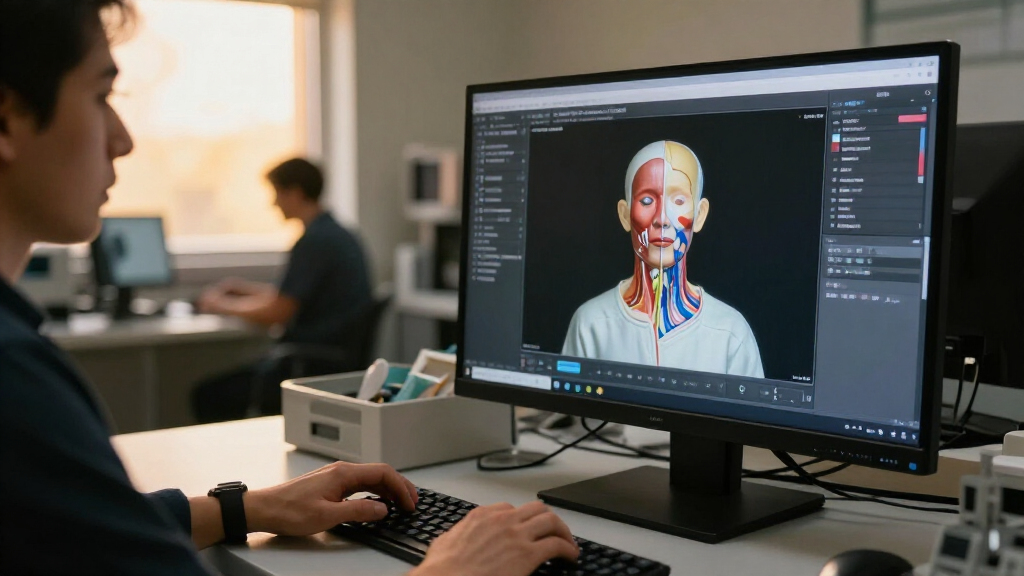

🔍 Read the full analysis: NVIDIA Cosmos3-H-Dreams: Bringing Clinical Surgery To Life Through Generative Simulation on ThorstenMeyerAI.com

Get business pricing on monitors, keyboards and dev gear
- Business-only prices and quantity discounts
- Tax-exempt purchasing
- Multiple users, one account, clear invoices
TL;DR
NVIDIA has introduced Cosmos3-H-Dreams, a generative simulator trained on clinical gallbladder-removal video and robot-control data from CMR Surgical’s Versius platform. The company says it supports live instrument control on one RTX PRO 6000 GPU, but the supplied material reports no independent validation, measured latency or evidence of clinical suitability.
NVIDIA has introduced Cosmos3-H-Dreams, a generative simulator that creates surgical video in response to instrument actions, using clinical gallbladder-removal recordings and robot-control data from CMR Surgical’s Versius platform. NVIDIA says the system supports live kinematic control and interactive operation on a single RTX PRO 6000 GPU, but the announcement does not establish that its outputs are accurate enough for clinical training, planning or decision-making.
The model was adapted from Cosmos3-H-Embodied-Nano, a 16-billion-parameter system pretrained on Open-H-Embodiment. NVIDIA says it then trained the model on selected cholecystectomy video synchronized with robot kinematics. The samples focus on two instruments: a left Cadiere grasper and a right monopolar hook. The action representation has 28 dimensions, covering both arms’ poses and gripper information, energy controls and thumbstick inputs.
The training video is 832 by 480 pixels, with actions aligned at 10 Hz. That is the training-data alignment rate, not a reported video-generation frame rate. NVIDIA describes two student checkpoints: one uses four denoising steps per video block, while another was trained separately with a two-step schedule to generate faster at a tradeoff in visual quality. The announcement provides no measured latency or frame-rate results.
For streaming inference, NVIDIA says the system uses FlashDreams and an adapted FadeMem module, which consolidates attention history during longer sequences. Its training process extended a bidirectional teacher model from 24 future frames to 72 frames, equivalent to 7.2 seconds at the 10 Hz action-alignment rate, before distilling it into a causal student that generates video in short blocks as actions arrive. The company describes the resulting setup as interactive on one RTX PRO 6000 GPU.
A New Route for Surgical Simulation
Cosmos3-H-Dreams applies action-conditioned video generation to clinical surgical scenes, moving beyond NVIDIA’s earlier Cosmos-H-Dreams work on tabletop suturing with a dVRK setup. If the approach can be validated, it could give researchers and developers another way to explore how surgical scenes may change as instruments move, without relying only on hand-built numerical simulations.
That potential depends on more than whether generated footage looks convincing. A useful simulator would need to keep anatomy stable over time and produce changes that correspond reliably to supplied instrument actions. Cholecystectomy scenes can include moving tissue, reflections, occlusion and smoke, adding challenges for a model that learns visual associations rather than explicitly calculating geometry, tissue deformation and physical interactions.
NVIDIA’s announcement frames visual realism as a starting point for validation, not proof of biomechanical accuracy. Until evaluations address that distinction, the system should be understood as a research and development demonstration—not as a validated clinical tool.
As an affiliate, we earn on qualifying purchases.
From Suturing to Cholecystectomy
The new system extends NVIDIA’s earlier Cosmos-H-Dreams work, which used Cosmos-Predict2.5 for interactive tabletop suturing on a dVRK platform. In this release, the training material comes from clinical gallbladder-removal procedures performed with CMR Surgical’s Versius system. The model is taught by pairing video with actions, then generating future frames conditioned on new action inputs.
This differs from a conventional numerical simulation that separately represents scene geometry and physical interactions. The supplied source says the approach learns visual patterns associated with instrument movement. NVIDIA calls Cosmos3-H-Dreams, to its knowledge, the first real-time generative surgical simulator trained on clinical cholecystectomy recordings that supports live kinematic control. That is NVIDIA’s priority claim; the material offers no independent comparison establishing it.
“Visual realism is therefore a starting point for validation, not proof of biomechanical accuracy.”
— NVIDIA, in the Cosmos3-H-Dreams announcement
As an affiliate, we earn on qualifying purchases.
Accuracy and Runtime Still Unmeasured
The supplied announcement reports no independent performance study, clinical evaluation, measured latency, frame rate or failure rate. It does not quantify how closely generated tissue movement matches biomechanical measurements, how well anatomy remains stable in longer rollouts, or how the system handles actions outside its training distribution. NVIDIA’s description of physically accurate tissue deformation is not accompanied in the supplied material by a cited evaluation.
It is also unclear what safeguards would prevent a plausible but incorrect generated sequence from being mistaken for a reliable simulation. The announcement does not say whether the model has been assessed for surgical education, robot development, preoperative planning or patient-facing use. A single-GPU runtime claim does not, without timing measurements, show how responsive the system would be in a particular workflow.
As an affiliate, we earn on qualifying purchases.
Validation Will Determine Its Use
The next meaningful evidence would be evaluations comparing generated movement with observed surgical video and biomechanical measurements, alongside tests of anatomy stability, failure cases and behavior under unfamiliar actions. Reporting measured latency and frame rates would also help researchers judge whether the system’s stated interactive operation fits their intended workflows.
The supplied source does not identify a planned clinical study, release schedule or regulatory pathway. Until NVIDIA or independent researchers provide those details and results, the model’s demonstrated scope remains action-conditioned generation from selected cholecystectomy footage, with its clinical utility still unresolved.
As an affiliate, we earn on qualifying purchases.
Key Questions
What is NVIDIA Cosmos3-H-Dreams?
It is a generative surgical video simulator that produces video in response to instrument actions. NVIDIA says it was adapted using clinical cholecystectomy footage and robot-control data from CMR Surgical’s Versius platform.
Does the announcement show that the simulator is clinically accurate?
No. The supplied material reports no independent validation or clinical evaluation and does not quantify how closely generated tissue movement matches real biomechanical behavior.
What does the 10 Hz figure mean?
It is the rate at which training actions are aligned with video. It is not a reported generation frame rate for the simulator.
What hardware does NVIDIA say it uses?
NVIDIA says the streaming setup runs interactively on one RTX PRO 6000 GPU. The supplied announcement gives no measured latency or frame-rate figure.
Could Cosmos3-H-Dreams be used for surgical training?
The announcement does not establish suitability for surgical education or any other clinical use. Whether it can support those workflows remains an open question pending validation.
Primary source: Hugging Face · via ThorstenMeyerAI.com
Halloween Picks
halloween
As an affiliate, we earn on qualifying purchases.