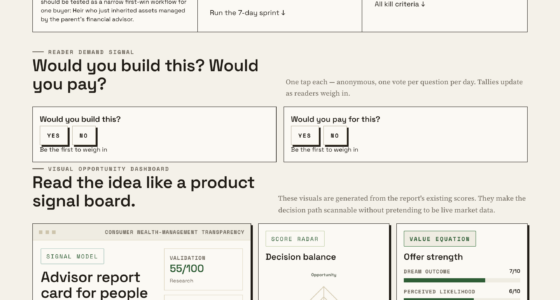
📊 Full opportunity report: Coordinating Calendar Availability For AI-Powered Scheduling on IdeaNavigator AI — validation score, market gap, and execution plan.

Get business pricing on monitors, keyboards and dev gear
- Business-only prices and quantity discounts
- Tax-exempt purchasing
- Multiple users, one account, clear invoices
TL;DR

IdeaNavigator AI outlines a proposed hosted service to coordinate calendar availability when multiple AI tools book or hold time for one person. The proposal recommends testing it with 10 executive assistants over two weeks; no test results or deployed product are reported.
IdeaNavigator AI has proposed testing a shared availability service for calendars managed by multiple AI scheduling tools, aiming to prevent tentative holds from being overwritten and appointments from being double-booked. The proposal calls for a two-week trial with 10 executive assistants, but does not report that the service has been built or tested.
The proposed service would ingest a user’s calendars and provide a single endpoint showing free and busy periods alongside tentative holds. Before any connected AI tool could book a slot, it would have to request a hold token; the hold would then expire after a set time limit, or TTL, if it was not confirmed. The proposal does not specify the TTL duration or technical design.
The intended users are executive assistants whose principals’ calendars are handled by more than one AI tool. IdeaNavigator AI describes a problem in which separate assistants can create, move, or reserve events without sharing a common record of what is truly available. Under the proposed workflow, the hosted layer would serve as that shared record rather than allowing each scheduling tool to make availability decisions independently.
For validation, IdeaNavigator AI suggests recruiting 10 assistants who already use two AI scheduling tools, routing both tools through the endpoint for two weeks, and counting how many double-bookings are prevented compared with the participants’ previous rate. The proposal also suggests a per-seat monthly subscription paid by a professional or assistant. No pricing, customer commitments, measured results, or operating service are described.
One shared view of calendar availability
IdeaNavigator AI proposes a hosted service that lets multiple scheduling tools check and hold time in one place. The concept has not been built or tested.
How a shared hold could work
Each tool would check availability and reserve a slot through a common endpoint.
The service would show free and busy periods, including tentative holds.
Before booking, a tool would request a temporary hold token for the slot.
A hold would expire after a time limit if it was not confirmed; the duration is unspecified.
Where conflicts can arise
Separate tools may make decisions without seeing one another’s tentative reservations.
- One tool may see a slot as open.
- Another may already have placed a tentative hold.
- Without shared state, both may act on the same time.
- Tools check a common availability record.
- Temporary holds are visible before confirmation.
- Direct bookings or missing calendars could still leave gaps.
What the trial would measure
The proposed test focuses on assistants already using two AI scheduling tools.
Route both tools
Connect each tool to the shared hold endpoint for two weeks.
Compare conflicts
Count double-bookings prevented against each participant’s prior rate.
Open questions for businesses
The proposal leaves key operating details unanswered.
- How would it connect to different calendar providers and keep data current?
- How would it handle permissions, simultaneous hold requests, and direct bookings?
- What is the hold time limit, and how would calendar data be protected?
- Would assistants and AI tools consistently route bookings through the service?
If multiple AI tools can write to one person’s calendar, a shared availability check could address a practical coordination failure: one tool may not know that another has placed a tentative hold. A common endpoint with temporary reservations could give each tool a consistent way to check and claim a slot before confirming an appointment. That could reduce conflicts, though the proposed workflow has not been shown to do so in practice.
The approach would also put an additional service between calendar owners and their scheduling tools. Its usefulness would depend on assistants and AI products actually routing booking activity through it, and on the service receiving sufficiently current calendar information. A system that only sees some calendars or is bypassed by one tool could still leave gaps. For assistants coordinating busy schedules, the proposed trial’s comparison with prior double-booking rates is a concrete way to begin measuring whether the extra layer helps.
Products Worth Considering

EcoFlow Delta 3 Portable Power Station – 1024 Wh, 1800 W

Bose QuietComfort Ultra Earbuds (2nd Gen), Wireless Noise-Cancelling Earbuds, Black

Samsung Galaxy Tab A7 Lite 8.7 32GB Wi‑Fi Android Tablet – Long‑Lasting Battery, Compact Slim Design, Sturdy Metal Frame (US Version)
As an affiliate, we earn on qualifying purchases.
Why Multiple Tools Can Conflict
Calendar software generally records events and availability, but the proposal focuses on a different issue: several AI tools acting on the same calendar without a shared process for tentative reservations. One system may treat a slot as available while another has already placed a hold that is not yet a confirmed event. If the tools do not exchange that state, they can make incompatible scheduling decisions.
IdeaNavigator AI frames the opportunity as a narrow first workflow for assistants already using two AI scheduling tools. It says the proliferation of scheduling assistants and agent frameworks is creating cases where multiple tools write to one calendar, but provides no adoption figures or independent evidence about how common the problem is. The proposed test is designed to focus on that specific use case, rather than establish a general solution for every calendar platform or scheduling workflow.
Trial Results and Design Details
No trial has been reported, and the proposal does not identify a product, developer, launch date, or participating assistants. It is also unclear how the service would connect to different calendar providers, keep availability synchronized, or handle a booking made outside the shared endpoint.
The proposal does not set out how it would protect calendar data, manage permissions, resolve simultaneous hold requests, or define when a hold expires. It provides no baseline double-booking rate or projected reduction, so the suggested test would need to establish the participants’ prior rates before comparisons could be made. The proposed subscription model is an idea, not evidence of customer demand or a confirmed price.
A Two-Week Test Is Proposed
The next step described by IdeaNavigator AI is to recruit 10 executive assistants who already use two AI scheduling tools, connect both tools to the shared hold endpoint, and run the workflow for two weeks. The stated measure is prevented double-bookings compared with each participant’s earlier rate.
Any assessment would also need to clarify how often holds expire, whether users can still book directly in their calendars, and whether all relevant calendars and tools are covered. No trial start date or follow-up findings are available, so it remains unknown whether the concept will move from a proposed test to a working service.
Source: IdeaNavigator AI
Key Questions
What is the proposed availability layer?
It is a hosted service concept that would combine calendar availability and tentative holds in one endpoint for multiple AI scheduling tools to use.
How would the hold-token process work?
A scheduling tool would request a temporary hold token before booking a time. The hold would expire after a time limit if not confirmed, but the proposed duration and implementation are not specified.
Has the service been tested?
No test results are reported. IdeaNavigator AI proposes a two-week trial with 10 assistants who use two AI scheduling tools.
How would the trial measure success?
The proposed measure is the number of double-bookings prevented during the test, compared with the assistants’ prior rates. No baseline figures or results have been provided.
Who would pay for the service?
The proposal suggests a monthly per-seat SaaS fee paid by the professional or their assistant. Pricing and customer demand have not been established.
Source: IdeaNavigator AI