📊 Full opportunity report: Basketball Highlights And Stats Through A Computer Vision Lens on IdeaNavigator AI — validation score, market gap, and execution plan.

Get business pricing on monitors, keyboards and dev gear
- Business-only prices and quantity discounts
- Tax-exempt purchasing
- Multiple users, one account, clear invoices
TL;DR
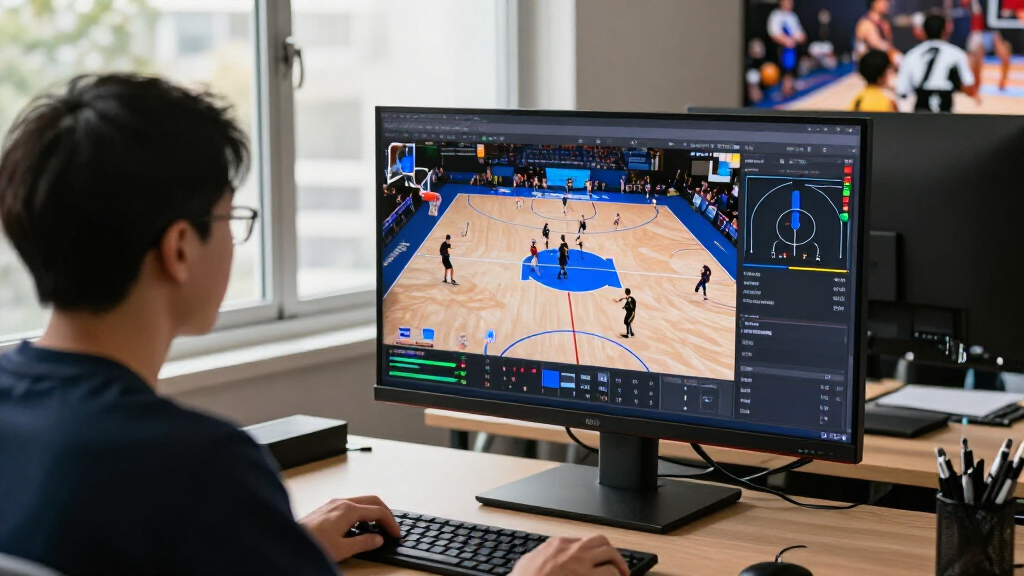
An IdeaNavigator AI proposal outlines an app that would use phone footage to generate youth basketball highlights, player stats and season profiles. The concept is a pilot opportunity, not a launched or validated product; its accuracy and willingness to pay remain untested.
IdeaNavigator AI has proposed a youth basketball app that would turn ordinary phone recordings into player-specific highlight reels and game statistics, targeting families who do not have access to higher-cost team video programs. The idea remains a product proposal: no working app, accuracy results, customer demand figures or confirmed pricing are provided.
According to the IdeaNavigator AI proposal, the app would let a user upload game footage and select a player for the system to follow. It would then attempt to identify that player, create a highlight reel with score overlays, produce a game-by-game stat line and maintain a shareable season profile. The proposal lists shots, rebounds and steals as events the system might detect. It does not specify how the app would resolve ambiguous plays, verify statistics or handle footage in which players are hard to distinguish.
The proposal identifies parents and players in youth and recreational basketball as the intended users. It describes the problem as games being recorded on phones while manually finding and clipping useful plays can take hours, potentially leaving players without usable highlight material or an ongoing performance record. This is the proposal’s account of the unmet need, not a finding supported by published user research.
For an initial business model, IdeaNavigator AI suggests a family subscription for a season, with separate charges for exporting individual reels. It proposes processing footage from 100 games, measuring satisfaction with highlight accuracy and testing subscription conversion at AAU tournaments. The proposal gives no price, recruitment plan, participant count beyond that suggested footage sample, or definition of a satisfactory result.
A Lower-Cost Route to Game Footage
If the system can reliably identify one player and label relevant plays in ordinary recordings, it could reduce the time families spend assembling clips and make game-by-game records easier to share. That would address a different buyer need from a full team video setup: an individual family seeking practical footage and stats, rather than a coaching staff purchasing tools for an entire program.
The potential value depends on accuracy and trust, not just whether a video can be processed. A mistaken player match or event label could make a reel misleading or leave a stat line unreliable. Families would also need to see enough benefit to pay for a season subscription or exports. Until those points are tested, the concept is an opportunity to validate, not evidence that phone video has already become a dependable substitute for more involved sports-video systems.
As an affiliate, we earn on qualifying purchases.
From Manual Clips to Automated Review
IdeaNavigator AI frames the proposal around a workflow in which families already record games but lack the time or tools to turn footage into organized clips. Its pitch is that computer vision could automate parts of this process, including tracking a selected player and detecting common basketball events. The proposal describes this as newly practical with on-device vision models, but names no model and provides no technical benchmark, independent evaluation or demonstration to support a performance claim.
The proposed scope is narrower than a complete team analytics platform: upload a game, identify one player, produce highlights and a stat line, then store results in a season profile. Keeping the first version focused on a single player and a small set of events could make it easier to test than attempting to analyze every player and action. The proposal gives no details on supported phone formats, recording angles, lighting conditions, processing time, privacy practices or whether analysis would happen on a device or on a server.
As an affiliate, we earn on qualifying purchases.
Accuracy, Demand and Pricing Remain Open
No product test results are reported in the IdeaNavigator AI proposal. Its suggested 100-game exercise is a validation plan, not a completed trial, and it provides no figures for player-identification accuracy, event-detection accuracy or family satisfaction. It is also unclear how those measures would be scored, who would review the outputs, and whether the footage would represent the range of camera angles and conditions families use.
Commercial demand is equally unverified. The proposal names season subscriptions and per-reel export pricing but gives no amounts or evidence that families would pay. It reports no interviews, sign-ups, conversion rates or tournament partnerships. Its technical claim that phone footage can support player tracking and event detection is not accompanied by an evaluation, so expected reliability should not be treated as established.
Privacy and consent arrangements are also unspecified in the proposal. Youth game footage can include children other than the selected player, but it does not explain how uploads, sharing, retention or permissions would be managed. Those questions would need answers before families could judge the service as well as its editing and statistical features.
As an affiliate, we earn on qualifying purchases.
A 100-Game Validation Test
IdeaNavigator AI proposes processing 100 games recorded by parents and assessing whether the generated highlights meet users’ expectations for accuracy. The concept also calls for testing season-subscription conversion at AAU tournaments. The proposal announces no dates, participating teams, evaluation method or results, so there is no confirmed milestone beyond the suggested test.
A useful assessment would need to distinguish technical performance from commercial interest: whether the app correctly follows the chosen player and labels plays, whether families consider the output useful, and whether they will pay at the proposed price. Until such evidence is available, the app’s development status, market demand and ability to produce dependable stats remain unsettled.
Source: IdeaNavigator AI proposal
As an affiliate, we earn on qualifying purchases.
Key Questions
Has the basketball highlights app launched?
No launch is reported. The app is described as a proposed product, with no release date or working version identified.
What would the app do with game footage?
The proposed workflow would identify a selected player in uploaded footage, create a highlight reel with score overlays, generate a game stat line and add the material to a shareable season profile.
Have its stats or highlight accuracy been tested?
No results are provided. Processing 100 games and measuring satisfaction with highlight accuracy is a proposed validation step, not a completed test.
How would the service charge families?
The suggested model is a family subscription for a season plus fees to export individual reels. Prices and evidence of willingness to pay are not provided.
What remains uncertain about the proposal?
Its technical reliability, customer demand, pricing, privacy arrangements and development timeline have not been established in the information available.
Source: IdeaNavigator AI
Halloween Picks
halloween
As an affiliate, we earn on qualifying purchases.