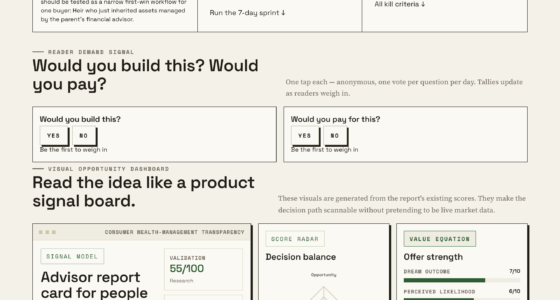

📊 Full opportunity report: Asana Cleared 5 Years Of Engineering Work In 2 Weeks With Codex on ThorstenMeyerAI.com — validation score, market gap, and execution plan.

Get business pricing on monitors, keyboards and dev gear
- Business-only prices and quantity discounts
- Tax-exempt purchasing
- Multiple users, one account, clear invoices
TL;DR
OpenAI claims that Asana used Codex to complete five years of engineering tasks in two weeks. The announcement is based on a vendor statement, with many details about the work and measurement methods undisclosed. The broader implications for enterprise productivity are still uncertain.
OpenAI has announced that Asana used Codex to complete what the company describes as five years of engineering work in just two weeks according to the original analysis. This claim suggests a significant acceleration in software development and maintenance tasks through AI assistance, though details about the scope, methodology, and verification are limited.
The announcement, published by OpenAI, attributes the rapid completion to Codex, an AI coding system, but does not specify which tasks or projects were involved. It remains unclear whether the work was coded, reviewed, merged, or deployed, or how the figure of five years was calculated. There is also no information on the number of engineers involved, the complexity of tasks, or the quality of the output.
OpenAI’s statement is based on a vendor-published case, not an independent study or verification. The company did not disclose details about the testing, review processes, or operational outcomes, making it difficult to assess the real-world impact or reproducibility of the claimed results.
Potential Impact of AI on Software Engineering Productivity
If supported by further evidence, this development could demonstrate that AI tools like Codex can dramatically reduce engineering backlogs, enabling companies to address long-standing technical debt and maintenance tasks more efficiently. Such a shift could influence enterprise strategies around automation, staffing, and project timelines, especially for large-scale or repetitive tasks.
However, the absence of detailed data on task complexity, quality, and operational safety means that the broader relevance remains uncertain. Businesses will need to evaluate whether similar results can be reliably achieved in their contexts before adopting such AI-assisted workflows at scale.
As an affiliate, we earn on qualifying purchases.
Background on AI-Assisted Engineering Work
OpenAI’s Codex has been available since 2021 as a tool to assist developers with code generation, explanation, and testing. Prior to this announcement, AI tools have shown promise in automating parts of the software development process, but large-scale claims like completing five years of work in weeks are rare and often unverified.
Asana, a workplace management platform, has integrated AI into its engineering operations, making this case notable as an example of AI application within a corporate environment. The claim builds on ongoing industry interest in AI’s potential to transform software engineering productivity.
As an affiliate, we earn on qualifying purchases.
Details on Scope, Methodology, and Verification Are Unclear
The announcement does not specify which tasks or projects were involved, how the five-year figure was calculated, or whether the work was deployed or just completed in code. The number of engineers, review processes, and quality assurance measures remain undisclosed. As a result, the reproducibility and real-world impact of this result are uncertain.
AI-powered software development tools
As an affiliate, we earn on qualifying purchases.
As an affiliate, we earn on qualifying purchases.
Need for Detailed Case Studies and Independent Validation
Further transparency from OpenAI and Asana is expected, including detailed case studies outlining the tasks, methods, and outcomes. Independent audits or third-party reviews will be necessary to confirm whether this approach can be reliably reproduced and scaled across different organizations and project types.
Industry observers will be watching for real-world operational metrics, defect rates, and security assessments to evaluate the practical benefits of AI-driven engineering acceleration.
As an affiliate, we earn on qualifying purchases.
Key Questions
Did Asana independently confirm this result?
No, the claim is attributed to OpenAI’s announcement. Asana has not publicly provided supporting data or verification.
What does five years of work mean in this context?
The announcement does not clarify whether this refers to five engineer-years, a backlog of tasks, or a time span of tasks completed. The interpretation remains uncertain.
Which tasks or projects did Codex complete?
The specific tasks, repositories, or programming languages involved have not been disclosed, nor whether the work was merged or deployed.
Can other companies expect similar results?
Reproducibility is currently unconfirmed. Without more detailed data, it is unclear whether similar productivity gains are achievable across different teams and workflows.
Source: ThorstenMeyerAI.com
Fall Picks
fall essentials
As an affiliate, we earn on qualifying purchases.