
📊 Full opportunity report: TRT Health Tracking: A Guide To Labs And Symptoms on IdeaNavigator AI — validation score, market gap, and execution plan.

Get business pricing on monitors, keyboards and dev gear
- Business-only prices and quantity discounts
- Tax-exempt purchasing
- Multiple users, one account, clear invoices
TL;DR
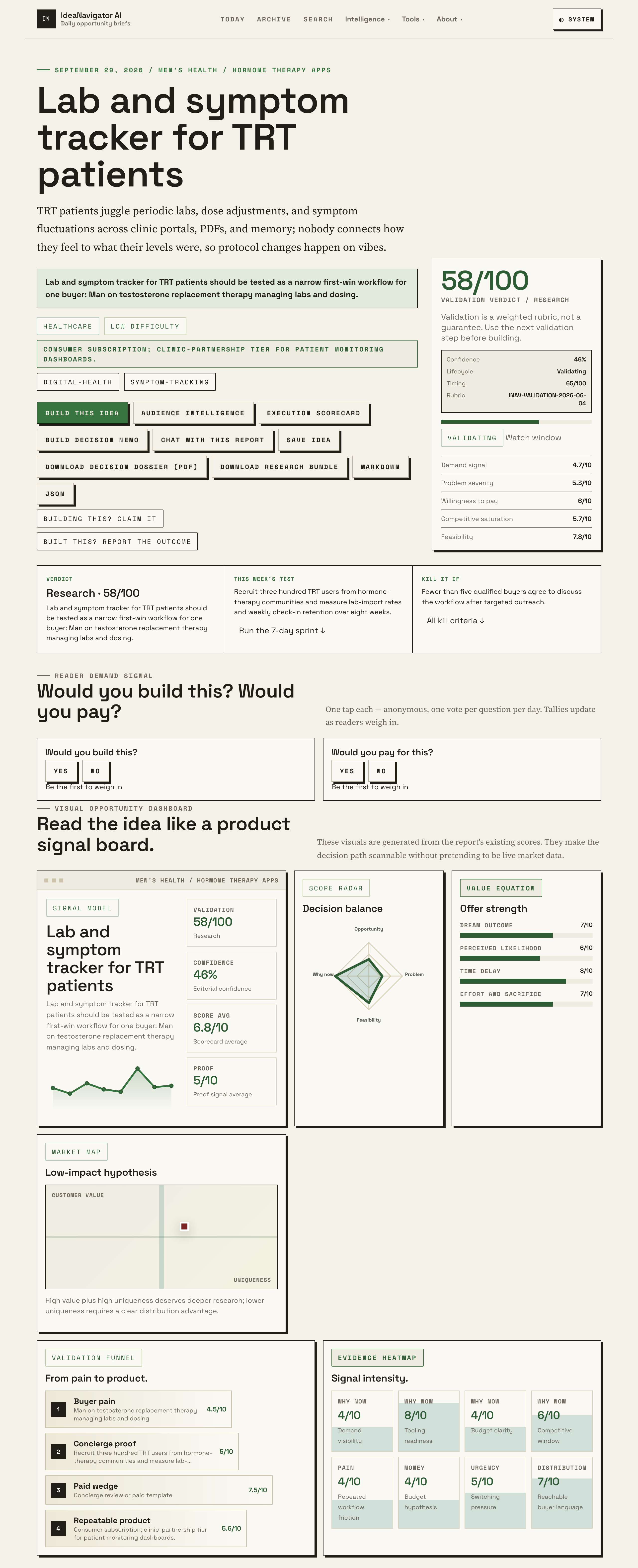
IdeaNavigator AI describes a proposed app for men on testosterone replacement therapy to connect lab results, dose changes and daily symptoms. The proposal outlines an eight-week test with 300 users, but reports no trial, product launch or clinical findings.
IdeaNavigator AI has outlined a proposed tracking app for men receiving testosterone replacement therapy (TRT), designed to bring lab results, dose changes and daily symptoms together in one timeline. The material describes a product opportunity and a suggested test, not a launched service or a clinical study; it provides no patient results or evidence that the app improves care.
According to the IdeaNavigator AI proposal, the app would let users import laboratory PDFs and chart hormone panels over time alongside dose changes and daily symptom check-ins. It would also produce summaries for clinic visits and flag values that move outside user-specific target ranges. The proposal does not specify which hormone tests would be supported, how target ranges would be set, or who would review alerts.
The proposal describes a practical record-keeping problem: patients may have lab reports in clinic portals or PDFs, while dosing history and day-to-day symptoms are kept elsewhere or remembered later. A combined record could help patients and clinicians review changes together. That potential benefit is the proposal’s product rationale, not a reported outcome from users or medical research.
For validation, IdeaNavigator AI suggests recruiting 300 TRT users through hormone-therapy communities and tracking lab-import rates and weekly check-in retention over eight weeks. The proposal’s revenue model combines a consumer subscription with a clinic partnership tier offering patient-monitoring dashboards. The supplied description identifies no recruitment, test results, pricing, clinic partners or operating company.
Connecting TRT Records Over Time
As described in the IdeaNavigator AI proposal, a shared timeline could make it easier for patients managing ongoing therapy to bring lab values, dose history and symptom patterns into a clinic conversation. Clinicians might have a clearer account of what changed between appointments, particularly when records sit across multiple portals. Whether that leads to better decisions depends on data quality, clinical interpretation and how well patients keep the record current.
The proposal points to a possible gap between consumer tracking and clinic workflows. A subscription app may appeal to people already organizing their own care, while a clinic dashboard would need to fit staff routines and provide information clinicians consider useful. Neither demand nor clinical usefulness is established by describing these customer groups or revenue options. The proposed retention test could assess continued use, but engagement alone would not establish health benefit.
Alerts deserve careful design because hormone results depend on the test, timing and individual clinical context. A value outside a selected range is not, by itself, a diagnosis or an instruction to change a dose. The proposal does not describe medical oversight or safeguards against users interpreting flags as treatment advice, leaving a central product question unanswered.
A Proposed Test, Not a Launch
The supplied IdeaNavigator AI description frames the tracker as a narrow first product workflow for one user group: men on TRT who manage labs and dosing. It situates the idea in men’s health and hormone-therapy apps and says increased prescriptions and telehealth clinics have created a larger self-managing population. It gives no prescription figures, dates, market-size estimate or independent data to quantify that claim.
The distinction matters because the described features remain at the concept stage in the available information. IdeaNavigator AI proposes importing PDFs, plotting results, generating visit summaries and flagging values; its material does not confirm that software has been built or tested. Nor does it name a developer, clinic, medical adviser or research team. No named patient or clinician statements are provided, so there are no direct quotes to report.
IdeaNavigator AI’s proposed validation plan focuses on two measures: whether recruited users import labs and whether they continue weekly symptom check-ins. Those measures could indicate usability and repeat engagement over the stated eight-week period. They would not, on their own, show whether symptom tracking is accurate, whether summaries change clinical decisions, or whether treatment outcomes improve. The plan is a recommendation, not evidence that a study is underway.
Clinical and Product Details Missing
The supplied IdeaNavigator AI proposal does not establish whether an app exists, whether recruitment has begun, or whether any clinic has agreed to participate. Its date and the current status of the concept are also unspecified. No data are reported on how many people use TRT, how fragmented their records are, or whether patients would pay for this service.
Important clinical and technical details remain open. The description does not explain how imported results would be checked for accuracy, how target ranges would account for differences between patients and laboratories, or how a user would be told to act on a flag. It also does not address privacy, data sharing, clinician access, or the handling of records from different portals. These omissions mean the product’s safety, regulatory position and fit with clinical practice cannot be assessed from the proposal.
Even the user test proposed by IdeaNavigator AI has unresolved design questions: recruitment criteria, participant oversight, success thresholds and the handling of dropouts are not stated. An eight-week engagement measure would be a limited test of use, not proof of effectiveness. The supplied material reports no medical claims or outcome figures.
Whether User Testing Begins
IdeaNavigator AI’s proposed next step is to recruit 300 TRT users for an eight-week validation test, then measure lab imports and weekly check-in retention. The proposal gives no start date, recruitment link, study protocol or planned publication of results, so it is unclear whether that test will take place. A future update would need to establish whether a product was built, whether users completed the test and what the measures showed.
Before clinical use could be assessed, further information would be needed about laboratory data checks, alert thresholds, privacy protections and the role of clinicians. A report of user retention could address whether people continue using the tracker; it would not establish that the system improves treatment. At present, the confirmed development is the concept described by IdeaNavigator AI, while implementation and impact remain unreported.
Source: IdeaNavigator AI
Key Questions
Has the TRT tracking app launched?
The available IdeaNavigator AI description presents a product proposal. It does not confirm that an app has been built or launched.
What would the proposed app track?
According to IdeaNavigator AI, it would combine imported lab results, dose changes and daily symptom check-ins, then chart trends and prepare summaries for clinic visits.
Has the app been shown to improve TRT care?
No outcomes or clinical findings are reported in the IdeaNavigator AI material. The suggested test measures lab-import rates and weekly check-in retention, which would assess use rather than prove a health benefit.
What is the proposed validation plan?
IdeaNavigator AI proposes recruiting 300 TRT users for eight weeks. The material does not say whether recruitment has started or provide results.
Source: IdeaNavigator AI
Fall Picks
fall essentials
As an affiliate, we earn on qualifying purchases.