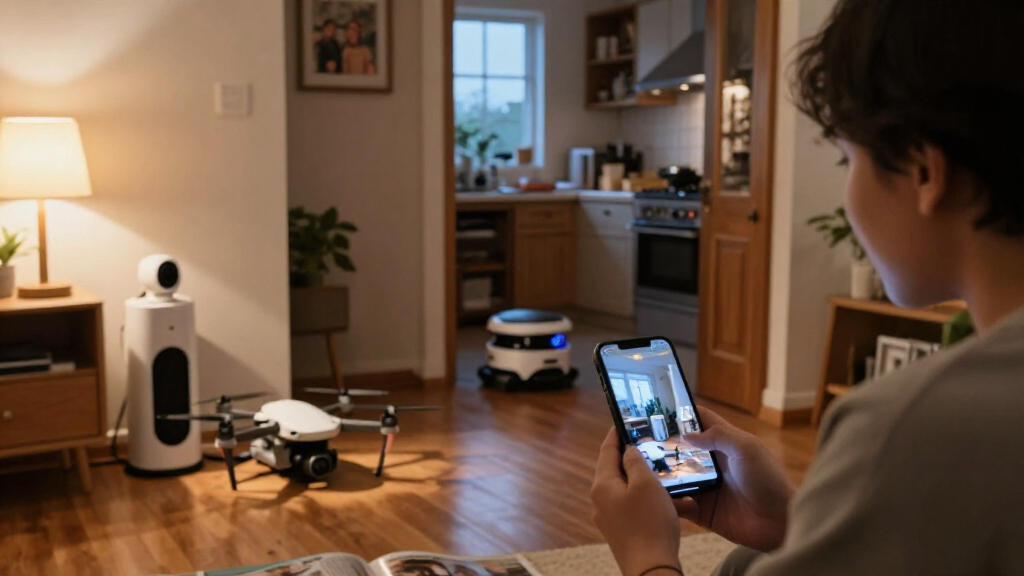

🔍 Read the full analysis: Ring’s Home Drone And Patrol Robot: A Look At Home Security’s Privacy Trade-Offs on ThorstenMeyerAI.com

Get business pricing on monitors, keyboards and dev gear
- Business-only prices and quantity discounts
- Tax-exempt purchasing
- Multiple users, one account, clear invoices
TL;DR
Amazon’s Ring announced two mobile security cameras on November 10, 2026: an indoor drone and a wheeled robot for businesses. The devices add automated patrols and recording, while raising questions about cloud processing, encryption, and how Ring’s privacy assurances compare with its past record.
Amazon’s Ring announced two mobile security cameras on November 10: the Ring Drone Cam, which flies inside homes, and the wheeled Ring Rover Cam, designed to patrol businesses. The products can move toward alerts from other Ring devices, extending surveillance beyond fixed cameras; their release plans and Ring’s privacy claims come with important conditions.
Ring says both devices use AI Pilot to map an area, suggest patrol points and navigate around obstacles using cameras, sensors, vision models and cloud processing. They can respond when another Ring camera, sensor or alarm is triggered. Scheduled patrols require a compatible Ring Protect plan, according to the company.
Ring lists Rover Cam at $999.99, with US shipping scheduled for December 16, 2026. The company lists Drone Cam at $249.99, with US shipping scheduled for January 27, 2027. Ring also says Drone Cam has not received authorization required under Federal Communications Commission rules and may not be sold until it does.
Ring describes Drone Cam as a device that can fly preset routes or launch on demand, with a 148-degree field of view, 2K video and LED lights. The Verge reported that the drone weighs 165 grams and that Ring estimates five to eight minutes of flight per charge. The outlet also reported that it relies on an internet connection and can only land if Wi-Fi is unavailable. Rover Cam, aimed at shops and offices, has an adjustable camera mast, two-way audio, a siren and a light tower. Ring says it records in up to 4K while moving or patrolling.
Ring’s Mobile Cameras Privacy Trade-Offs
Ring’s indoor drone and business patrol robot add automated movement and recording. Their launch depends on conditions, while key privacy and performance details remain unverified.
Two cameras, different settings
Both can respond to alerts from other Ring devices, according to the company.
Drone Cam
Flies inside homes with 2K video and a 148-degree field of view. Reported flight time is five to eight minutes per charge.
Rover Cam
A wheeled patrol camera for shops and offices, recording up to 4K while moving.
What mobility changes
A camera that moves can inspect places fixed cameras miss, and capture more routine activity.
- Responds to alerts from Ring cameras, sensors or alarms.
- Can patrol beyond a single fixed viewpoint.
- A camera may approach activity or enter rooms automatically.
- Scheduled patrols require a compatible Ring Protect plan.
Launch conditions
The announced US dates are schedules, and Drone Cam has an additional approval requirement.
Privacy claims and open questions
Ring describes its safeguards, but the provided material does not independently verify performance or fully explain recording practices.
- Ring says cloud features temporarily access encryption keys, then delete them; full end-to-end encryption remains optional.
- The source does not detail recording retention and access or how reliably AI Pilot handles different spaces.
- In 2023, the FTC charged Ring over access to private videos and privacy and security protections; this was a charge, not a new ruling.
Mobile Cameras Expand Surveillance
The products shift Ring’s security model from cameras fixed in place to devices that can move through a home or workplace. That may let users inspect areas a stationary camera cannot see, but it also means a camera can enter rooms or approach activity automatically after an alert. In a business, a moving camera that records while patrolling can capture a wider range of routine activity than one aimed at a single doorway.
Those capabilities make recording controls and data handling central to the product, not secondary details. A user’s understanding of when a device is active may depend on its lights, sleep or dock state, connectivity and cloud features. Ring’s stated privacy safeguards are company descriptions; they do not by themselves establish how every recording or cloud process will work in practice.
The practical trade-off also differs by device. Drone Cam is intended for inside a home and has limited reported flight time, while Rover is designed for commercial spaces and records as it moves, according to Ring. Buyers will need to weigh the added coverage against the presence of a mobile camera, the subscription requirement for scheduled patrols and the unresolved approval condition for the drone.
Products Worth Considering

Bose QuietComfort True Wireless Earbuds with Active Noise Cancellation, Bluetooth 5.3, USB-C Charging, and IPX4 Water Resistance

Samsung Odyssey G9 QD-OLED 49 Dual QHD Curved Gaming Monitor

Apple Watch Series 8 GPS 41mm Midnight Aluminum Case with Midnight Sport Band
As an affiliate, we earn on qualifying purchases.
Ring’s Earlier Drone and Astro
Ring’s mobile-camera concept predates this announcement. CNBC reported that the company previewed an indoor drone called the Always Home Cam in 2020. The Verge reported that founder Jamie Siminoff said development began in 2016. Ring is now presenting the product under its new Ring Robotics line.
Rover Cam also draws on an earlier Amazon device. Ring says it developed the business robot after feedback from Amazon Astro customers who valued its security patrol features. The Verge reported that Amazon launched Astro for Business in 2023 and discontinued it a year later. That history is relevant to the new product’s commercial prospects, but does not establish how long Rover Cam will be supported.
Ring says the devices use its Throw Away the Key encryption (TAKE), announced in August 2026. The company describes TAKE as inspired by end-to-end encryption principles: Ring servers temporarily access keys for cloud features such as smart alerts and then delete them. Ring says full end-to-end encryption, in which only a customer’s devices hold the keys, remains an optional setting.
“For years, customers told us they wanted eyes in the places a fixed camera couldn’t reach, and peace of mind in the spots they’d never want one.”
— Jamie Siminoff, Ring founder and chief inventor, in the company announcement
Approval and Privacy Details Remain
The most immediate uncertainty is whether Drone Cam will receive FCC authorization in time for its scheduled US shipment date. Ring says it is not authorized as required by FCC rules and may not be sold until it is; the announcement does not give a decision date or explain the status of an application.
Questions also remain about the products’ real-world performance and data practices. Ring’s release does not establish how reliably AI Pilot will map different homes or businesses, how often false alerts might prompt a device to move, or what happens during service interruptions beyond the reported drone behavior. The source material does not provide independent testing of the devices or a full technical account of how recordings are retained and accessed.
Ring’s privacy assurances also sit alongside a prior regulatory case. In May 2023, the Federal Trade Commission charged Ring with compromising customer privacy by allowing employees or contractors to access private videos and by failing to implement basic privacy and security protections. That was an FTC charge, not a finding stated here as a new ruling. The available source material does not include the full details of the agency’s case or a Ring response to the specific criticism of TAKE.
US Launch Dates and FCC Review
The next listed milestones are Rover Cam’s scheduled US shipping date of December 16, 2026, followed by Drone Cam on January 27, 2027. Ring’s announced dates may change, and the drone’s sale depends on receiving the required FCC authorization. The company has not given a timeframe for that approval in the material provided.
More information will be needed on subscription terms, device availability and how the patrol features operate outside demonstrations. Buyers and privacy advocates will also be watching for technical detail on TAKE, cloud processing and recording controls, along with independent testing once devices are available. Until then, Ring’s stated functions and safeguards should be understood as company claims rather than independently verified results.
Key Questions
What did Ring announce?
Ring announced Ring Robotics, a product line starting with an indoor flying camera, Drone Cam, and a wheeled business patrol camera, Rover Cam. Both can respond to alerts from other Ring devices, according to the company.
When will the devices ship, and what are the listed prices?
Ring lists Rover Cam at $999.99, with US shipping scheduled for December 16, 2026. Drone Cam is listed at $249.99, with US shipping scheduled for January 27, 2027, but Ring says it may not be sold until it receives required FCC authorization.
What privacy safeguards does Ring describe?
Ring says Drone Cam’s camera is off while the device is docked, Rover has a Sleep Mode, and both devices have indicators showing when they are recording. The company says recordings use TAKE encryption; the source material says full end-to-end encryption remains an optional setting.
Why are privacy advocates criticizing TAKE?
The Electronic Frontier Foundation argues that TAKE does not provide privacy protections equivalent to end-to-end encryption. Ring says its servers temporarily access encryption keys to provide cloud features, then delete them. The disagreement concerns what protection that arrangement provides compared with keys held only on a customer’s devices.
Source: ThorstenMeyerAI.com