TL;DR

Get business pricing on monitors, keyboards and dev gear
- Business-only prices and quantity discounts
- Tax-exempt purchasing
- Multiple users, one account, clear invoices
A December 2022 blog report documented attempts to bring up the $8 Ox64, a RISC-V board built around Bouffalo Lab’s BL808 chip. The author got serial output after working around several programming obstacles, but had not yet booted Linux; Ethernet, Wi-Fi and SD-card support were also reported as unavailable at the time.
A December 2022 report on the $8 Ox64 described early work bringing up the low-cost RISC-V computer, including a successful serial connection after several programming hurdles. The author had not yet booted Linux, and reported that Ethernet, Wi-Fi and the SD-card interface were not working at the time, so the board’s advertised potential was not the same as a ready-to-use computer.
The Ox64 is based on Bouffalo Lab’s BL808 chip, which the report describes as containing three different RISC-V cores. The writer presented its ability to run Linux as the board’s promise, while stressing that the practical setup was still at an early stage. The report’s title refers to an $8 price, but it does not provide a retailer, purchase date or a breakdown of what that price included.
Getting code onto the board required a UART serial connection through its TX and RX pins rather than the familiar USB programming approach used with many development boards. The writer said the vendor’s Dev Cube flashing program crashed under Ubuntu’s Wayland desktop, and a CH340G USB-to-serial adapter failed to complete the handshake. A separate issue was that the available flashing tool needed modification before it would work in the author’s setup.
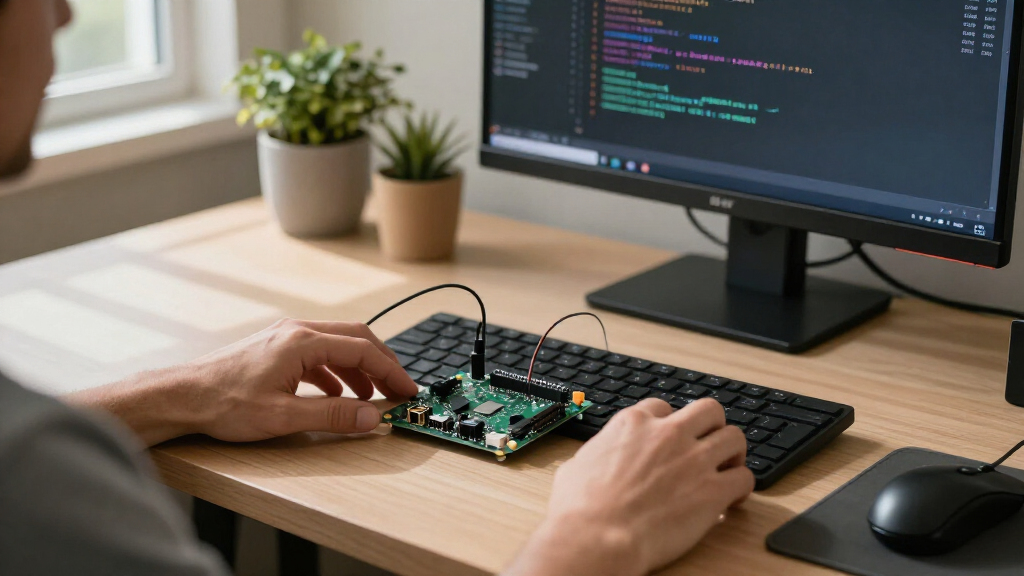
The workaround used an RP2040 board as a serial bridge and the bflb-mcu-tool utility. After modifying the tool and flashing a low-level M0 binary, the author received startup messages from the Ox64 on a computer. That output showed that the board was communicating over serial; it did not establish that Linux had booted. The writer said additional firmware for another core and the operating system image still needed to be flashed, and linked to a follow-up post without supplying its results in the report summarized here.
What the $8 Board Could—and Could Not—Do
The report matters as a snapshot of the gap between a strikingly low board price and the work needed to turn the hardware into a functioning Linux system. For hobbyists, the Ox64 offered a way to experiment with RISC-V hardware at a low stated cost. But the experience described was not plug-and-play: users needed serial hardware, a compatible host setup and changes to the flashing workflow just to reach an initial communication milestone.
The distinction between serial output and a Linux boot is central. Startup text can confirm that a chip has begun executing firmware and can send data, but it does not prove that the operating system, storage, networking or other components are working. The report therefore supports a limited conclusion: one user got as far as flashing a low-level binary and receiving output, while the broader Linux setup remained unfinished in that account.
That limitation affects how readers should interpret the $8 figure. The report does not establish the total cost of a usable setup, account for the serial adapter or other accessories, or say how much skill and time would be needed. Its detailed troubleshooting may still help technically experienced readers evaluate the board, but it is not evidence that the Ox64 was a complete, functioning Linux computer for every buyer.
Products Worth Considering

Logitech MX Keys S Combo Wireless Keyboard and Mouse, Graphite

Sonos Era 100 SL Compact Microphone-Free Speaker, Black

Bose SoundLink Plus Portable Bluetooth Speaker, Black
As an affiliate, we earn on qualifying purchases.
The Early BL808 Bring-Up
The report appeared during an early period of development for the Ox64 and BL808. Its author described a board with multiple RISC-V cores and a Linux target, but also warned readers that major interfaces were not working in the setup then available. Those status notes are time-specific and should not be treated as a statement about the board’s capabilities today.
The author’s path illustrates why initial board bring-up can involve several separate stages: establishing a programming connection, loading low-level firmware, confirming that the chip responds, and then bringing up additional cores and an operating system. In this case, the first programming route failed, the serial adapter handshake did not work, and the initial flashing utility was not usable without changes. The successful result was a modest but concrete step—receiving boot-related messages—rather than a completed Linux installation.
The post also points to a Part 2, indicating that the work was continuing. The material supplied for this article does not include that follow-up’s findings, so later progress cannot be inferred from the initial report alone.
“At the time of writing, ethernet, wifi and SD-Card are not working.”
— The Ox64 report’s author
Linux Boot and Hardware Status
The report does not confirm a Linux boot. It says the author still needed to flash software for the D0 core and then install the operating system, but gives no result for those steps. The linked Part 2 may contain further information, but its contents are not included in the source material used here.
It is also unclear how broadly the reported failures applied. The post documents one author’s setup, including Ubuntu on Wayland, particular serial hardware and specific tool versions; it does not establish that every Ox64 user faced the same problems or that all flashing tools behaved identically. The source gives no current status for Ethernet, Wi-Fi, SD-card support, availability or pricing, so its 2022 observations should not be presented as current product specifications.
The Remaining Steps to Linux
In the report, the next technical steps were to load the required firmware for the D0 core and flash the Linux operating system. Those steps would determine whether the initial serial communication could progress to a working system, but the initial post does not say whether they succeeded.
The author pointed readers to a follow-up installment. Without its details or more recent documentation, the outcome remains unresolved here: the confirmed milestone is serial output from a low-level firmware image, not a completed Linux computer. Any later assessment of the board’s operating-system support or connectivity would need to rely on dated follow-up testing or other current sources.
Key Questions
Did the report show Linux running on the Ox64?
No. The author received serial startup output after flashing a low-level binary, but said additional firmware and the operating system still needed to be loaded.
What was the Ox64’s stated price?
The report’s title and text describe it as an $8 computer. The source does not identify a seller or explain whether that amount included shipping, accessories or other costs.
How did the author connect to the board?
The author used the Ox64’s UART TX/RX pins and an RP2040 board as a serial bridge after a CH340G adapter failed to handshake in that setup.
Which features did the author say were not working?
At the time of the December 2022 post, the author said Ethernet, Wi-Fi and SD-card support were not working. The post does not establish their status today.
What remains unconfirmed?
The initial report does not confirm a successful Linux boot, the completion of the D0 firmware step, or the later status of the board’s networking and storage interfaces. It refers to a Part 2, but its results are not available in the supplied source material.