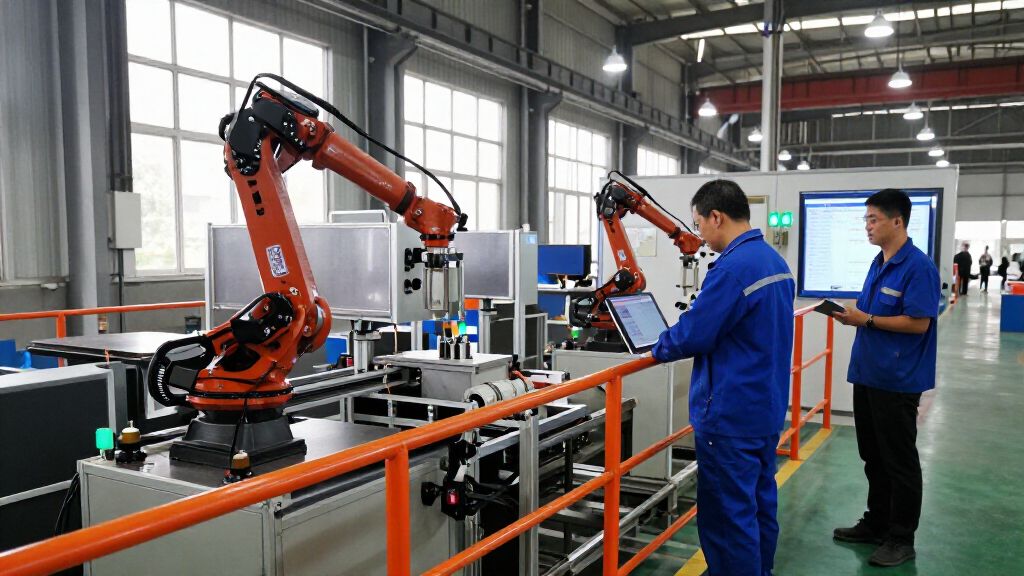

🔍 Read the full analysis: Factory Work’s Transformation In The Age Of AI on ThorstenMeyerAI.com

Get business pricing on monitors, keyboards and dev gear
- Business-only prices and quantity discounts
- Tax-exempt purchasing
- Multiple users, one account, clear invoices
TL;DR
A Nov. 8, 2026, report from ThorstenMeyerAI.com says U.S. factory employment fell from a record 19.6 million in June 1979 to a preliminary 12.7 million in October 2026, while manufacturing output nearly doubled over that period. The figures describe a long shift in factory work, not a direct measure of AI’s effects; the report also notes U.S. factory output remains below its 2007 peak.
U.S. factory employment stood at a preliminary 12.7 million jobs in October 2026, down about 35% from its June 1979 record, while factory output was nearly twice its 1979 level, according to a Nov. 8 report by ThorstenMeyerAI.com. The figures show how manufacturing has changed over decades, but they do not establish how much of the shift is due to artificial intelligence.
The report uses the Bureau of Labor Statistics’ payroll series, which counts jobs at employers outside farming and excludes self-employed workers and people employed in private households. In June 1979, the series recorded 19.553 million manufacturing jobs, its highest monthly level. By October 2026, the preliminary count was 12.7 million, or 8.0% of all U.S. payroll jobs.
Employment’s share of payroll jobs peaked much earlier: at 38.8% in November 1943, during World War II. The share was 21.7% in June 1979. The report says the number of jobs rose for decades even as manufacturing’s share declined, before the absolute count began its longer retreat.
Output followed a different path. The Federal Reserve’s manufacturing production index was 50.4 in June 1979 and 98.4 in September 2026, with 2017 set to 100. That is about 1.95 times the 1979 level. The report’s rough comparison of output with job counts suggests more output per job, but it does not account for hours worked. Output has also not continually risen: it peaked at 108.6 in December 2007 and remained about 9% below that level in September 2026.
Fewer Jobs, More Output
The gap between employment and production matters to workers, employers and communities that depend on manufacturing. The figures show that factory output and factory headcount can move in different directions: a country may produce more goods without employing as many factory workers. That difference complicates claims that a production rebound will automatically restore jobs lost over previous decades.
The report frames its subject as factory work in the age of AI, but the historical data it presents do not isolate AI’s role. Changes in technology, productivity, trade, demand and the composition of industry may all matter. Readers should treat the figures as evidence of a long-term transformation, not as proof that AI caused the job losses or that automation alone explains higher output.
The post-2007 record adds another qualification. While output was nearly twice its 1979 level, it remained below its 2007 peak in the latest month cited. So the long-run comparison does not mean that U.S. factory production has grown steadily, or that each worker’s output rose by the same amount in every period.
Products Worth Considering

DJI Osmo 360 Road Cycling First-Person Combo 360° Action Camera

Kindle Paperwhite Kids (2024), 16 GB, 7-inch Display, Cyber City Cover

Samsung Odyssey G7 40-Inch WUHD Curved Gaming Monitor (G75F)
As an affiliate, we earn on qualifying purchases.
How the Factory Job Count Changed
The BLS series begins in January 1939, when U.S. factories had about 9.1 million jobs, equal to 30.3% of payroll employment. During the war, factory employment climbed to 16.6 million in November 1943. Afterward, the share of jobs in manufacturing fell, but economic growth kept the number employed rising: the count reached about 18.4 million in January 1970 and its record in June 1979.
Job losses came in waves. Recessions in the early 1980s brought the count down to 16.7 million in December 1982, followed by a recovery. Between January 2000 and February 2010, employment fell from 17.3 million to 11.4 million—nearly six million jobs. The count later recovered somewhat, dropped during the 2020 pandemic shock and reached the preliminary October 2026 level reported above.
The report also compares the U.S. with Germany and China, while warning readers that national measures are not identical. Germany’s industry-and-construction share was 22.9% in 2025, compared with 49.2% for West Germany’s broader producing sector in 1965. China’s industry-and-construction employment peaked at 232 million in 2012, according to the report. These figures provide international context, not a like-for-like ranking.
“The number to remember is 19.6 million.”
— Thorsten Meyer, ThorstenMeyerAI.com
What the Historical Data Cannot Show
The October 2026 U.S. job count is preliminary, and the cited output measure is for September. The report does not provide a separate estimate of AI-related job losses, new jobs, or productivity gains. Its comparisons establish how employment and output changed over time, but do not identify the causes of those changes.
The estimate of roughly three times as much output per factory job since 1979 is described by the report as a rough calculation. It compares output with job counts, not hours worked, and should not be read as a precise measure of worker productivity. The report also says economists estimate that rising Chinese imports cost up to about one million U.S. factory jobs from 1999 to 2011, out of nearly six million lost; that is an attributed estimate, not a full explanation of the decline.
International comparisons also have limits because the countries’ sector definitions and statistical classifications differ. The report notes changes in Germany’s classifications, and its cited measures include industry and construction rather than manufacturing alone. How much current or future factory employment will be affected specifically by AI remains unclear from the evidence presented.
Watch Jobs and Output Separately
The next data points will update two different parts of the story: BLS releases will show whether the preliminary October 2026 employment estimate changes and how factory payrolls move, while Federal Reserve figures will track production. Comparing both measures over time can show whether recent shifts in factory output are accompanied by changes in employment.
To evaluate AI’s impact, readers will need evidence that identifies adoption and links it to specific workplace outcomes, rather than relying on decades-long manufacturing trends alone. The report does not give a timetable or forecast for such an assessment. Its immediate finding is narrower: the U.S. has fewer factory jobs than at its 1979 peak, output remains higher than in 1979, and production is still below its 2007 high.
Key Questions
How many people worked in U.S. factories at the 1979 peak?
The BLS payroll series recorded 19.553 million manufacturing jobs in June 1979, usually rounded to 19.6 million.
How many U.S. factory jobs were there in October 2026?
The report cites a preliminary count of 12.7 million, equal to 8.0% of all payroll jobs.
Has U.S. factory output returned to its 2007 peak?
No. The report says output in September 2026 was about 9% below its December 2007 peak, despite being nearly twice its June 1979 level.
Does the report show that AI caused factory job losses?
No. It documents long-term changes in jobs and output but does not isolate AI’s effect or establish that AI caused the decline.
Did all U.S. factory jobs lost after 1999 move to China?
No such conclusion is established. The report says the decline began before China joined the WTO and cites an estimate that rising Chinese imports cost up to about one million U.S. factory jobs from 1999 to 2011, out of nearly six million lost.
Source: ThorstenMeyerAI.com