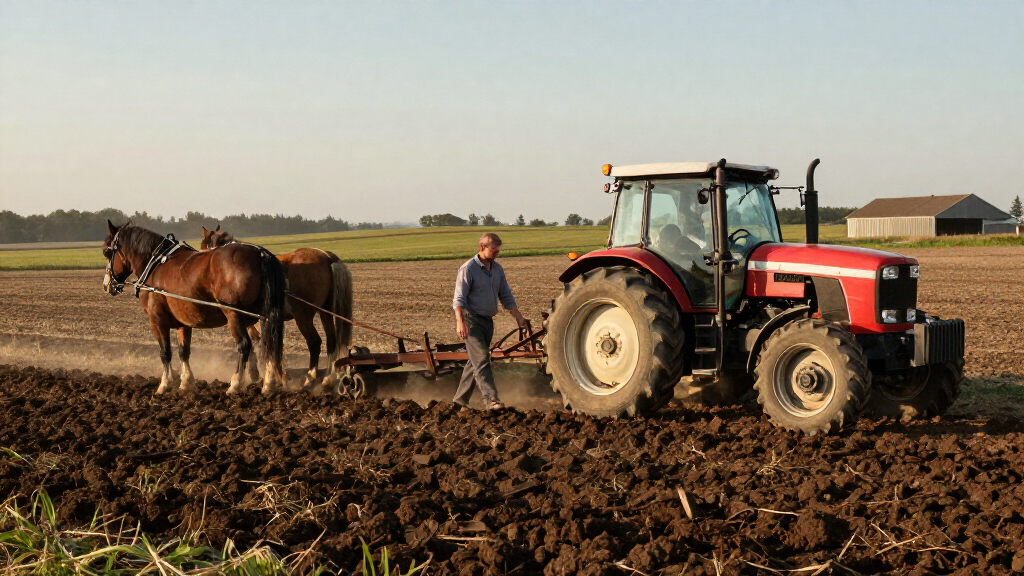

🔍 Read the full analysis: From 26.7 Million Working Animals To The Tractor Age on ThorstenMeyerAI.com

Get business pricing on monitors, keyboards and dev gear
- Business-only prices and quantity discounts
- Tax-exempt purchasing
- Multiple users, one account, clear invoices
TL;DR
U.S. farm horses and mules peaked at 26.7 million in 1918, then fell to 3.1 million by 1960 as tractor numbers rose and farm work changed. The figures, drawn from historical government statistics, show a major shift in agricultural technology and employment; they do not establish that human workers will follow the same path.
U.S. farms went from 26.7 million horses and mules in 1918 to about 3.1 million in 1960, as tractors and other machinery took over much of the work animals had done. A November 4 account by Thorsten Meyer, based on historical government statistics, examines the shift as an early large-scale example of automation—and cautions that comparisons with today’s human workers are an analogy, not a prediction.
The combined number of horses and mules on U.S. farms reached its high on January 1, 1918, according to Department of Agriculture estimates reproduced in the U.S. Census Bureau’s Historical Statistics of the United States, Colonial Times to 1970. Horses alone had peaked earlier, at 21.4 million in 1915. The animals powered farm equipment and transport, but they also required feed: an estimated 93 million acres of harvested cropland grew feed for them in 1915, out of 340 million harvested acres.
Tractor numbers rose sharply over the following decades. The account lists about 1,000 tractors in 1910, 246,000 in 1920 and 4.69 million in 1960. Meanwhile, the farm horse-and-mule count fell from 25.7 million in 1920 to 3.1 million in 1960. The two counts crossed around 1955, when the source reports 4.35 million tractors and 4.31 million horses and mules. The historical series uses census counts taken on somewhat different dates in some years.
Mechanization extended beyond tractors. The number of combine harvesters on U.S. farms rose from about 4,000 in 1920 to 1.042 million in 1960, according to the account. The Department of Agriculture estimated that each farm worker supplied 7.1 people in 1910 and 47.1 in 1970; that final figure includes people abroad supplied through exports. These measures describe changes in farm equipment and output, but do not by themselves show how gains were distributed among workers, farm owners or consumers.
How Mechanization Changed Farm Work
The decline of working animals was part of a broader restructuring of agriculture, not simply a swap of one engine for another. The source estimates that U.S. farm employment fell from 13.6 million in 1916 to 4.5 million in 1970, even as the overall U.S. labor force doubled. It says new jobs increasingly arose in cities, meaning many people had to move as the economy changed. The figures indicate the scale of the shift, though they do not establish that machinery alone caused every employment change.
Replacing animals also freed land previously used to grow their feed. The account puts that acreage at about five million acres in 1960, down from 93 million in 1915. That change illustrates one economic advantage of tractors: unlike a horse, a machine does not need to be fed when it is idle. The resulting land could instead be used to grow crops for people or sale. The source does not quantify the full economic value of that land or how benefits were shared.
The history matters to current debates about automation because it shows that a technology can remove a longstanding category of work while changing the industries and places where people work. But it cannot settle what will happen to workers affected by artificial intelligence or robotics. Human employment involves political rights, training, wages and choices that are not captured by a comparison between workers and farm animals.
Products Worth Considering

Bose TV Speaker Compact Soundbar with Bluetooth and HDMI-ARC, Black

Amazon Kindle Paperwhite (2024), 16 GB, 7-inch Display, Black

Anker SOLIX C300 Portable Power Station, 288Wh
As an affiliate, we earn on qualifying purchases.
From Farm Animals to Tractors
Before tractors became common, horses and mules supplied much of the power for ploughing, planting, harvesting and hauling. They were also a substantial claim on farm resources: the source estimates that in 1915 more than a quarter of U.S. harvested cropland was devoted to their feed. That acreage gives context for why machinery offered more than a replacement for animal muscle.
The account identifies the Fordson, launched by Ford in 1917, as an important step in making tractors accessible beyond the largest farms. The Henry Ford museum describes it as a mass-produced, inexpensive lightweight tractor designed for small farmers and says it became the most popular tractor in America. On February 21, 1920, the 100,000th Fordson left the assembly line, according to the source.
In a 1983 comparison cited by Meyer, economist Wassily Leontief likened workers to horses displaced by tractors. Leontief also identified a key limit to the analogy: horses could not vote. The account further notes that modern farm automation remains task-specific. It cites John Deere’s February 2025 announcement of a 16-camera autonomy kit for tillage on selected large tractors, and says China reported that about 74% of ploughing, sowing and harvesting was mechanized in 2023. Those examples concern particular technologies and measures, not complete automation of farming.
“The Fordson was “the first mass-produced and inexpensive lightweight tractor.””
— The Henry Ford museum, as quoted in Thorsten Meyer’s account
Limits of the Horse Analogy
The historical counts document a steep decline in farm horses and mules, but the source does not provide a detailed account of individual animals, farmers’ finances or the effects on every community. It says farmers generally stopped breeding replacements and the working population aged out; it does not describe this as one coordinated event. The annual estimates also ended soon after the period covered.
It remains uncertain how directly the experience applies to current automation. The article offers no evidence that today’s autonomous farm equipment can perform all agricultural tasks, or that its adoption will produce employment changes on the same scale or timeline. The cited Deere system is limited to tillage on selected large tractors, while China’s 74% figure covers mechanization of ploughing, sowing and harvesting in 2023; the source does not specify a common measurement method for comparing those examples.
The employment figures show that farm jobs declined while the wider labor force grew, but they do not trace the paths of displaced workers or distinguish the effects of machinery from other economic changes. The distribution of productivity gains and the conditions faced by people who moved to cities also remain outside the figures presented.
What Farm Automation Can Do Now
The next practical test is how quickly farm automation expands beyond specific uses such as tillage, and which farms can afford and operate it. The source’s cited examples establish that autonomous machinery is in use or being offered for particular tasks, but they do not provide adoption totals, performance comparisons or evidence that the equipment has replaced a broad range of farm jobs.
For readers assessing claims about automation, the historical record offers measurable milestones: animal counts, tractor numbers, acreage and farm employment. Any comparison with present-day technology will need similar detail on the tasks automated, the number of workers affected, the period measured and where new jobs appear. The account does not give a forecast for those outcomes.
The broader question raised by the episode is how workers and communities adapt when a technology changes the work an industry needs. The U.S. farm experience shows that such change can unfold over decades and coincide with a wider shift in employment. What happens next with driverless tractors, and whether their effects resemble that history, remains an open question.
Key Questions
How many horses and mules worked on U.S. farms at the peak?
The combined farm count peaked at 26.7 million on January 1, 1918, according to Department of Agriculture estimates reproduced in the U.S. Census Bureau’s historical statistics. Horses alone reached their high earlier, at 21.4 million in 1915.
How much did the farm horse and mule population fall?
The count fell from 26.7 million in 1918 to 3.1 million in 1960, according to the source. It attributes the decline to farmers stopping the breeding of replacements as machinery took over farm work.
When did tractors outnumber horses and mules?
The source places the crossover around 1955, reporting 4.35 million tractors and 4.31 million horses and mules. It notes that some tractor census figures were taken on different dates.
Does the history prove that automation will replace human workers?
No. The horse comparison is an analogy, not a forecast. The source notes that human workers differ from animals in political rights and does not establish how current automation will affect employment, wages or the creation of new jobs.
What can the cited autonomous farm equipment do?
The account cites a John Deere 16-camera autonomy kit announced in February 2025 for tillage on selected large tractors. It does not describe the system as capable of automating every farm task.
Source: ThorstenMeyerAI.com