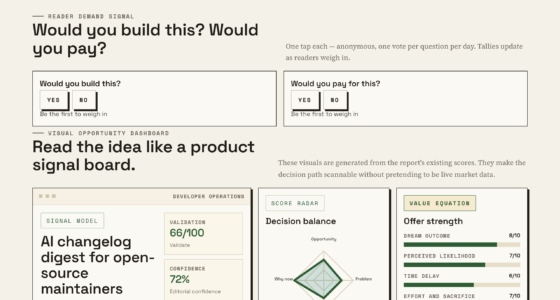
📊 Full opportunity report: SMB Marketplace Deal Matching: Pairing Buyers With Relevant Businesses on IdeaNavigator AI — validation score, market gap, and execution plan.

Get business pricing on monitors, keyboards and dev gear
- Business-only prices and quantity discounts
- Tax-exempt purchasing
- Multiple users, one account, clear invoices
TL;DR

A proposed small-business marketplace workflow would match buyers with businesses based on verified skills and experience, then send brokers fit-scored inquiries. IdeaNavigator AI has not reported a launched product or proven service; its suggested test is to compare outcomes across 500 listings and 100 buyer profiles.
IdeaNavigator AI has proposed a small-business acquisition marketplace that would match buyers to listings based on their verified operating skills and experience, rather than relying mainly on price and industry filters. In its proposal, IdeaNavigator AI targets individual buyers and brokers; it reports no deployed service, pilot results or evidence of improved deal conversions.
In the workflow described by IdeaNavigator AI, buyers would create a verified skills and experience profile. A marketplace would then score businesses for operational fit, explain why each listing matches a buyer, and pass brokers fit-scored inquiries instead of unqualified form submissions. The proposal identifies a narrow initial use: helping one buyer find businesses that align with what they can operate.
IdeaNavigator AI’s recommendation responds to a mismatch it identifies in how listings are commonly browsed. The proposal says platforms often organize businesses by price and industry, which may not show whether a buyer has the capabilities needed to run a particular company. It offers a marketing executive considering an agency as an illustration; this is an example in the proposal, not a documented transaction or measured customer outcome.
IdeaNavigator AI suggests testing the concept with 500 active listings and 100 buyer profiles. Under its plan, a test team would score listings against profiles, hand-deliver the strongest matches, and compare inquiry-to-letter-of-intent conversion with a marketplace baseline. The proposal also names buyer subscriptions and broker success fees on completed matched deals as possible revenue sources. It gives no pricing, projected revenue or evidence that either model has been adopted.
Testing Fit Beyond Listing Filters
If the matching approach works, it could help buyers focus on companies whose day-to-day demands suit their backgrounds and give brokers a way to prioritize inquiries with a clearer rationale. As described by IdeaNavigator AI, the proposed value is not simply more recommendations: it is a possible improvement in the relevance of buyer-business introductions, measured by whether more inquiries advance to a letter of intent.
For brokers, better-qualified inquiries could reduce time spent responding to buyers who lack relevant operating experience or are otherwise poorly matched. For buyers, explanations attached to recommendations could make it easier to assess why a business fits and where experience may fall short. These are potential benefits identified by the proposal, not established results. Its suggested comparison with a platform baseline is needed to determine whether matching adds value beyond ordinary search and broker judgment.
The commercial consequences would depend on what the test measures and how the service is implemented. A high match score would not itself establish a business’s financial health, fair price, or suitability for a buyer’s financing and personal circumstances. The proposal focuses on operating fit, leaving those other dimensions to diligence and the parties involved.
small business operational skills assessment tools
As an affiliate, we earn on qualifying purchases.
As an affiliate, we earn on qualifying purchases.
A Proposed Pilot, Not a Launch
IdeaNavigator AI frames the idea as a narrow first-win workflow for individual buyers searching for businesses and brokers seeking qualified prospects. The proposal does not present it as a broad replacement for existing listing marketplaces, and it does not identify a company building or operating the service.
The proposal argues that an aging population of business owners preparing to retire could add businesses to the market, and that matching by operator skills may now be automatable. These are the rationale IdeaNavigator AI offers for testing the concept; it supplies no figures on listings, retiring owners, software capabilities or market growth. Its plan is to begin with manual delivery of top matches, allowing the approach to be evaluated before relying on a fully automated product.
business matching platform software
As an affiliate, we earn on qualifying purchases.
As an affiliate, we earn on qualifying purchases.
Conversion Results Remain Unknown
IdeaNavigator AI has not documented a pilot or stated whether a marketplace, broker or buyer group has agreed to participate. Its proposal also does not define how skills would be verified, what information buyers and sellers would need to provide, or how the scoring system would weigh different forms of experience.
The proposed test names a sample of 500 listings and 100 buyer profiles, but IdeaNavigator AI provides no timeline, comparison results or baseline conversion rate. The proposal also does not explain how a test would account for differences in listing quality, buyer readiness, financing, geography or broker practices. Without those details, readers cannot assess whether skill matching would cause any change in outcomes or how large that change might be.
business broker inquiry management tools
As an affiliate, we earn on qualifying purchases.
As an affiliate, we earn on qualifying purchases.
The Proposed Test Measures Offers
In the plan outlined by IdeaNavigator AI, the next step is to assemble the listing and buyer samples, score their operational fit, and manually deliver the highest-ranked matches. The test would then track whether introductions generate inquiries and advance to letters of intent, comparing those results with a platform baseline.
IdeaNavigator AI provides no schedule or next public milestone. The central question for a follow-up is whether the pilot produces measurable improvement, and whether buyers and brokers consider the match explanations useful enough to support a continuing service. Any claims about effectiveness or commercial viability would require results from such a test.
Source: IdeaNavigator AI proposal
small business experience verification services
As an affiliate, we earn on qualifying purchases.
As an affiliate, we earn on qualifying purchases.
Key Questions
Has a skill-matching marketplace for small-business sales launched?
IdeaNavigator AI describes a proposal, not a launched product. Its available information provides no company, release date or operating marketplace.
How would the proposed matching work?
Under IdeaNavigator AI’s proposal, buyers would create profiles of verified skills and experience. The platform would score listings for operational fit, explain the matches and send brokers fit-scored inquiries.
What would the proposed pilot measure?
IdeaNavigator AI suggests comparing inquiry-to-letter-of-intent conversion after scoring 500 listings against 100 buyer profiles with a platform baseline. It has provided no results or baseline rate.
How might the service make money?
IdeaNavigator AI’s proposal identifies buyer subscriptions and broker success fees on completed matched deals as possible revenue sources. Pricing and actual adoption are unspecified.
Would a skills match replace financial due diligence?
No. The concept described by IdeaNavigator AI addresses operational fit; it does not establish a business’s financial condition, value, financing availability or suitability. Those issues would still require separate review.
Source: IdeaNavigator AI
Halloween Picks
halloween
As an affiliate, we earn on qualifying purchases.