
📊 Full opportunity report: How To Structure A Trust Funding And Retitling Tracker on IdeaNavigator AI — validation score, market gap, and execution plan.

Get business pricing on monitors, keyboards and dev gear
- Business-only prices and quantity discounts
- Tax-exempt purchasing
- Multiple users, one account, clear invoices
TL;DR
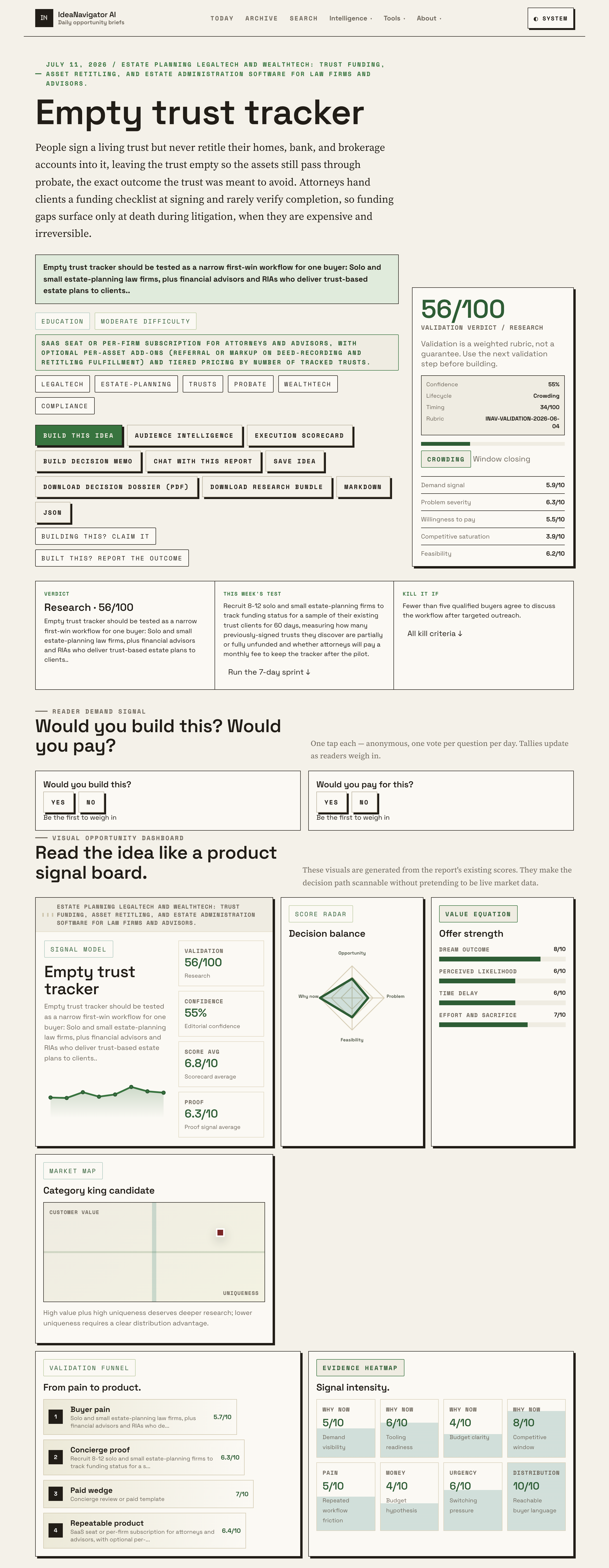
IdeaNavigator AI has published a product blueprint for a trust funding and retitling tracker aimed at solo and small estate-planning law firms and financial advisors. The proposal targets the well-documented gap between signing a living trust and actually retitling assets into it, which can leave trusts empty and force assets through probate.
A new product blueprint from IdeaNavigator AI argues that solo and small estate-planning law firms — along with financial advisors and RIAs who deliver trust-based plans — should adopt a trust funding and retitling tracker as a narrow, high-value first workflow. The proposal responds to a persistent problem: clients sign living trusts but never retitle their homes, bank, and brokerage accounts into them, leaving the trust empty and pushing assets back through probate, the exact outcome the trust was meant to avoid.
According to the IdeaNavigator AI analysis, the core failure point is procedural rather than legal. Attorneys typically hand clients a funding checklist at signing and rarely verify completion afterward. As a result, funding gaps surface only at death, often during litigation, when they are expensive and irreversible. The analysis positions this as an unaddressed step that existing document-drafting software does not close, because trust funding remains a manual, fragmented process spread across county recorder offices, banks, and brokerages.
The proposed MVP is a client-by-client tracker. Attorneys or advisors would create a funding checklist per trust covering real estate, bank accounts, brokerage accounts, retirement accounts, business interests, and beneficiary designations. Each asset would carry a status — pending, in-progress, or confirmed funded — with proof attached, such as a recorded deed or a retitled account statement. Automated reminders would go to clients, and a firm-level dashboard would show the book of trusts by percent funded, letting partners flag dangerously empty trusts before a client dies.
On monetization, the analysis proposes a SaaS seat or per-firm subscription for attorneys and advisors, with optional per-asset add-ons such as referral fees or markups on deed-recording and retitling fulfillment, plus tiered pricing based on the number of tracked trusts. It cites per-deed funding services already priced from $250 as evidence a paid market exists that a software layer could sit on top of. The addressable market is framed as estate planning legaltech and wealthtech — trust funding, asset retitling, and estate administration software.
Why Empty Trusts Cost Firms and Heirs
The problem matters because an unfunded trust provides no probate protection, yet the client typically believes the estate plan is complete. For law firms, funding gaps discovered post-death can become malpractice exposure and family litigation. For advisors and RIAs, the analysis notes that firms are racing to bundle funded estate plans into client offerings in 2026, and a verifiable funding record is a differentiator that raw document drafting does not provide.
The market context sharpens the case. Per IdeaNavigator AI, estate planning adoption and digital tooling are surging in 2026, yet only about 11% of Americans hold a trust — a figure the analysis presents as its own estimate of current penetration. That combination, per the analysis, means both demand and headroom are growing while the funding step remains manual. A tracker that surfaces unfunded trusts before death converts an irreversible, litigation-prone failure into a routine operational task.
The Funding Gap Document-Drafting Tools Miss
Living trusts avoid probate only for assets titled in the trust’s name. Retitling real estate requires recording a new deed; financial accounts require retitling forms and updated beneficiary designations. The IdeaNavigator AI analysis states that current document-drafting software focuses on generating the trust instrument itself and stops at the checklist stage, leaving verification to memory and client follow-through.
The analysis also identifies a changed commercial landscape: third-party services now handle individual deed transfers at published prices starting around $250, which means a software layer can orchestrate and verify fulfillment rather than build it from scratch. That, per the analysis, is what makes a tracker viable for solo practitioners who lack operations staff.
Unverified Numbers and the Pilot Question
The proposal is a plan, not a shipped product, and its central claims are untested. The 11% trust-holding figure comes from the analysis itself and is not independently sourced, dated, or methodologically described. The $250 per-deed pricing point is presented without a named vendor, so current market rates should be verified before being relied on.
Most importantly, two assumptions are unproven: whether attorneys and advisors will discover enough partially or fully unfunded trusts in their existing books to justify the effort, and whether they will pay a monthly subscription once the pilot ends. The analysis does not cite pre-orders, design partners, or survey data, and no firm has publicly committed to testing the workflow.
The 60-Day Firm Pilot
The proposed validation step is to recruit 8–12 solo and small estate-planning firms and have them track funding status for a sample of their existing trust clients over 60 days. Two metrics would decide go or no-go: how many previously signed trusts turn out to be partially or fully unfunded, and how many attorneys pay a monthly fee to keep the tracker after the pilot ends.
Observers of the legaltech space can watch for early signals: pilot announcements from estate-planning firms, per-asset pricing from deed-recording services, and whether existing document-drafting platforms add native funding-status features — a development that would compress the window for a standalone tracker.
Source: IdeaNavigator AI
Key Questions
What is an empty or unfunded trust?
A living trust that was legally signed but whose assets — a home, bank accounts, brokerage accounts — were never retitled into the trust’s name. Untitled assets generally do not pass under the trust and may go through probate despite the trust existing.
Who is the proposed tracker for?
Per the IdeaNavigator AI analysis: solo and small estate-planning law firms, plus financial advisors and RIAs who deliver trust-based estate plans to clients.
How would the tracker work day to day?
Each trust gets a checklist of asset categories, each asset gets a status of pending, in-progress, or confirmed funded with proof attached (such as a recorded deed), clients receive automated reminders, and a dashboard shows each firm’s book of trusts by percent funded.
How would it make money?
A SaaS seat or per-firm subscription, with optional per-asset add-ons such as referral or markup revenue on deed-recording and retitling fulfillment, and tiered pricing by the number of trusts tracked.
Has this been validated?
No. The next step is a 60-day pilot with 8–12 firms to measure how many existing trusts are unfunded and whether attorneys will pay to keep the tracker afterward. Market-size and pricing figures come from the analysis and are not independently verified.
Source: IdeaNavigator AI
Fall Picks
fall essentials
As an affiliate, we earn on qualifying purchases.