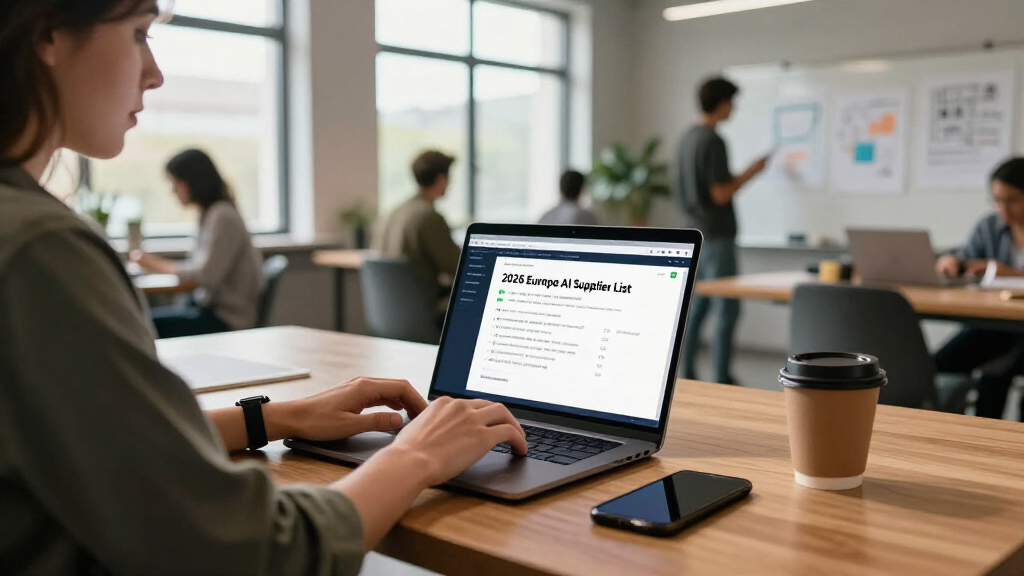

🔍 Read the full analysis: The 2026 Europe AI Supplier List: Leading Companies Revealed on ThorstenMeyerAI.com
Open a free Amazon Business account
Business pricing, bulk buying and tax-exempt orders.
Create a free accountAs an affiliate, we earn on qualifying purchases.
TL;DR
The 2026 European AI supplier list has been published, revealing the leading companies based on ownership, certification, and sovereignty criteria. Major firms like Mistral AI, Cohere, Helsing, and Nscale are featured, illustrating Europe’s strategic AI landscape.
The 2026 Europe AI Supplier List has been officially published, revealing the top companies that meet European sovereignty and procurement criteria. This list is significant for policymakers and buyers seeking to ensure control, compliance, and strategic independence in AI procurement. The list highlights companies that are considered most aligned with European standards on ownership, certification, jurisdiction, weights, and exit options.
Among the key players, Mistral AI from France stands out with a valuation above $3.05 billion and ownership rooted in France, supported by notable investors including Nvidia and IBM. It is the only European lab with full-stack ambitions, covering models, Forge, compute, and agents, with a target of approximately 1 GW of compute capacity by 2030. Its ownership structure, primarily French, aligns with sovereignty goals, and it holds the strongest certification position, being SecNumCloud-eligible in principle.
Another prominent company, Cohere–Aleph Alpha, based in Toronto and Heidelberg, has a combined valuation near $20 billion. It is the only supplier on the list with public ownership data, showing roughly 90% ownership by shareholders, but it fails the EU ownership cap due to non-EU investors. It holds a BSI C5 certification, providing jurisdictional clarity, and is suitable for German public-sector and enterprise markets, though less so for French procurement due to ownership concerns.
Helsing, based in Munich, is Europe’s most valuable defense-tech company, with an estimated valuation of €12 billion and a reported 80% European ownership ratio. It is the only company publicly confirming its ownership percentage, making it a model for transparency. Helsing has secured initial contracts under Germany’s HX-2 framework and has expanded through acquisitions like Keybotic, with a focus on defense applications and submarine detection. Its ownership transparency is a notable feature amid a landscape often lacking such disclosures.
In the infrastructure domain, Nscale, a UK-based firm, raised $2 billion in March 2026 at a valuation of $14.6 billion, making it the largest European AI infrastructure funding round. Its partnership with OpenAI on Stargate UK and Stargate Norway illustrates a model where European infrastructure hosts American frontier compute, blurring lines between sovereignty and capacity. The list also includes Harmattan AI, backed by Dassault Aviation, with a valuation of $1.4 billion, emphasizing defense industry involvement in AI development.
Europe’s AI suppliers: the 2026 shortlist
Eleven articles argued that ownership is the only real sovereignty test, certifications mostly measure practice rather than control, and “not American” is a proxy. Those were arguments. This is the list — every supplier a European buyer might shortlist, scored on ownership · certification · jurisdiction · weights · exit.
For almost every company here, the ownership answer is not public. That’s nobody’s scandal — private companies don’t publish cap tables. But it means Europe’s sovereignty debate is being conducted without the one number its own rules turn on (24% individual / 39% collective non-EU). Two exceptions: the SecNumCloud-qualified tier, which has been audited — and Helsing, which publishes.
Defence · classified · DORA · national health data. Your shortlist is short: the SecNumCloud tier, S3NS or Bleu for hyperscaler capability, Mistral for models, Helsing for defence AI. Pay the premium and stop apologizing for the benchmark gap — your alternative isn’t a worse model, it’s no deployment.
Use the best model available, put a router in front of it, and spend the difference on shipping. That argument survived its own steelman and nothing on this page changes it. Everything above the router line, buy only if a law requires it.
Europe’s specialists are excellent and under-celebrated — FLUX, Helsing, ElevenLabs, DeepL, Wayve, Legora are category leaders, not consolation prizes. The generalist race is over as a European story: one French champion with a real jurisdictional edge and a real capability gap, one Canadian-controlled entity with the politics and the balance sheet. Everything else is specialization — the correct strategy, and it should be said out loud rather than treated as retreat. And the ownership data doesn’t exist. Europe built a regime that turns on 24%/39% — then built an industry where almost nobody publishes that number. It’s fixable tomorrow, cheaply: publish your non-EU capital and voting share, update it each round. The ones that do will win procurement they’d otherwise lose. The ones that don’t are telling you something.
Strategic Control and Sovereignty in European AI
This list underscores the importance of ownership transparency, certification standards, and jurisdictional clarity for European AI sovereignty. It highlights how leading companies are aligning with European procurement rules, which prioritize control over AI assets and data. The presence of major international investors in European firms reflects ongoing challenges and opportunities in balancing global capital with regional sovereignty goals. For policymakers, the list provides a benchmark for assessing future AI procurement strategies and fostering a resilient, autonomous AI ecosystem within Europe.
As an affiliate, we earn on qualifying purchases.
European AI Landscape and Procurement Criteria
Over the past year, European policymakers have emphasized sovereignty in AI procurement, focusing on ownership, jurisdiction, and control. The 2026 list builds on previous debates about the role of foreign investment, certification practices, and physical infrastructure. Notably, ownership transparency remains elusive for many companies, as private firms typically do not publish cap tables, complicating sovereignty assessments. The list reflects a strategic effort to identify companies that meet strict criteria, including ownership within Europe, certification compliance, and control over data and models.
Historically, European AI development has been fragmented, with significant reliance on non-EU capital and infrastructure. Recent policy initiatives aim to foster local innovation, reduce dependency, and ensure strategic autonomy. The list reveals a landscape where defense, infrastructure, and large-scale models are prioritized, with companies like Helsing and Nscale exemplifying this shift. The ongoing debate about sovereignty versus capacity continues to shape procurement policies and industry investments.
As an affiliate, we earn on qualifying purchases.
Remaining Questions on Ownership and Control
While some companies like Helsing publish ownership figures, many others do not, leaving uncertainties about actual control and sovereignty. The future ownership structure of firms like Cohere–Aleph Alpha, which has a high proportion of non-EU investors, remains unclear. Additionally, the impact of future funding rounds on ownership ratios and control is unpredictable, especially for privately held firms. Certification compliance and jurisdictional authority also continue to be areas of ongoing assessment, with some companies still awaiting final certification or legal clarity.
As an affiliate, we earn on qualifying purchases.
Next Steps for European AI Procurement and Industry Growth
European policymakers are expected to refine procurement criteria further, emphasizing ownership transparency and sovereignty metrics. Companies on the list will likely pursue additional certifications and disclose ownership details to meet evolving standards. Industry investments may shift toward firms that demonstrate clear control and compliance, fostering a more autonomous AI ecosystem. Additionally, ongoing discussions about infrastructure sovereignty and cross-border hosting will influence future capacity building and strategic partnerships. Monitoring these developments will be crucial as Europe seeks to balance innovation with sovereignty.
As an affiliate, we earn on qualifying purchases.
Key Questions
Which companies are the most transparent about ownership?
Helsing is currently the most transparent, publicly confirming its approximately 80% European ownership ratio, setting a standard for disclosure in the industry.
Why is ownership transparency so important for European AI sovereignty?
Ownership transparency allows policymakers and procurement officials to verify control, prevent undue foreign influence, and ensure compliance with sovereignty standards essential for strategic autonomy.
What are the main challenges companies face in meeting European sovereignty criteria?
The primary challenges include limited public disclosure of ownership structures, the complexity of cross-border investments, and certification hurdles that test practice versus control.
How might this list influence future AI procurement policies?
The list sets a benchmark for transparency and control, encouraging companies to disclose ownership and pursue certifications aligned with European standards, ultimately shaping procurement strategies.
Will non-European investors be excluded from future lists?
Not necessarily; the focus is on ownership control and transparency. Companies with significant non-EU investment can still qualify if they meet sovereignty criteria and disclose ownership details.
Source: ThorstenMeyerAI.com
Fall Picks
fall essentials
As an affiliate, we earn on qualifying purchases.