
📊 Full opportunity report: The City That Watches Itself: The Living Digital Twin, And The God’s-Eye View We’re Building on ThorstenMeyerAI.com — validation score, market gap, and execution plan.
TL;DR
Cities are increasingly creating dynamic digital twins that monitor and simulate urban environments in real time. This development combines sensors, satellite data, and AI to improve planning but also raises privacy concerns. The story is ongoing as technology advances and governance questions emerge.
Urban digital twins are evolving into live, AI-enabled models that can monitor, simulate, and answer questions about city life in real time. This technological leap is driven by the convergence of sensors, satellite imagery, and frontier AI, creating a system that not only aids city planning but also functions as a powerful surveillance instrument. The development is happening now across multiple cities, with significant implications for governance and privacy.
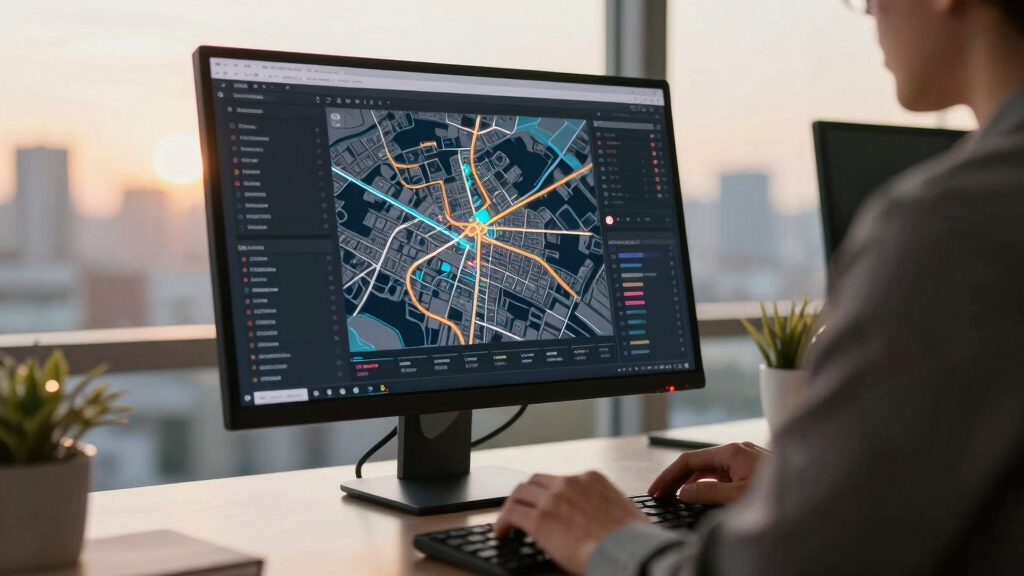
Most cities already use static digital twins for planning, modeling infrastructure, and simulating scenarios. These models integrate data from IoT sensors, GIS, and satellite imagery to provide a real-time virtual replica. Cities like Singapore, Helsinki, and Las Vegas are already employing such systems for operational management, yielding cost savings and efficiency gains.
The recent breakthrough is the integration of Wide-Area Motion Imagery (WAMI) sensors, which enable continuous, wide-area surveillance of vehicle and pedestrian movement. When fused into the twin, these sensors allow cities to rewind, analyze, and understand traffic and activity patterns in granular detail. Layered with all-weather radar and satellite data, the resulting multi-sensor model offers a comprehensive view of urban dynamics, day and night, regardless of weather conditions.
The key technological leap is the advent of frontier AI models capable of processing heterogeneous data streams, recognizing complex patterns, and enabling natural language queries. This transforms the digital twin from a static planning tool into an interactive oracle that can answer detailed questions about city operations, simulate emergencies, and support decision-making in real time. However, this also raises concerns about the potential for misuse and privacy violations, as the system can track individual movements and behaviors.
The city that watches itself: the living digital twin, and the god’s-eye view we’re building
Soon most cities will exist twice — once in concrete, once as a live data model you can rewind, simulate, and question in plain language. Persistent sensing + frontier AI turn the planner’s digital twin into an oracle. The most useful thing we’ve built — and the most powerful surveillance instrument. Both at once.
- Plan better — cities & rural: traffic, zoning, energy, land use
- Emergency response — route crews, one live picture, ~50% faster
- Disaster resilience — simulate, track live, assess damage in hours
- Mass surveillance — track everyone, retroactively, forever
- Pattern-of-life — AI links movements, infers associations
- Social control — no warrant, no suspicion (cf. Baltimore, 2021 ruling)
We’re building a city that watches itself, remembers everything, and can be asked anything. The technology won’t choose between saving lives and ending privacy — we will, through the rules we write now, while the twin is still under construction and the defaults haven’t yet hardened into permanence. WAMI and the living twin open our lives to a view from the heavens that, from the dawn of civilization until a heartbeat ago, was reserved for gods and stars. The question is no longer whether we can see everything — it’s who gets to look, and who watches the watchers.
Impacts on Urban Planning and Surveillance Power
The development of live, AI-powered digital twins represents a major shift in how cities manage and understand their environments. They promise more efficient planning, faster response to crises, and better resource allocation. However, the same capabilities also turn these systems into powerful surveillance tools, raising questions about privacy, sovereignty, and control. The potential for misuse by governments or foreign entities underscores the need for regulatory oversight and ethical considerations.

Geodesign, Urban Digital Twins, and Futures
As an affiliate, we earn on qualifying purchases.
As an affiliate, we earn on qualifying purchases.
Progression of Digital Twin and Surveillance Technologies
The concept of digital twins in urban management has been evolving over the past decade, with cities like Singapore pioneering large-scale implementations. Initial models were static and limited to infrastructure planning. The recent integration of WAMI sensors and frontier AI signifies a new phase, transforming these models into real-time, interactive systems capable of detailed activity monitoring. The technology’s convergence aligns with broader trends in smart city development and AI capabilities, but also introduces new risks related to privacy and sovereignty.
“The city as a living data model is a double-edged sword — it can vastly improve urban life or become an unprecedented surveillance apparatus.”
— Thorsten Meyer, AI researcher

Chiffonade GY-SGP30 Air Quality Sensor Module – I2C Interface eCO2 Detector for IoT & Smart Home Applications, 2V-5V Compatible
Integrated Multi-Gas Sensor: Features four sensing components on a single chip for comprehensive air quality monitoring including eCO2…
As an affiliate, we earn on qualifying purchases.
As an affiliate, we earn on qualifying purchases.
Unresolved Issues and Risks of Self-Monitoring Cities
It is still unclear how widespread the adoption of AI-powered digital twins will become and how governments will regulate their use. Concerns about privacy, data sovereignty, and potential misuse by malicious actors remain unresolved. The extent to which these systems can or should be used for surveillance outside of urban management is a subject of ongoing debate, with legal and ethical frameworks still evolving.

Deep Learning for Satellite Imagery with Python: End-to-End Workflows for Image Analysis, Object Detection, and Change Monitoring
As an affiliate, we earn on qualifying purchases.
As an affiliate, we earn on qualifying purchases.
Future Developments and Regulatory Considerations
The next steps involve broader deployment of AI-enhanced digital twins across cities worldwide, alongside the development of governance frameworks to address privacy and security concerns. Technological advancements will likely improve the system’s accuracy and capabilities, but policymakers and civil society will need to establish boundaries for surveillance and data use. Monitoring how these systems influence urban governance and civil liberties will be crucial in the coming years.

Towers: The Rising
As an affiliate, we earn on qualifying purchases.
As an affiliate, we earn on qualifying purchases.
Key Questions
What is a digital twin in urban management?
A digital twin is a virtual, real-time model of a city that integrates data from sensors, satellite imagery, and other sources to simulate and analyze urban environments and infrastructure.
How do AI and sensors improve city monitoring?
AI processes heterogeneous data streams to recognize patterns and answer complex queries, while sensors like WAMI provide continuous, wide-area surveillance, enabling detailed activity tracking.
What are the privacy concerns associated with these systems?
These systems can potentially track individual movements and behaviors, raising issues about surveillance, data security, and civil liberties, especially if misused or poorly regulated.
Are all cities adopting these technologies?
No, adoption is currently concentrated in a few pioneering cities like Singapore and Las Vegas, with broader use contingent on technological, political, and regulatory developments.
What legal frameworks are in place for these systems?
Legal frameworks are still evolving, with many jurisdictions lacking specific regulations governing the use of AI-powered surveillance and digital twins in urban environments.
Source: ThorstenMeyerAI.com