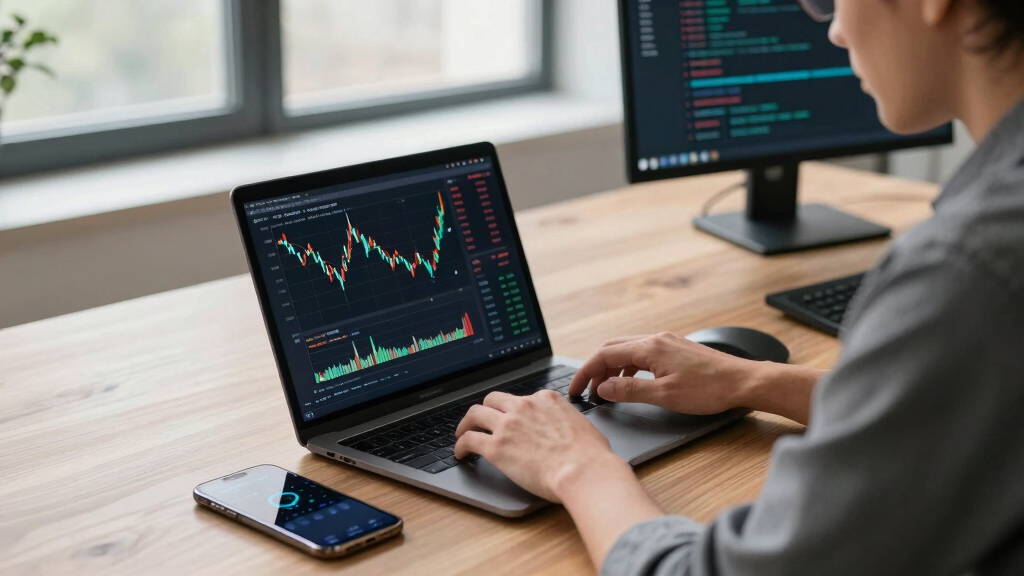

📊 Full opportunity report: Week Three — Foundation model vs Brownian motion. Kronos on five-minute BTC. on ThorstenMeyerAI.com — validation score, market gap, and execution plan.

Get monitors, keyboards and dev gear delivered free — and shop member deals
- Fast, free delivery on millions of items
- Access to Prime Big Deal Days deals on October 6–7
- Prime Video, Amazon Music and more included
TL;DR
A recent test shows that Kronos, a large foundation model, does not outperform the traditional Brownian motion model in predicting 5-minute Bitcoin price movements. The study used real trading data and found no significant advantage for the AI model over the classic approach, questioning its immediate trading utility.
Recent testing shows that Kronos, a large open-source foundation model for financial time series, does not outperform the traditional Brownian motion model in predicting 5-minute Bitcoin price movements, based on out-of-sample data.
Over the past two weeks, a researcher conducted an extensive offline comparison of Kronos-small against a Brownian motion baseline using historical trading data from Polymarket’s 5-minute BTC markets. The test involved 497 paired trades, reconstructing market context and evaluating each model’s predictive accuracy through metrics like Brier score, log-loss, and hypothetical profit and loss.
The results showed that Kronos’s predictive performance was statistically indistinguishable from Brownian motion on out-of-sample data, with Brier scores of 0.189 for Kronos and 0.188 for Brownian motion. The market-implied probabilities fell in between, slightly favoring the traditional model. Consequently, the study concluded that the modern foundation model did not provide a measurable edge over the classical approach in this specific trading horizon.
As a result, the researcher determined that integrating Kronos into the trading bot as a live strategy is not justified based on current evidence, challenging assumptions that AI models inherently outperform traditional stochastic models in short-term crypto prediction.
Implications for AI-based Trading Strategies
This finding questions the assumption that large foundation models automatically deliver superior predictive power in short-term financial markets. For traders and developers, it underscores the importance of rigorous out-of-sample testing before deploying AI models in live trading, especially in highly volatile assets like Bitcoin. The results also suggest that traditional models like Brownian motion remain competitive in certain contexts, and that more complex AI models may require further refinement or different applications to demonstrate tangible advantages.
Bitcoin 5-minute trading indicator
As an affiliate, we earn on qualifying purchases.
As an affiliate, we earn on qualifying purchases.
Background on Model Testing and Market Expectations
Over recent years, the trading community has increasingly turned to AI and machine learning models, believing they can uncover subtle patterns in market data beyond traditional stochastic models. Kronos, a prominent open-source foundation model trained on millions of candlesticks from global exchanges, was developed with the expectation that it could outperform classical approaches like Brownian motion in short-term forecasting.
Previous experiments with AI in trading have yielded mixed results, often limited by overfitting or in-sample biases. The current study aimed to rigorously test Kronos’s out-of-sample predictive power against a well-understood baseline, using real trading data from Polymarket’s 5-minute BTC markets, to assess whether it offers a genuine edge.
“The modern foundation model Kronos does not outperform the traditional Brownian motion in short-term Bitcoin prediction, based on rigorous out-of-sample testing.”
— Thorsten Meyer
As an affiliate, we earn on qualifying purchases.
Remaining Questions on Model Performance and Future Tests
It remains unclear whether different model configurations, training data, or market conditions could enable Kronos or similar models to outperform traditional approaches. Additionally, the current test focused solely on 5-minute BTC predictions; other horizons or assets might yield different results. Further research is needed to determine if AI models can be optimized for real-world trading advantages or if their current limitations are fundamental.
As an affiliate, we earn on qualifying purchases.
Next Steps in Evaluating Foundation Models for Trading
Future research could explore alternative model architectures, larger datasets, or different market conditions to assess whether foundation models like Kronos can be refined to deliver genuine trading edges. Additionally, real-time live testing and integration with trading systems may provide further insights into their practical utility. For now, traders should approach AI-based predictions with caution, emphasizing rigorous validation over assumptions of superiority.
As an affiliate, we earn on qualifying purchases.
Key Questions
Does this mean AI models are useless for trading?
No, this specific test shows that Kronos did not outperform traditional models for 5-minute BTC predictions. AI models may still have value in other contexts or with further development.
Can Kronos be improved to outperform Brownian motion?
Potentially, but current evidence suggests significant challenges. Further research and model refinement are needed to realize any practical advantage.
Is traditional Brownian motion still relevant?
Yes, in short-term trading contexts like this, it remains a robust baseline against which to compare more complex models.
What does this mean for AI trading strategies?
It underscores the importance of rigorous out-of-sample testing and cautions against assuming that larger or newer models automatically provide an edge.
Source: ThorstenMeyerAI.com
Halloween Picks
halloween
As an affiliate, we earn on qualifying purchases.