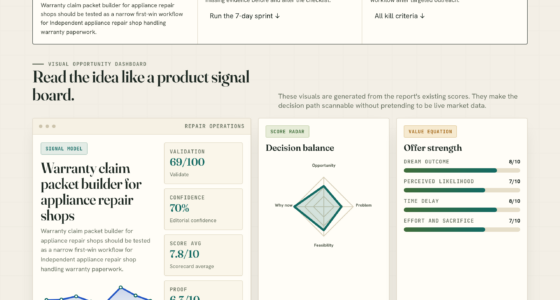
📊 Full opportunity report: Invoice Auditing For Restaurant Groups: A Practical Approach on IdeaNavigator AI — validation score, market gap, and execution plan.

Get business pricing on monitors, keyboards and dev gear
- Business-only prices and quantity discounts
- Tax-exempt purchasing
- Multiple users, one account, clear invoices
TL;DR
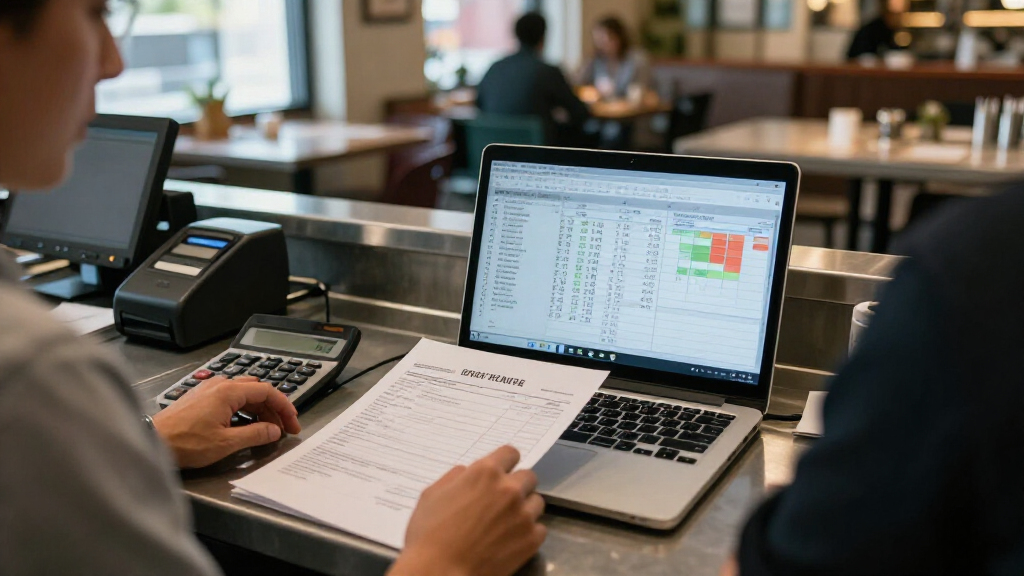
A proposal from IdeaNavigator AI outlines a software workflow to compare supplier invoices with contracts, orders and deliveries, flagging possible overcharges and billing discrepancies. It recommends testing the approach against 90 days of paid invoices at three groups before deciding whether recovered credits justify a subscription.
An IdeaNavigator AI proposal describes a supplier-invoice auditing workflow for independent restaurant groups. The system would compare each billed line with agreed prices, purchase orders and recorded deliveries, then track requests for credits. The proposal recommends testing the product with three restaurant groups using a 90-day review of paid invoices before setting a subscription price or expanding the service.
According to the IdeaNavigator AI proposal, the workflow is aimed at a specific buyer: a purchasing director or controller at a multi-location restaurant group that buys from broadline and specialty food and beverage suppliers. The proposed system would accept electronic invoices where available, along with PDFs or photos processed using optical character recognition. It would also load supplier contracts or quote sheets and the group’s order guide.
For each invoice line, the system would compare what was ordered, received and billed with the agreed price. The proposal says it would flag potential cases such as a contract price not being applied, a short shipment billed as a full case, a substitution charged at a higher price, or a line price rising between orders. It would draft a credit request for the supplier and record whether a credit later appears on an invoice.
The proposal suggests charging a monthly fee per location, with an optional contingency fee tied to credits recovered. It does not report that a product has been built, that restaurant groups have adopted it, or that any particular amount has been recovered. Those are questions for the proposed pilot, not established results.
Invoice Auditing for Restaurant Groups: A Practical Approach
An IdeaNavigator AI proposal outlines a workflow to compare supplier invoices with contracts, orders and deliveries. A limited pilot would test whether documented credits justify the service cost.
What the workflow checks
The proposed system compares what was ordered, received and billed against agreed supplier prices.
Contract mismatch
Flag a billed price that does not match the contract or quote sheet.
Short shipment
Identify a full case charge when records show fewer goods arrived.
Substitutions and price creep
Surface higher-priced substitutions and line prices that rise between orders.
Why invoice checks matter
Input costs can rise faster than menu prices, putting pressure on food-cost margins.
- Retail beef and veal prices: forecast to rise 9.4% in 2026.
- Wholesale beef prices: forecast to rise 8.5% in 2026.
- Food-away-from-home prices: forecast to rise 3.5% in 2026.
- Check billed prices against supplier agreements.
- Match quantities to order and receiving records.
- Forecasts provide context; they do not show losses from invoice errors.
Test value before expanding
The proposal recommends a lookback at three restaurant groups before setting subscription pricing or scaling the service.
Review 90 days of paid invoices, contracts or quote sheets, orders and receiving information.
Separate supported price and quantity differences from items that cannot be confirmed.
Measure credits actually received per location against the planned subscription fee.
Open questions for operators
| Question | What the proposal says | Still unknown |
|---|---|---|
| Has it been tested? | A 90-day review at three groups is proposed. | Adoption, accuracy and recovered-credit totals. |
| How would it be priced? | Monthly fee per location, with an optional contingency fee. | Rates, terms and value per location. |
| Can every match be verified? | The workflow would compare invoices with purchasing and receiving records. | Handling of informal substitutions, incomplete records and human review needs. |
Where Invoice Errors Hit Margins
Supplier billing discrepancies can affect food costs and operating margins when they go unnoticed and are paid without a check against the original order or delivery. The IdeaNavigator AI proposal targets that gap by bringing invoice review closer to the purchasing and receiving records that can show whether the billed price or quantity matches what the restaurant agreed to buy and actually received.
The business case depends on documented recoveries, not on the number of flagged lines alone. A subscription makes financial sense for a group only if credits that can be supported and collected outweigh the service fee and the staff time needed to resolve disputes. The proposal’s 90-day test is meant to establish that value per location before a buyer commits to a recurring cost.
For restaurant operators, the approach also points to a practical control question: whether invoice review is happening before payment, after payment, or inconsistently across locations. A tool can organize evidence and follow-up, but the proposal does not show that software can independently confirm every delivery or compel a supplier to issue a credit.
Products Worth Considering

DJI Mic 3 Wireless Microphone Kit (2 Transmitters, 1 Receiver, Charging Case)

Logitech MX Master 4 Ergonomic Wireless Mouse with Haptic Feedback, Graphite

Amazon Kindle Paperwhite (2024, 16 GB) – 7-inch Display, Black
As an affiliate, we earn on qualifying purchases.
Food Costs Set the Timing
The IdeaNavigator AI proposal cites a USDA Economic Research Service forecast dated September 25, 2026. According to the proposal, the outlook forecast retail beef and veal prices to rise 9.4% and wholesale beef prices to rise 8.5% in 2026, while food-away-from-home prices were forecast to increase 3.5%. These are forecasts, not confirmed final price changes.
The comparison matters to the proposal because restaurant menu prices may not move at the same pace as particular input costs. When an ingredient’s cost rises faster than menu prices, billing above an agreed supplier price can add pressure to a restaurant’s food-cost margin. The figures provide economic context for checking invoices; they do not establish how much any restaurant group has lost to billing errors.
The proposal’s suggested first step is deliberately limited: examine 90 days of paid invoices, contracts or quote sheets, and related purchasing and receiving information from three restaurant groups. The test would total billed amounts above agreed prices, cases billed in full despite short shipment, and documented price creep. The proposal says to proceed only if the credits identified per location clearly exceed the planned subscription fee.
Pilot Results Are Not Yet Known
The IdeaNavigator AI proposal provides no pilot findings, customer interviews, product performance data or recovered-credit totals. It is therefore not yet clear how often the listed discrepancies occur, how much money a typical location could recover, or whether suppliers would accept the proposed documentation and issue credits.
The practical difficulty of matching invoices to deliveries also remains open. Kitchen managers may record receipts inconsistently, substitutions may have been approved informally, and supplier price files may be incomplete or out of date. The proposal does not specify how the system would handle those cases, how accurate photo-based invoice extraction would be, or how much human review would be required.
Pricing is also unsettled. The proposal presents a per-location subscription and a possible contingency fee as options, but gives no rates or terms. Its value test depends on establishing recoverable credits and comparing them with fees; neither outcome is available yet.
Measure Recoveries Before Expansion
The IdeaNavigator AI proposal’s recommended next step is a 90-day lookback across three restaurant groups. Each group would provide paid invoices, contract or quote information, and records that can help establish what was ordered and received. The review would separate documented price differences and quantity discrepancies from items that cannot be verified.
Operators assessing the result would need to compare supported credit claims with credits actually received, then calculate the recovery per location against the expected subscription fee. The proposal recommends proceeding only if the documented credits clearly exceed that fee. It does not set a required recovery threshold or describe a formal decision date.
If the test supports the business case, the workflow could be developed around supplier-specific invoice intake, discrepancy review and credit tracking. If the evidence is weak or staff must spend too much time resolving uncertain matches, the product scope or pricing would need reconsideration before a broader rollout.
Key Questions
What would the invoice-auditing tool check?
According to the IdeaNavigator AI proposal, it would compare supplier invoices with agreed prices, orders and recorded deliveries, flagging possible overcharges, short shipments billed in full, higher-priced substitutions and price increases between orders.
Has the proposed tool been tested?
No test results are reported in the IdeaNavigator AI proposal. It recommends a 90-day review at three restaurant groups as a validation step; adoption, accuracy and recovered-credit totals remain unknown.
How could the service be priced?
The IdeaNavigator AI proposal suggests a monthly subscription per location and an optional contingency fee tied to credits recovered. No prices or fee terms are specified.
Why does the proposal focus on food costs?
The proposal cites a USDA forecast published September 25, 2026, which projected 2026 increases of 9.4% for retail beef and veal and 8.5% for wholesale beef, compared with 3.5% for food-away-from-home prices. These are forecasts, not final measured changes.
Source: IdeaNavigator AI