
📊 Full opportunity report: Employee handbook change digest for small employers on IdeaNavigator AI — validation score, market gap, and execution plan.

Get business pricing on monitors, keyboards and dev gear
- Business-only prices and quantity discounts
- Tax-exempt purchasing
- Multiple users, one account, clear invoices
TL;DR
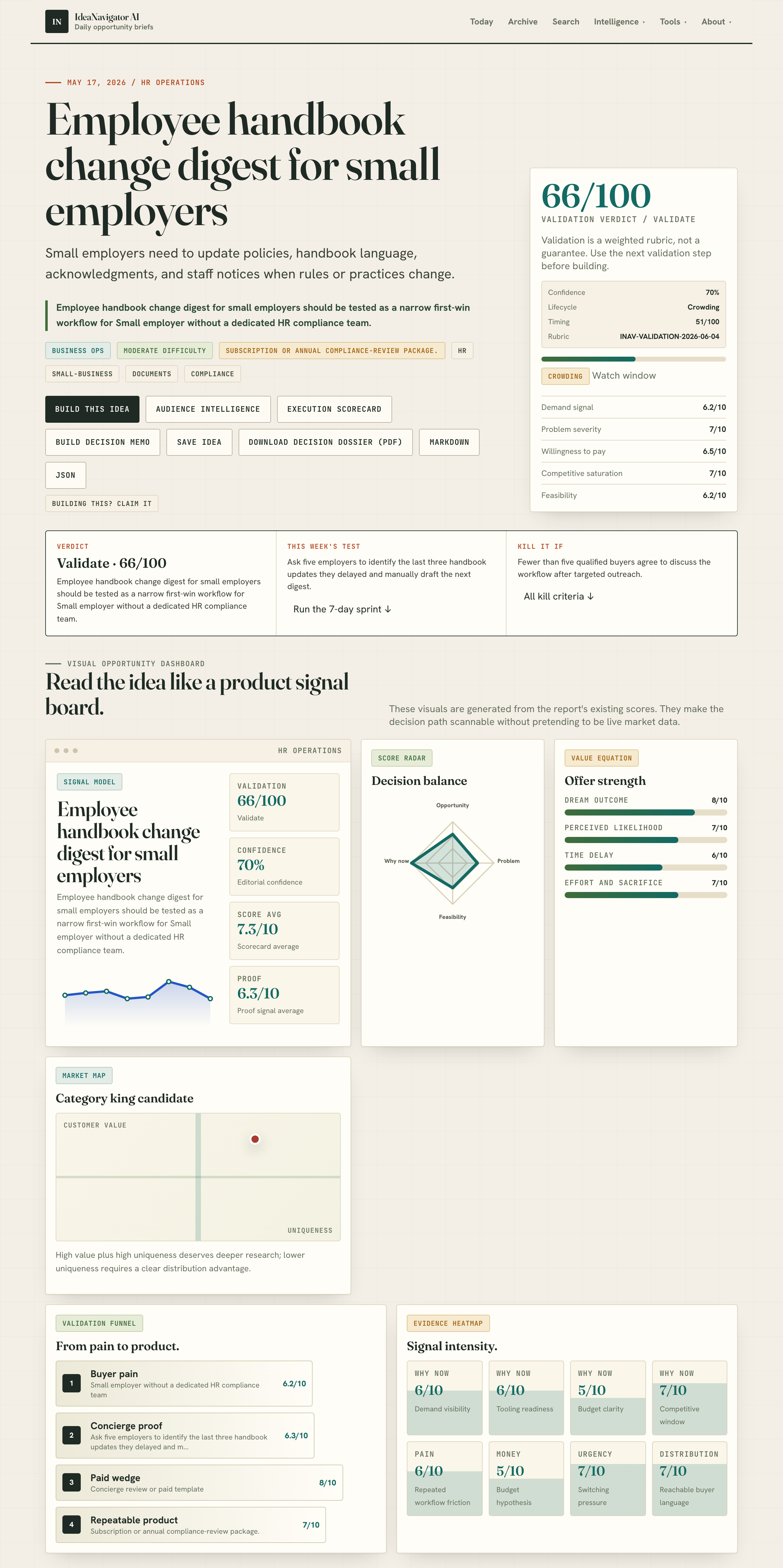
A new workflow for small employers to digest and implement employee handbook updates is being tested. It aims to simplify policy changes and tracking acknowledgments, addressing compliance challenges.
Small employers lacking dedicated HR compliance teams are testing a new workflow designed to streamline employee handbook updates, tracking policy changes, and employee acknowledgments.
The initiative, developed by IdeaNavigator AI, aims to address the growing challenge small businesses face in keeping employee policies current due to remote work, AI integration, and state-level employment law changes. The proposed workflow involves logging policy topics, drafting digest notes, and monitoring acknowledgment statuses, offering a structured approach to compliance management.
This pilot program is intended as a minimal viable product (MVP), with potential revenue through subscription or annual compliance review packages. The approach is being validated by asking five small employers to identify recent handbook updates they delayed and to manually draft upcoming digests, testing its practicality and effectiveness.
Why Small Employers Need Better Policy Management Tools
This initiative addresses a significant gap for small businesses that lack dedicated HR resources, helping them stay compliant with evolving regulations. An efficient digest workflow could reduce legal risks, improve employee communication, and ease administrative burdens, especially as policy changes become more frequent due to remote work and state law updates. If successful, it could set a new standard for compliance management tailored to small teams, with potential scalability for broader HR operations.Products Worth Considering

EcoFlow Smart Home Panel 2 Whole-Home Backup System Hub

Amazon Kindle Scribe Colorsoft 64GB (1st Generation)

Logitech MX Keys S Wireless Keyboard, Graphite
As an affiliate, we earn on qualifying purchases.
Growing Policy Complexity and Small Employer Challenges
Small employers often struggle to keep employee handbooks updated due to limited HR resources and the rapid pace of policy changes driven by remote work, AI tools, and state-level employment law updates. Currently, many delay or overlook handbook revisions, risking non-compliance and legal exposure. The new workflow aims to provide a structured process to mitigate these issues by simplifying tracking and acknowledgment processes, with the pilot testing its viability in real-world settings.“Small employers need a straightforward way to manage handbook updates without the overhead of dedicated HR teams.”
— an anonymous researcher
Uncertainty About Workflow Adoption and Effectiveness
It is not yet clear how widely small employers will adopt this digest workflow or how effective it will be in reducing compliance risks. The pilot is still in testing, and results on ease of use, accuracy, and impact on policy adherence are pending.Next Steps in Testing and Potential Rollout
The pilot will continue with the five participating employers, collecting feedback on usability and impact. If successful, the developers plan to refine the workflow and consider broader deployment, including marketing to other small businesses and integrating additional features like automated reminders and legal updates.Key Questions
How will this workflow help my small business stay compliant?
The workflow aims to simplify tracking policy changes, drafting digest notes, and monitoring employee acknowledgments, reducing the risk of outdated policies and non-compliance.
Is this tool suitable for small employers without HR staff?
Yes, it is specifically designed for small employers lacking dedicated HR teams, providing a straightforward process to manage handbook updates efficiently.
When will this workflow be available for general use?
The current phase is testing with a small group. If the pilot proves successful, wider rollout could occur within the next year, depending on feedback and development timelines.
Will this tool include legal updates automatically?
The initial MVP focuses on manual logging and tracking, but future versions may incorporate automated legal update alerts as part of the subscription package.
How much will the subscription or review package cost?
Pricing has not yet been set; it will depend on features offered and market response, but aims to be affordable for small businesses.
Source: IdeaNavigator AI