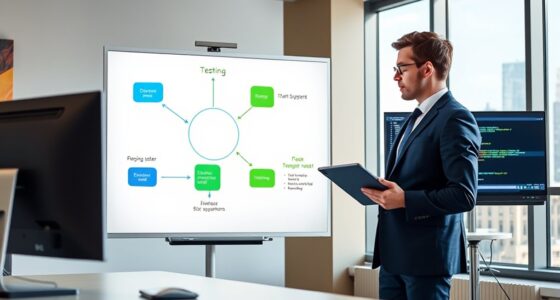
To effectively use static and dynamic testing, you should start with static methods like code reviews and analyzing documentation early in development—they’re quick and cost-effective for catching issues before coding begins. Use dynamic testing later when the software is functional to test performance, usability, and security in real-world scenarios. Combining both approaches ensures thorough coverage and a more reliable product; keep exploring to learn how to implement each method effectively.
Key Takeaways
- Static testing is performed early, examining code and documentation without executing the program; dynamic testing occurs later with real execution.
- Use static testing for early defect detection, code reviews, and ensuring standards, while dynamic testing verifies runtime behavior, performance, and usability.
- Static methods include code reviews and analysis of design documents; dynamic methods involve functional, load, security, and usability testing.
- Static testing is faster and more cost-effective for identifying issues before testing phase; dynamic testing provides insights into real-world application performance.
- Combining static and dynamic testing ensures comprehensive coverage, improving code quality, reliability, and user satisfaction throughout development.

When it comes to software testing, understanding the differences between static and dynamic methods is vital for guaranteeing quality. Static testing involves examining your code, documentation, or design without executing the program. Techniques like code review are central to static testing, where you or your team scrutinize the source code line by line, looking for errors, inconsistencies, or potential vulnerabilities. Code reviews are effective early in development, catching issues before they reach the testing phase, saving time and reducing debugging efforts later. Static testing also includes analyzing design documents, requirements, and user manuals to guarantee clarity, completeness, and correctness. Since static testing doesn’t require running the software, it’s faster and more economical for identifying logical mistakes and adherence to coding standards. Additionally, static testing can help identify issues related to Water on Water, such as design flaws that could lead to runtime problems if not addressed early.
On the other hand, dynamic testing requires executing the software to observe its behavior in real-time. This approach is vital for uncovering issues that only surface during actual use, such as runtime errors, performance bottlenecks, or usability problems. Usability testing, a key form of dynamic testing, involves real users interacting with the system to evaluate how intuitive, efficient, and satisfying the application is. It provides insights into user experience, helping you identify navigation issues, confusing interfaces, or unmet user needs that static techniques might miss. Dynamic testing also includes functional testing, load testing, and security testing, all of which require running the application under various conditions to guarantee it performs reliably and securely.
Choosing between static and dynamic testing depends on what you’re trying to achieve. Static methods like code review are best employed early, during development, to catch issues before they escalate. They’re invaluable for maintaining code quality, guaranteeing standards are met, and reducing bugs down the line. Dynamic testing, including usability testing, is more suited for later stages, when the software is functional enough for users to interact with. It allows you to assess the system’s real-world performance and user satisfaction.
Ultimately, integrating both static and dynamic testing creates a thorough testing strategy. Static techniques help you refine your code and design, while dynamic methods verify that the software works as intended in real-world scenarios. By understanding when and how to deploy each approach, you guarantee a more robust, reliable, and user-friendly product.

ANCEL AD310 Classic Enhanced Universal OBD II Scanner Car Engine Fault Code Reader CAN Diagnostic Scan Tool, Read and Clear Error Codes for 1996 or Newer OBD2 Protocol Vehicle (Black)
CEL Doctor: The ANCEL AD310 is one of the best-selling OBD II scanners on the market and is…
As an affiliate, we earn on qualifying purchases.
As an affiliate, we earn on qualifying purchases.
Frequently Asked Questions
Can Static Testing Replace Dynamic Testing Entirely?
Static testing can’t replace dynamic testing entirely because it mainly involves code reviews and documentation analysis, which find issues early. You need dynamic testing to execute the software and identify runtime errors, performance problems, and actual user experience. While static methods catch many defects, combining both approaches ensures thorough testing. So, you should view static testing as an essential part of an all-encompassing testing strategy, not a replacement for dynamic testing.
What Tools Are Best for Static Testing?
Imagine uncovering bugs early by shining a light on your code; tools like static analyzers are perfect for this. For static testing, you should use tools like code review platforms such as GitHub or Bitbucket, which facilitate thorough documentation analysis. These tools help you identify issues without executing the program, saving time and ensuring your code’s integrity before dynamic testing even begins.
How Do Testing Costs Compare Between Static and Dynamic Methods?
You’ll find that static testing generally costs less because it requires fewer resources and less time, focusing on reviews and inspections. Dynamic testing, however, tends to be more expensive due to the need for specialized tools, execution environments, and more extensive resource allocation. When planning, consider your budget and project needs, balancing static methods for early defect detection with dynamic testing for thorough validation to optimize costs.
Are There Industry Standards Guiding Static Vs Dynamic Testing?
You know what they say, “Standards are the backbone of quality.” Industry standards do guide static and dynamic testing practices. Regulatory guidelines, such as ISO and IEEE standards, set best practices for each testing type. These help guarantee your testing aligns with safety, quality, and compliance requirements. Following these standards helps you choose the right method at the right time, reducing risks and boosting your project’s credibility.
How Does Testing Type Impact Project Delivery Timelines?
You’ll find that the testing type directly impacts your project timelines. Static testing, like reviews and walkthroughs, speeds up defect detection early, reducing delays later. Dynamic testing, including test automation, takes longer but uncovers more complex issues. Balancing both guarantees quicker defect detection and fewer surprises, helping you stay on schedule. Using test automation can accelerate dynamic testing, but it requires initial setup time, influencing your overall delivery timelines.

Simple HealthKit At-Home 5-Panel STD Test Kit for Chlamydia, Gonorrhea, Trichomoniasis, HCV & Syphilis – STD HCV Test Kit – Free Follow-Up/Telehealth & High Quality Lab Results
Tests for 5 STDs: An easy-to-use 5-Panel STD test with simple, fast, and private results. Simple HealthKit's 5-Panel…
As an affiliate, we earn on qualifying purchases.
As an affiliate, we earn on qualifying purchases.
Conclusion
Just as Da Vinci knew the value of both sketches and sculptures, you must balance static and dynamic testing. Static methods catch flaws early, like the careful drafts of a masterpiece, while dynamic tests breathe life into your code, revealing real-world flaws. Master when to use each—your project’s canvas depends on it. Embrace both tools, and like a great artist, craft a flawless, resilient masterpiece that stands the test of time.

Software Performance Testing: Concepts, Design, and Analysis
As an affiliate, we earn on qualifying purchases.
As an affiliate, we earn on qualifying purchases.

Upgraded 8K IP Camera Tester, WANLUTECH CCTV Tester 7inch Touchscreen 8MP TVI CVI AHD CVBS Camera Test 90W PoE Power Cable Tracer RJ45 Cable TDR Test SFP Network Tools WiFi HDMI VGA (IPC-9800CADH Pro)
[ Upgraded IP Analog Camera Tester ] WANLUTECH 8K IP camera tester has 7'' touchscreen, 1280×800 resolution. It…
As an affiliate, we earn on qualifying purchases.
As an affiliate, we earn on qualifying purchases.