
TL;DR
Large language models turn prompts into tokens and numbers, process them through transformer layers, then generate an answer by predicting one token at a time. The source guide says this explains both their fluency and their errors, and why users should verify important outputs.
Thorsten Meyer AI published an explainer on November 22 describing how large language models turn a user prompt into a response, from tokenization and transformer processing to next-token selection. The guide says models generate text step by step rather than looking up a ready-made answer, a design that helps explain both their useful fluency and their occasional confident errors.

Get business pricing on monitors, keyboards and dev gear
- Business-only prices and quantity discounts
- Tax-exempt purchasing
- Multiple users, one account, clear invoices
The guide describes a five-stage process. First, a tokenizer divides text into tokens, which may be whole words, parts of words or punctuation. Those tokens are converted into numerical representations called embeddings. A transformer then processes the representations in layers, using attention to relate parts of the input to one another.
At the end of that processing, the model assigns probabilities to possible next tokens. A sampling method selects one, which is added to the text; the model repeats the process until it has produced a response. The guide says temperature affects how adventurous the selection is, so the same prompt can produce different answers.
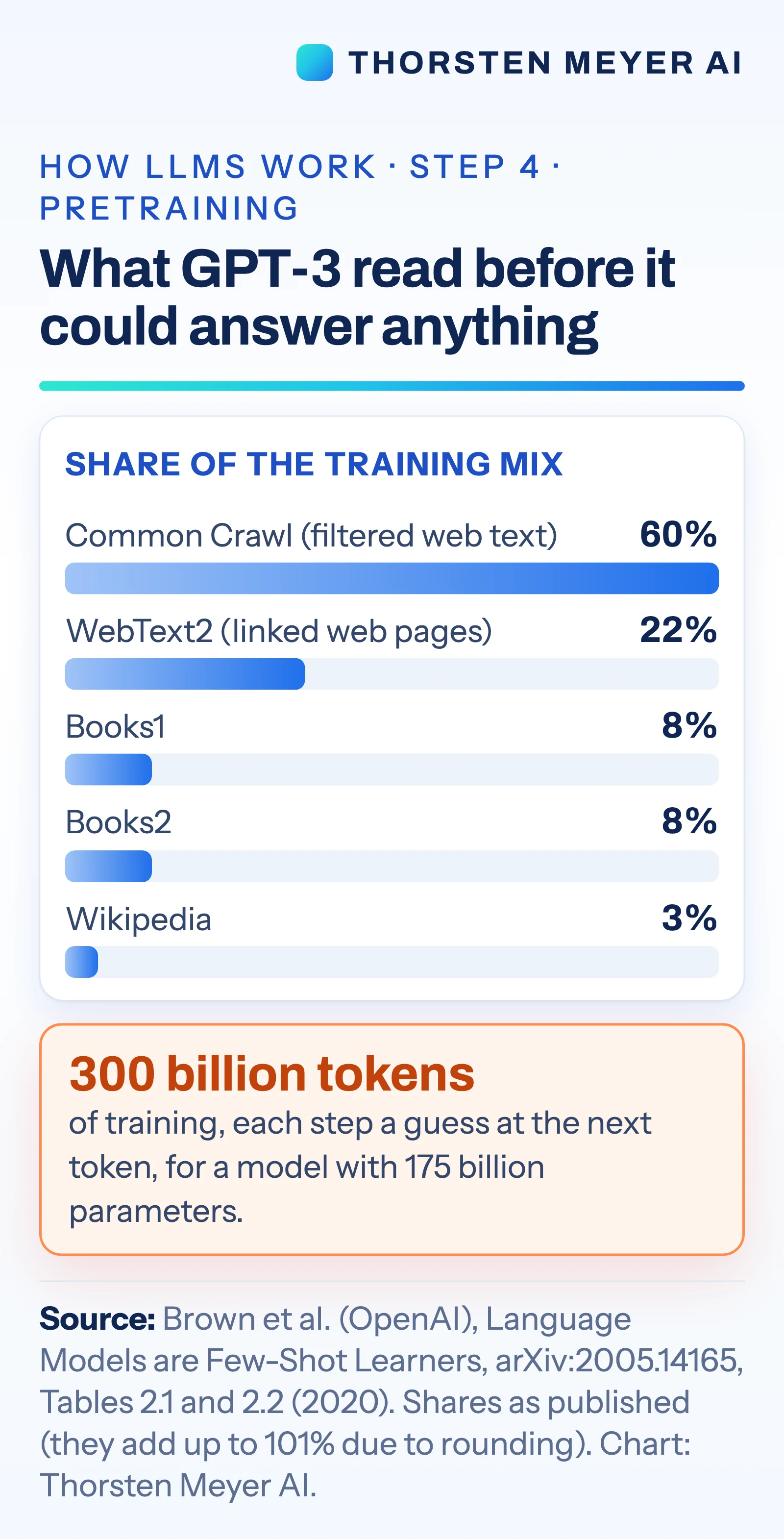
The article distinguishes initial training from later assistant training. In pretraining, a model learns to continue text from a large corpus. Post-training methods, including human feedback or feedback guided by written principles, are used to make it follow instructions. The source also says reasoning models may spend additional compute generating hidden reasoning tokens before they provide an answer.
Why Generated Answers Need Checking
The process matters because a fluent response is not proof that the model has retrieved or verified a fact. The guide says each answer is built through repeated predictions of what text should come next. That can produce useful language, but it also leaves room for plausible mistakes.
The source identifies practical limits: models can make things up, may not know information beyond their training data, and incur costs as tokens are processed. For readers using these systems at work, the implication is straightforward: check consequential claims against reliable sources, and account for token limits and costs when handling long prompts or generated responses.
Products Worth Considering

LG UltraGear 32-inch QHD Curved Gaming Monitor, 180Hz, 1ms, AMD FreeSync

Apple MacBook Air 15-inch Laptop with M5 Chip, 16GB Memory, 512GB SSD, Liquid Retina Display, and 12MP Center Stage Camera (Midnight)

Bose Lifestyle Ultra Wireless Home Speaker, White Smoke
As an affiliate, we earn on qualifying purchases.
From Text Prediction to Assistant
The transformer architecture was introduced in the 2017 paper Attention Is All You Need, cited by the source as the basis for the processing stage described in the guide. Tokenization also shapes what a model receives: common words may be represented as one token, while rare names or unfamiliar terms can be split into several pieces.
The guide cites OpenAI’s estimates that an English token averages about four characters, or roughly three-quarters of a word, while stressing that these are approximations and token counts vary by model. It also references an OpenAI 2022 study in which a 1.3 billion-parameter model trained with feedback was preferred to GPT-3, which had 175 billion parameters. That result is specific to the cited study and does not establish that smaller models are generally better.
“The model never looks up an answer. It turns text into numbers, predicts the next token, picks one, adds it to the text and starts again.”
— Thorsten Meyer AI guide
Limits the Guide Leaves Open
The source is an explainer, not a new experimental study, and it does not quantify how often generated answers are wrong or how accuracy varies across tasks and models. Its account of token sizes is explicitly approximate, and behavior differs across model families.
The article also does not provide a detailed comparison of reasoning models or specify how their hidden reasoning is handled across products. Its discussion should be read as a general description of model behavior, not a guarantee that every system follows an identical process.
How Readers Can Apply It
The guide points readers to related explainers on neural-network arithmetic, deep learning and context windows for further detail. For users assessing a particular model, the next step is to consult that system’s documentation for its tokenizer, limits, pricing and training information, then verify important answers independently.
Key Questions
Does a language model look up an answer?
Not in the process described by the guide. It predicts and selects tokens in sequence to construct a response.
What is a token?
A token is a piece of text, such as a character, part of a word, whole word or punctuation mark. The number of tokens in a passage varies by model.
Why can the same prompt produce different answers?
The model selects from possible next tokens, and sampling settings such as temperature affect those choices. The source says this can lead to different responses to the same prompt.
Why should users verify model answers?
The guide says models can produce confident errors and may lack information beyond their training data. Important claims should be checked against reliable sources.
Source: Thorsten Meyer AI