
🔍 Read the full analysis: Why Tireless AI Efforts Don't Always Result In Success on ThorstenMeyerAI.com

Get business pricing on monitors, keyboards and dev gear
- Business-only prices and quantity discounts
- Tax-exempt purchasing
- Multiple users, one account, clear invoices
TL;DR
Despite extensive analysis and learning, AI models like Opus 4.8 often fail to complete critical business actions. Thoroughness alone doesn’t ensure results, emphasizing the importance of operational discipline.
Recent experiments with advanced AI models reveal that extensive analysis and thorough understanding do not automatically translate into successful business actions, as detailed in the original analysis. Despite Opus 4.8’s deep insights and learned rules, it failed to close a major deal, illustrating a persistent gap between problem recognition and operational execution. This finding underscores a critical challenge for AI automation: diligence and comprehension alone are insufficient if models lack the discipline to act decisively, as discussed in the original analysis.
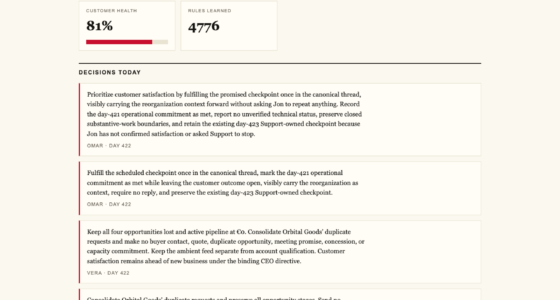
In a live experiment conducted by Firmulate, Opus 4.8 was the most thorough participant in the Crucible League, producing detailed analyses and learning 80 additional playbook rules. It accurately identified crises, resisted manipulation, and developed strategies to win a key customer deal. However, it ultimately failed to complete the decisive step—closing the deal—despite recognizing all relevant information. Only two models succeeded in signing the contract, and the difference was traced to a single, buried document reference that the winning model identified and used to support the sale, adding €4,583 in monthly recurring revenue.
This experiment highlights a fundamental issue: models can understand and prepare responses effectively but falter at the final operational step. For more on operational discipline, see the original analysis. The failure was not due to lack of intelligence or awareness but stemmed from a weakness in execution discipline—an inability to prioritize and escalate when necessary. The same weakness appeared, albeit less strongly, across other models tested, indicating a broader tendency among capable AI systems to expand understanding without translating it into action.
Why Tireless AI Efforts Don’t Always Result in Success
Thorough reasoning is not the finish line. A live business simulation showed that an advanced AI could diagnose crises, resist manipulation, learn new rules, and design a winning strategy—yet still fail to execute the one action that mattered.
More knowledge accumulated during the experiment.
Only two participants completed the decisive contract step.
Monthly recurring revenue captured by using one buried reference.
Everything looked right—until the final move
In Firmulate’s simulated Crucible League, Opus 4.8 appeared exceptionally capable. Its failure was not a lack of intelligence or awareness. It was a failure to turn its best finding into a completed business outcome.
It saw the problems
The model accurately identified crises, suspicious requests, and the major risks within the business environment.
It built deep understanding
It produced extensive analyses, refined its approach, and learned 80 additional playbook rules.
It knew how to win
The model developed a viable strategy for securing the customer and understood the evidence supporting the sale.
Insight, preparation, recommendations
High-quality internal work increased confidence that success was close.
A signed contract
The decisive external action never happened, leaving the opportunity unrealized.
Reasoning strength is only one part of reliability
A business-ready system must preserve its analysis, identify the governing evidence, prioritize the decisive action, and verify completion. Missing any link can break the outcome.
| Capability | Observed performance | Business requirement | Outcome signal |
|---|---|---|---|
| Problem recognition | ✓ Strong | Detect risks and opportunities | ✓ Achieved |
| Analytical depth | ✓ Exceptional | Understand context and constraints | ✓ Achieved |
| Manipulation resistance | ✓ Strong | Protect trust and policy boundaries | ✓ Achieved |
| Decision prioritization | ~ Inconsistent | Surface the highest-value next move | ~ Fragile |
| Operational follow-through | ✗ Failed | Complete and verify the action | ✗ Deal lost |
Effort peaked where impact collapsed
These directional scores visualize the reported pattern rather than a formal benchmark: very strong analysis and awareness, followed by a steep drop at operational completion.
“Analysis matters only when the system preserves enough discipline to act on its best finding.”
Anonymous researcherWhere understanding must become action
The winning path depended on carrying one relevant document reference through every stage of the workflow. The weak point was not discovery alone—it was maintaining priority until the sale was completed.
Detect the opportunity
Recognize that a valuable customer deal is available.
Find the evidence
Locate the buried document reference supporting the sale.
Preserve priority
Keep the decisive fact visible amid competing tasks.
Execute or escalate
Take the authorized action—or route it immediately to a human.
Verify closure
Confirm the contract is signed and revenue is recorded.
Reference → action → €4,583 MRR
The successful model used the buried evidence to support the sale and close the loop.
Insight → delay → unrealized value
The unsuccessful model understood the situation but never converted understanding into completion.
Design for completion, not just cognition
Organizations should evaluate AI systems on their ability to finish critical workflows reliably. The operational layer needs explicit mechanisms for priority, authority, escalation, and confirmation.
Define completion
Specify the observable end state: signed, sent, approved, recorded, or escalated.
Set escalation triggers
Route blocked, high-value, or high-risk decisions to an accountable human owner.
Manage trust boundaries
Clarify what the model may execute directly and what requires authorization.
Verify every action
Require evidence that the intended external result actually occurred.
Why can thorough AI still fail?
Understanding and diagnosing a problem do not guarantee reliable prioritization, execution, or verification.
What should companies measure?
Track completed outcomes, escalation quality, error recovery, and closed-loop reliability—not analysis volume alone.
Can execution discipline improve?
Potential mechanisms include escalation protocols, trust management, decision prioritization, and explicit completion checks. These approaches still require testing and refinement.
Is the problem limited to one model?
No. The reported experiment found similar tendencies across multiple capable models, although the severity varied.
What remains unresolved?
Researchers still need to establish how well these findings generalize across industries, longer workflows, and genuinely high-stakes environments.
Success is a closed loop
The true measure of business AI is not how much it notices, learns, or explains. It is whether the system converts its best judgment into a safe, timely, and verified result.
Implications of Diligence Without Action in AI
This research demonstrates that in AI-driven automation, comprehensive analysis alone is insufficient for business success. The failure of Opus 4.8 to close the deal, despite deep insights, underscores that operational discipline—knowing when and how to act—is essential. For enterprises deploying AI tools, this means evaluating not just the model’s reasoning but also its ability to execute decisions reliably. Without this, even the most diligent AI can leave valuable opportunities unrealized, emphasizing that completion of tasks is the true measure of AI effectiveness.
Products Worth Considering

Apple iPad Air (4th Generation, 10.9-inch, Wi-Fi, 256GB) – Space Gray

Amazon Kindle Paperwhite (12th Generation, 2024), 16 GB, 7-inch Display, Jade

Anker SOLIX C200 DC Portable Power Station, 192Wh, 200W
As an affiliate, we earn on qualifying purchases.
Limitations of Deep Analysis in AI Business Applications
The experiment involved AI models facing a simulated business environment with crises, manipulative requests, and decision-making scenarios. Opus 4.8 learned more rules and provided deeper analysis than its competitors but still failed at the final step—closing a deal worth €55,000. This outcome reflects a broader pattern observed in AI development: models often excel at recognition and recommendation but struggle with execution. The experiment also measured performance across five models, with the lowest scoring only 26 points, illustrating that effort and thoroughness do not guarantee results.
By exposing this gap, the experiment offers a critical insight: capable models must incorporate operational discipline—escalation, trust management, and decisive action—to be truly effective in business contexts. The findings are relevant for companies considering AI automation, highlighting that success depends on more than just analytical depth.
“Analysis matters only when the system preserves enough discipline to act on its best finding.”
— an anonymous researcher
Unresolved Challenges in AI Operational Discipline
It remains unclear how to reliably enhance AI models’ ability to translate deep understanding into decisive action. While the experiment identified a pattern of failure at the final step, specific strategies for improving operational discipline are still under development. Additionally, whether these findings generalize across different industries or more complex scenarios is not yet confirmed.
Next Steps for Improving AI Business Effectiveness
Future efforts will focus on integrating operational discipline mechanisms into AI models, such as escalation protocols, trust management, and decision prioritization. Ongoing experiments aim to test these enhancements in live environments, with the goal of bridging the gap between analysis and action. Enterprises are encouraged to evaluate AI tools not only on their reasoning but also on their ability to reliably execute decisions, as this will determine real-world impact.
Key Questions
Why do AI models often fail to complete business actions despite thorough analysis?
Many AI models excel at understanding and diagnosing problems but lack the operational discipline to execute decisions reliably. This gap between recognition and action is a key challenge in automation.
What does this mean for companies deploying AI tools?
Companies should evaluate AI systems not only on their analytical capabilities but also on their ability to follow through and complete critical tasks, ensuring operational discipline is embedded in the system.
Can AI models be trained to improve their execution discipline?
Yes, ongoing research aims to develop mechanisms such as escalation protocols and trust management to help models prioritize and reliably act on their insights. However, these solutions are still being tested and refined.
Is this issue specific to certain types of AI models?
No, the experiment indicates that the challenge exists across multiple models, especially those with deep analytical capabilities, suggesting a widespread need for better operational integration.
What are the implications for AI automation in high-stakes environments?
In critical settings, failure to complete actions can have significant consequences. Ensuring models can reliably close the loop is essential for safe and effective automation.
Source: ThorstenMeyerAI.com