

TL;DR
In a post dated Nov. 25, 2026, Thorsten Meyer describes replacing several work software services with tools built using Anthropic’s Claude and OpenAI’s Codex coding agents. He says the tools handle tasks including analytics, project tracking, PDFs and video, but his account is a personal report, and he now takes on maintenance and security while relying on two AI companies.
Thorsten Meyer says he has replaced several software services he used for work with tools built using Anthropic’s Claude and OpenAI’s Codex, describing the approach in a post published Nov. 25. His examples include analytics, project tracking, PDF work and video recording; the change shifts software costs and responsibility toward AI subscriptions, hands-on review and maintaining the tools himself.

Get business pricing on monitors, keyboards and dev gear
- Business-only prices and quantity discounts
- Tax-exempt purchasing
- Multiple users, one account, clear invoices
Meyer says he pays for several Claude and Codex subscriptions, and has AI coding agents build software tailored to his business. He describes these agents as systems that can read project code, write code, run tests and report results. He sets goals and reviews their work. His account does not provide a cost comparison between the subscriptions and the services they replaced.
The article describes seven tools taking part in the workflow for its accompanying video and article. The job moves from a project tracker through tools for reading their own guides, transcribing reference videos, producing PDFs and 3D models, publishing through ChannelHelm, and checking readership with Grynlume. Meyer says the steps run without a person clicking through each handoff, while people set the goal and check the result.
Meyer reports that seven tools in his own repositories had 5,648 commits and 2,128 test files as of Nov. 24, 2026. Those are counts from his repositories; the post gives no external comparison or measure of tool quality based on them. He also says AI models used for voices, images and video clips are paid for per use.
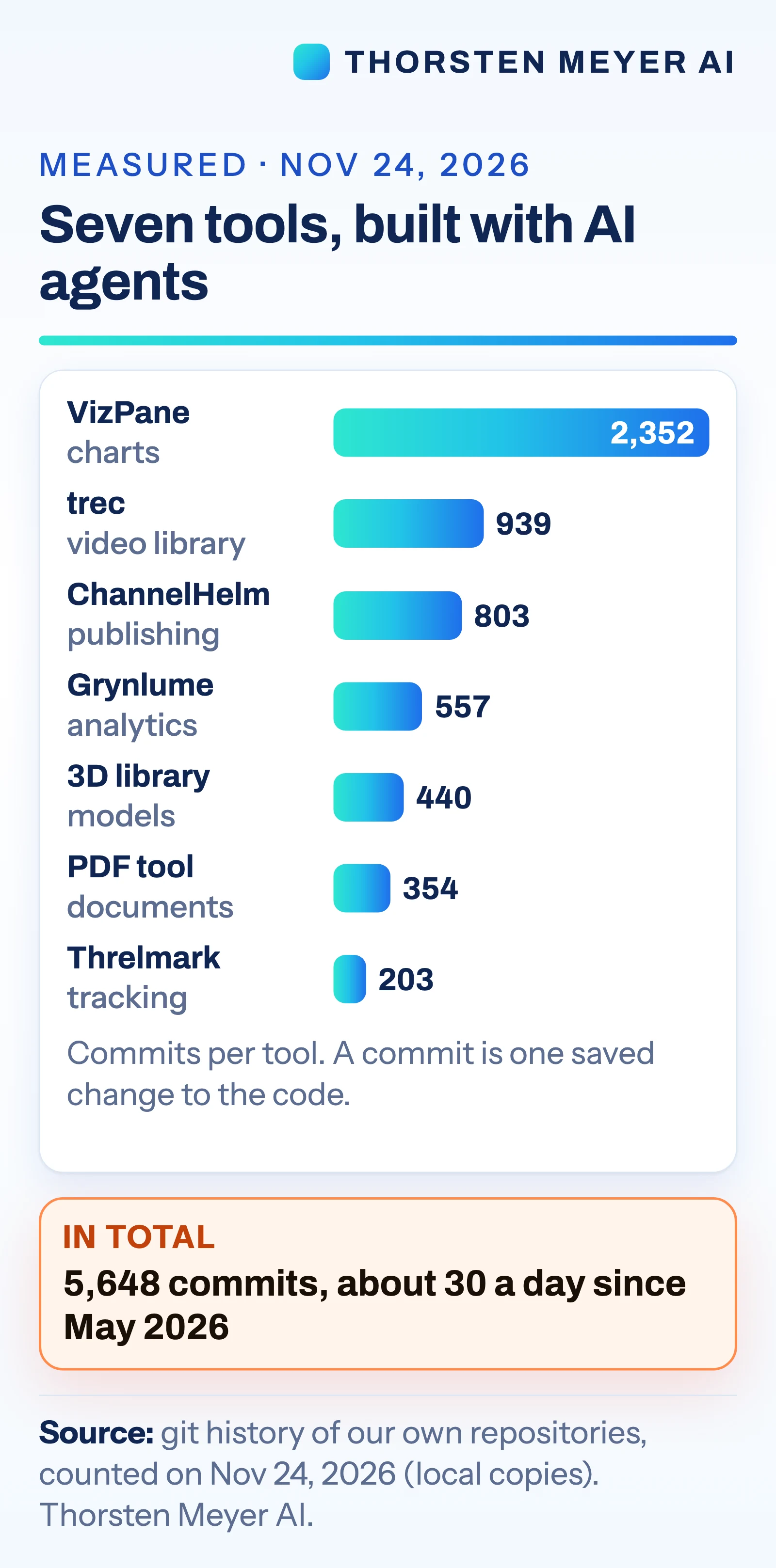
Software Costs Shift to Tool Ownership
Meyer’s example illustrates how AI coding agents can let an individual or small business build software around a specific workflow. For someone whose needs are narrow, that could reduce reliance on multiple general-purpose services and allow tools to fit existing processes. The account is one person’s experience, however, and does not establish that building custom tools is cheaper or more reliable for other businesses.
The work also changes who carries the burden. Meyer says maintenance, security and review are now his responsibility. A tool that replaces a subscription still requires someone to fix defects, manage access and keep it working. He also says his workflow depends heavily on Anthropic and OpenAI, leaving him reliant on the companies providing the coding agents.
For software companies, Meyer argues that customers may build narrow substitutes for some products. He suggests reliability, support, security and compatibility with agents could matter more in response. That is his assessment of the market, not evidence that software subscriptions are broadly being replaced.
Products Worth Considering

DJI Osmo Action 5 Pro 4K Waterproof Action Camera with Dual OLED Touchscreens, Froggi 47-Piece Sport Kit and SD Card

DJI Mic 3 Wireless Microphone Kit (2 Transmitters, 1 Receiver, Charging Case)

Logitech MX Master 4 Ergonomic Wireless Mouse with Haptic Feedback, Graphite
As an affiliate, we earn on qualifying purchases.
From Software Rental to Custom Tools
Meyer frames the change as a move away from software as a service, commonly accessed through a browser and paid for on a recurring basis. He cites the U.S. National Institute of Standards and Technology’s definition of SaaS in SP 800-145: users access a provider’s applications running on cloud infrastructure, while the provider controls the underlying infrastructure and many application capabilities.
His proposed alternative is not to avoid all paid software. He says he continues to pay for Claude and Codex, and pays per use for AI models that generate voices, images and clips. The difference is that he builds and operates some of the work tools himself. He calls the resulting setup “agentic” because software agents can read a tool’s guide and interact with it through a standard interface, instead of relying on a person to navigate its screens.
Meyer says AI coding agents need written project rules and records of prior work because they do not automatically retain a full understanding of a business between sessions. He compares their coding ability to that of senior developers, but that is his opinion based on his experience, not an independently measured finding.
““I no longer pay other vendors for the software I run my work on.””
— Thorsten Meyer
Costs and Reliability Still Unmeasured
The post does not list the subscription fees for the software Meyer stopped using, the cost of Claude and Codex, or the time he spends maintaining the replacement tools. It therefore does not show whether the approach reduces his total costs. The repository counts he provides do not establish how often the tools fail, how secure they are or how much work they save.
It is also unclear how the workflow would perform for a business with different needs, less technical experience or stricter security requirements. Meyer presents a personal practice and explicitly says that building this way suits people who enjoy making tools; he says renting software remains a reasonable option for others.
Testing the Fleet in Daily Work
Meyer presents the article as a companion to a video explaining the workflow and shows how one article and video moved through seven tools. The post does not announce a launch, product release or upcoming evaluation. Its next test is the ongoing work of using the tools, checking their outputs and maintaining them.
Readers assessing the approach would need more information about total costs, uptime, security practices and the time required to supervise and repair the tools. Meyer’s account does not say whether he plans to publish those measures or extend the workflow.
Key Questions
Which software does Meyer say he replaced?
He identifies tools for web analytics, project tracking, PDFs and video recording. The post does not name every former service.
Does Meyer use AI coding agents without paying for software?
No. He says he pays for several Claude and Codex subscriptions, as well as per-use AI models for voices, images and clips.
What does “agentic” mean in his account?
He uses the term for tools that other software agents can learn about through a written guide and use through an interface, without a person clicking through the app.
How much did the custom tools save?
The post does not provide a savings figure or compare the cost of the subscriptions and tools he replaced. Meyer says he is now responsible for maintenance, security and review.
Source: Thorsten Meyer AI