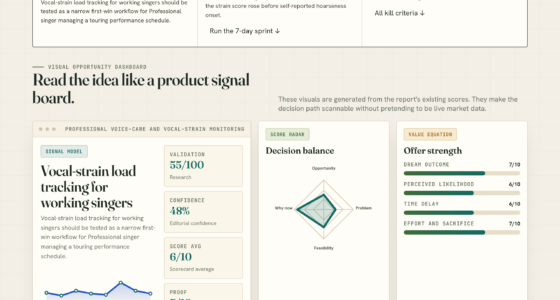

📊 Full opportunity report: Sovereignty Is A Pipe, Not A Passport on ThorstenMeyerAI.com — validation score, market gap, and execution plan.

Get monitors, keyboards and dev gear delivered free — and shop member deals
- Fast, free delivery on millions of items
- Access to Prime Big Deal Days deals on October 6–7
- Prime Video, Amazon Music and more included
TL;DR
Mistral claims sovereignty over its AI models by hosting in Europe, but when models are accessed via US cloud platforms, jurisdiction shifts. The core issue is legal sovereignty, not physical location.
Mistral has built a $14 billion company based on the promise of providing European AI that is not subject to US legal jurisdiction. However, its models are distributed through American cloud providers like Microsoft Azure, Google Cloud, and Amazon Web Services, complicating claims of sovereignty. This raises questions about the effectiveness of physical hosting versus legal jurisdiction in data sovereignty.
While Mistral promotes its models as sovereign by hosting them on European infrastructure, the models are often accessed via US-based cloud platforms. Under the US CLOUD Act, authorities can compel US companies to produce data regardless of where servers are physically located, making jurisdiction the key factor. European regulators, including France and Germany, have expressed skepticism about relying solely on physical hosting to ensure sovereignty, citing legal reach over data even when stored in Europe.
Real sovereignty, according to experts, depends on who governs the company holding the data and the entire stack, from hardware to cloud services. Mistral’s claim holds when models are run entirely on self-hosted, on-premise infrastructure within Europe, where legal jurisdiction is clear. However, once models are delivered as managed services through US platforms, the jurisdiction shifts back to the US, exposing data to the CLOUD Act.
Despite this, Mistral’s infrastructure investments, such as its Paris data center, are European-owned and financed by European banks, and its models can be run entirely within European borders, making the sovereignty argument valid in those scenarios. Yet, the reliance on US hardware, such as Nvidia chips, complicates the sovereignty claim further, as hardware supply chains are US-controlled.
Sovereignty is a pipe, not a passport
Mistral sells European data sovereignty — then distributes its models through Azure, Bedrock & Google Cloud, the American infrastructure it tells customers to flee. A French passport on the lab doesn’t travel down an American wire.
Mistral-direct
hyperscaler
The CLOUD Act lets US authorities compel a US-headquartered provider to hand over data wherever it physically sits. Picking the “EU region” in AWS or Azure doesn’t resolve it — jurisdiction follows the company’s HQ, not the server’s location. Schrems II established the same from the EU side.
Mistral isn’t selling a lie — it’s selling a conditional truth, and the condition is the part the marketing skips. Sovereignty holds on Mistral’s own iron; it leaks the moment convenience routes the model through the American cloud. The deeper lesson cuts at Brussels: sovereignty is an end-to-end property of the whole stack — model, cloud, chips, supply chain — that Europe owns at no layer except the model itself. As Mensch put it: you “cannot regulate your way to computing supremacy.”
Implications of Jurisdiction in Data Sovereignty Claims
This situation underscores that physical hosting alone does not guarantee sovereignty. Legal jurisdiction over data depends on the company’s domicile and the applicable law. For European enterprises, understanding this distinction is vital when evaluating AI providers and cloud services. The reliance on US infrastructure and hardware means that true sovereignty remains difficult to achieve without full control over the entire stack, including hardware supply chains.
European regulators and enterprises are increasingly aware that legal jurisdiction can override physical data location, influencing procurement decisions and regulatory compliance. The debate over sovereignty is therefore shifting from infrastructure to legal and contractual frameworks.
As an affiliate, we earn on qualifying purchases.
The Limits of Physical Hosting in Achieving Sovereignty
The concept of data sovereignty has gained prominence in Europe amid concerns over US legal reach, especially after the 2018 CLOUD Act and the 2020 Schrems II ruling. Many European companies and regulators have focused on hosting data within European borders to avoid US jurisdiction. However, legal rulings clarify that jurisdiction follows the company’s legal domicile, not server location.
Historically, companies like Mistral have promoted self-hosted models and European infrastructure to claim sovereignty. Yet, most models are distributed via US cloud platforms, which are subject to US law. The supply chain for hardware, notably Nvidia chips, remains US-controlled, further complicating claims of sovereignty. This layered complexity reveals that sovereignty is more a property of legal jurisdiction than physical infrastructure.
European industry surveys show that data sovereignty influences procurement, with certifications like SecNumCloud and BSI C5 favoring EU-based providers. Nonetheless, the practical limits of sovereignty are evident in the reliance on US hardware and cloud services, which cannot be fully circumvented.
“The CLOUD Act means that data stored in Europe but processed by US companies remains under US legal reach, complicating sovereignty claims.”
— European regulator official
As an affiliate, we earn on qualifying purchases.
Unresolved Questions About Full Sovereignty
It remains unclear whether European regulators and enterprises will develop binding legal frameworks or technical solutions that fully insulate data from US jurisdiction. The extent to which hardware supply chains and cloud platform policies can be modified or controlled to enhance sovereignty is still under debate. Additionally, the impact of emerging EU-specific cloud controls like Microsoft’s EU Data Boundary is yet to be fully assessed in legal and practical terms.
As an affiliate, we earn on qualifying purchases.
Next Steps in Clarifying Data Sovereignty Limits
European regulators are likely to continue scrutinizing cloud and hardware supply chains, potentially imposing stricter certification standards or encouraging more fully European-owned infrastructure. Companies like Mistral may focus on expanding self-hosted, on-premise solutions within Europe to strengthen sovereignty claims. Legal clarifications and industry standards will play a key role in defining the future landscape of data sovereignty and jurisdictional control.
As an affiliate, we earn on qualifying purchases.
Key Questions
Does hosting data in Europe guarantee sovereignty?
Not necessarily. While physical hosting within Europe reduces certain risks, jurisdiction depends on the company’s legal domicile and the applicable laws, such as the US CLOUD Act.
Can a European AI model be fully sovereign if run on US hardware?
Full sovereignty is difficult to achieve when the hardware and supply chain are US-controlled. Even if models are run locally, the underlying hardware may still be subject to US export laws.
What role do European regulations play in data sovereignty?
Regulations like GDPR, SecNumCloud, and BSI C5 aim to promote sovereignty, but legal jurisdiction remains the key factor in data protection and access.
Will US cloud providers change their policies to address sovereignty concerns?
Some providers are developing EU-specific data controls, but legal jurisdiction and hardware supply chains continue to pose challenges to full sovereignty claims.
Source: ThorstenMeyerAI.com
Fall Picks
fall essentials
As an affiliate, we earn on qualifying purchases.