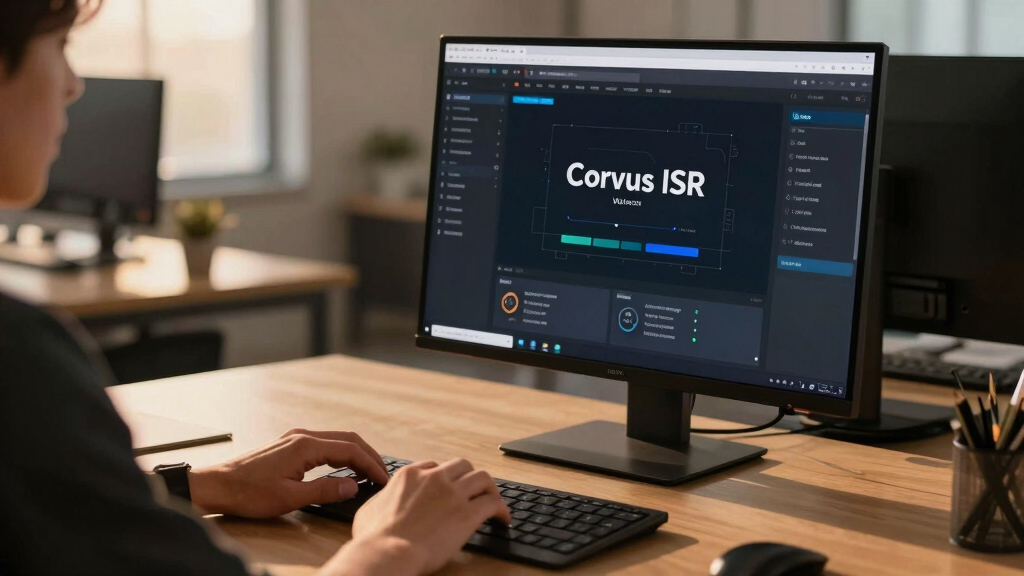

📊 Full opportunity report: Public Development Of Corvus ISR: WAMI Exploitation Stack Begins With Synthetic Data on ThorstenMeyerAI.com — validation score, market gap, and execution plan.

Get business pricing on monitors, keyboards and dev gear
- Business-only prices and quantity discounts
- Tax-exempt purchasing
- Multiple users, one account, clear invoices
TL;DR
Corvus ISR announces the public launch of its synthetic Wide-Area Motion Imagery (WAMI) exploitation stack, featuring live detection and tracking in a browser. This marks a significant step toward open, customizable ISR software, starting with synthetic data to address legal and technical challenges.
Corvus ISR has publicly launched the first stage of its synthetic WAMI exploitation platform, demonstrating live detection and tracking in a browser-based environment. This development aims to address the exploitation gap in wide-area motion imagery (WAMI) by providing an open, customizable software stack that starts with synthetic data, making it accessible and legal for public demonstration.
The platform is built on a fully synthetic WAMI scene, simulating a cityscape with hundreds of moving vehicles, a configurable sensor, and an integrated detection and tracking system. The demonstration runs entirely in-browser, providing real-time motion detection, persistent track IDs, and trail histories without relying on real surveillance footage.
This approach allows Corvus ISR to avoid legal and governance issues associated with using actual surveillance data, which is often classified, restricted, or subject to GDPR laws. Synthetic data also offers perfect ground truth, enabling precise benchmarking and development of detection and tracking algorithms before transitioning to real-world data.
The initial release does not incorporate deep learning models; instead, it relies on geometric detection methods. The system is designed to be extendable, with future plans to incorporate AI models and more complex scene generation, but the current focus is on establishing a reliable, transparent exploitation pipeline that can be deployed in different custody models, including sovereign air-gapped and EU-compliant cloud environments.
CORVUS ISR · synthetic WAMI scene — live detect & track
BUILD IN PUBLIC · DAY 1 ARTIFACTImplications for Open, Transparent ISR Software Development
This development signals a shift toward open, customizable ISR software platforms, especially in the WAMI domain where exploitation software remains largely closed and US-controlled. By starting with synthetic data, Corvus ISR aims to build trust, facilitate benchmarking, and enable European and other non-US operators to develop independent exploitation capabilities. It also highlights the importance of custody and jurisdiction in procurement decisions, emphasizing software sovereignty and compliance.
synthetic WAMI exploitation software
As an affiliate, we earn on qualifying purchases.
As an affiliate, we earn on qualifying purchases.
WAMI’s Growing Role and Exploitation Challenges
Wide-area motion imagery (WAMI) sensors produce gigapixel-scale, continuous surveillance data over large urban areas, creating enormous data volumes that are difficult to exploit efficiently. Historically, the collection outpaced the ability to analyze, leading to a reliance on post-mission analysis by human operators. The proliferation of WAMI platforms—mounted on drones, aerostats, and aircraft—has increased data volume and complexity, while the software ecosystem remains dominated by US-controlled solutions.
Corvus ISR’s approach of leveraging synthetic data and open development aims to address these bottlenecks, especially in jurisdictions wary of dependence on foreign software. The project’s emphasis on transparency, benchmarking, and jurisdictional control aligns with broader trends toward software sovereignty in defense and intelligence sectors.
“Starting with synthetic data allows us to build, benchmark, and refine the exploitation pipeline without legal or governance hurdles, setting a foundation for real-world deployment.”
— Thorsten Meyer, creator of Corvus ISR
browser-based motion detection camera
As an affiliate, we earn on qualifying purchases.
As an affiliate, we earn on qualifying purchases.
Remaining Questions About Transition to Real Data
It is not yet clear how effectively the synthetic-based pipeline will transfer to real WAMI data, which involves more complexity, noise, and variability. The roadmap indicates future integration of AI models and real data, but the timeline and success metrics are still to be determined.
geometric detection surveillance tools
As an affiliate, we earn on qualifying purchases.
As an affiliate, we earn on qualifying purchases.
Next Steps in Development and Real Data Testing
Corvus ISR plans to extend the synthetic scene complexity, incorporate machine learning detection models, and test the pipeline with real WAMI datasets when available. The project aims for incremental releases, benchmarking against ground truth, and validation in operational environments. Community feedback and collaboration will likely shape subsequent iterations.
As an affiliate, we earn on qualifying purchases.
Key Questions
What is synthetic WAMI data, and why is it used?
Synthetic WAMI data is artificially generated imagery that simulates real urban scenes with moving objects, used to develop and test exploitation software without legal or privacy concerns associated with real surveillance footage.
How does Corvus ISR’s approach differ from traditional WAMI exploitation software?
Corvus ISR starts with open, synthetic data and transparent development, contrasting with proprietary, US-controlled solutions. It emphasizes software sovereignty, benchmarking, and legal compliance.
When will the system be tested with real WAMI data?
The timeline for real data testing has not been specified, but future development phases include integrating machine learning models and acquiring real datasets for validation.
What are the benefits of an open exploitation stack for WAMI?
An open stack allows customization, benchmarking, transparency, and independence from foreign software dependencies, which is especially important for European and allied operators.
Source: ThorstenMeyerAI.com
Halloween Picks
halloween
As an affiliate, we earn on qualifying purchases.