TL;DR
CISA urged organizations on November 17, 2026, to patch Java4Shell, a memory-corruption flaw in the Java virtual machine’s Base64 decoder. The stated exposure requires an affected Java runtime, an x86-64 processor with AVX-512 VBMI, and external data reaching the decoder; CISA’s record listed no exploitation at that time.
The U.S. Cybersecurity and Infrastructure Security Agency (CISA) urged organizations on November 17 to immediately patch CVE-2026-114938, a memory-corruption flaw in the Java virtual machine’s Base64 decoder. The vulnerability, called Java4Shell by its finders, could allow remote code execution under specified conditions, and fixes were available in vendors’ November updates.

Get business pricing on monitors, keyboards and dev gear
- Business-only prices and quantity discounts
- Tax-exempt purchasing
- Multiple users, one account, clear invoices
CISA says specially crafted Base64 input could crash the JVM and allow unauthenticated remote code execution. The affected component is the optimized decoder in the x86-64 HotSpot Java Virtual Machine. The alert was issued with input from the Canadian Centre for Cyber Security.
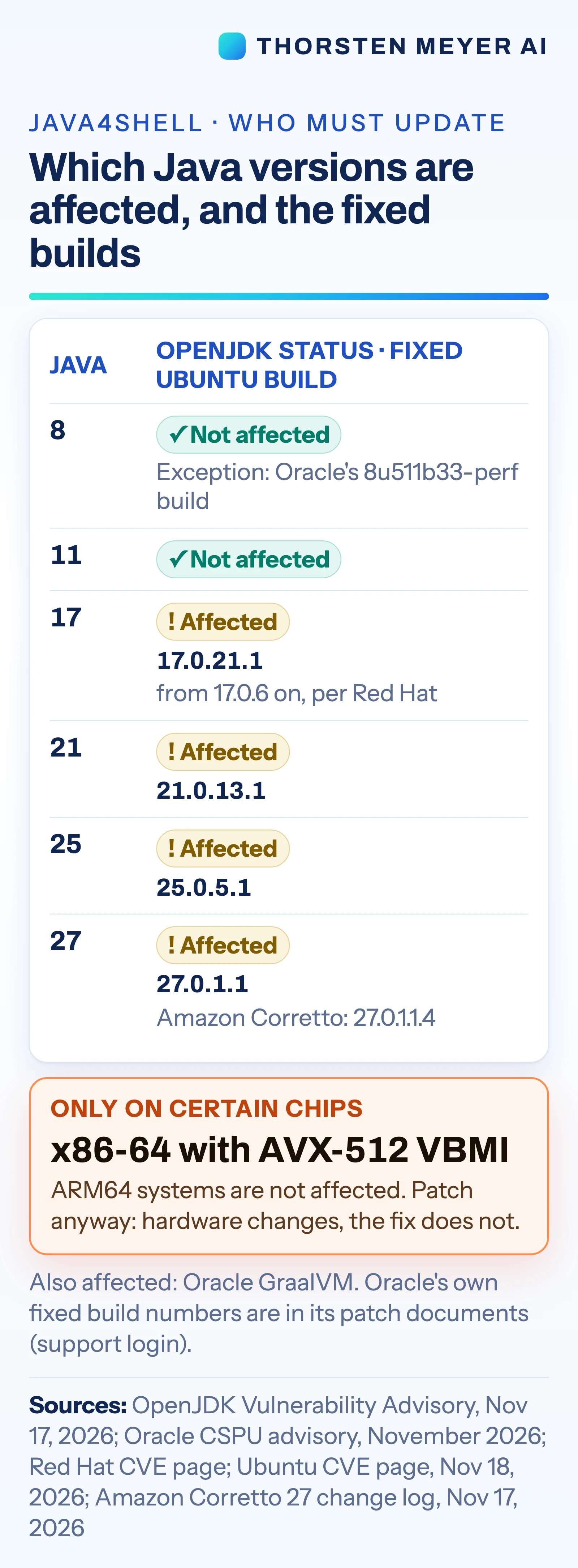
The reported scope has several limits. Advisories identify Java 17, 21, 25 and 27 runtimes, Oracle GraalVM, and a specific Oracle Java 8 build as affected. Red Hat says the vulnerable code entered OpenJDK with version 17.0.6; it says OpenJDK 8 and 11 do not contain that code. Exposure also requires an x86-64 processor with the AVX-512 VBMI instruction set and a program path that sends outside data to the decoder. Red Hat says ARM64 systems and x86-64 systems lacking that processor feature are not affected.
Oracle and OpenJDK published fixes on November 17. Oracle’s November Critical Patch Update includes 11 Java SE security patches among 655 patches across Oracle products. The supplied advisories identify CVE-2026-114938 as the highest-scored Java SE issue in that update. Administrators should apply the update for their distribution and check Java runtimes bundled inside other software and container images.
Which Java Systems Need Attention
The conditions narrow the affected systems, but Java may be embedded in servers, commercial products and container images that an organization does not track as separately installed runtimes. A system can therefore be missed if administrators check only their main Java installation. The practical priority is to identify Java deployments, determine their vendor and version, and patch exposed systems—especially services that accept external input.
The flaw also illustrates why vulnerability names and severity scores need context. Oracle rates it 8.1 out of 10 and describes exploitation as difficult; Red Hat rates it Critical at 9.8, while the finders assign 9.2 under CVSS 4.0. The National Vulnerability Database had not scored it in the source material. These differing assessments do not change the vendor advice to apply the fixes, but they reflect different scoring assessments rather than one agreed severity figure.
As of the cited CISA record, no exploitation was listed, and the vulnerability was not in the agency’s known exploited vulnerabilities catalogue version dated November 18. That status describes what had been reported at the time; it does not establish that exploitation could not occur later.
Products Worth Considering

Apple AirPods Pro 3 Wireless Earbuds with Active Noise Cancellation

DJI Mini 4K Drone with 4K UHD Camera, Under 249 g

Bose QuietComfort Ultra Earbuds (2nd Gen), Wireless Noise-Cancelling Earbuds, Black
As an affiliate, we earn on qualifying purchases.
How the Java Warning Emerged
CISA’s November 17 alert named Java4Shell, linked to Oracle’s advisory and urged organizations to patch. The name echoes Log4Shell, a widely known vulnerability in a Java logging library, but the issues involve different components. Java4Shell concerns a Base64 decoding routine in the virtual machine itself. The similar naming alone does not establish that the flaws have the same reach or exploitation conditions.
Oracle’s advisory says the issue can be exploited by supplying data to APIs in the affected component, such as through a web service. It excludes untrusted Java Web Start applications and applets from the stated route. The OpenJDK advisory lists Java 17, 21, 25 and 27, while leaving Java 8 and 11 unmarked; Red Hat separately describes the OpenJDK version boundary. Those vendor and distributor details are useful when checking a specific installation.
Oracle releases quarterly cumulative Critical Patch Updates and said its November 2026 package complemented that schedule. The supplied source identifies the November package as the route to the Java fix. Organizations should consult the advisory for their particular Java distribution because product builds and update channels can differ.
““strongly urges organizations to immediately patch” CVE-2026-114938”
— CISA
Exploit Activity and Scope
The source material reports no known exploitation in CISA’s record on November 17 and says the issue was absent from the November 18 known exploited vulnerabilities catalogue. That is a dated status, not a guarantee about later activity. The researchers said they were withholding product-specific attack chains while organizations had time to upgrade.
The exact number of vulnerable systems is not established in the supplied advisories. Determining exposure depends on runtime version and vendor, processor capabilities, and whether an application passes external data to the affected decoder. Severity ratings also differ, and the National Vulnerability Database had not yet published a score in the material provided.
Patch and Check Embedded Java
Organizations should install the November vendor update for each affected Java runtime, prioritizing internet-facing services and applications that process data from outside their network. They should inventory Java bundled in third-party products and container images, then follow the relevant vendor’s instructions for updating those components.
Administrators should continue to check vendor and CISA advisories for changes to affected-version details, severity assessments, and exploitation status. The supplied source does not identify a later CISA deadline or a separate follow-up milestone.
Key Questions
What is Java4Shell?
It is the name used by the flaw’s finders for CVE-2026-114938, a memory-corruption vulnerability in an optimized Base64 decoder in the x86-64 HotSpot Java Virtual Machine.
Which Java versions are listed as affected?
The advisories identify Java 17, 21, 25 and 27, Oracle GraalVM, and a specific Oracle Java 8 build. Red Hat says the vulnerable code entered OpenJDK at 17.0.6 and that OpenJDK 8 and 11 are not affected. Check the advisory for the exact product build.
Does every system running an affected Java version need to be exposed?
No. The reported conditions also include an x86-64 processor with AVX-512 VBMI and external data reaching the affected decoder. Red Hat says ARM64 systems and x86-64 systems without that processor feature are not affected by this flaw.
Has Java4Shell been exploited?
CISA’s record listed “Exploitation: none” on November 17, 2026, and the flaw was not in the cited November 18 known exploited vulnerabilities catalogue. Those are time-specific records and could change.
What should administrators do?
Apply the November update from the relevant Java vendor, starting with internet-facing services, and check for Java bundled inside other products and container images.
Source: Thorsten Meyer AI