
🔍 Read the full analysis: New NVIDIA Cosmos 3 Open Models For Interactive World Simulation on ThorstenMeyerAI.com

Get business pricing on monitors, keyboards and dev gear
- Business-only prices and quantity discounts
- Tax-exempt purchasing
- Multiple users, one account, clear invoices
TL;DR
NVIDIA has added four open-weight checkpoints to its Cosmos 3 Nano family for generating driving and robotics simulation observations. The models cover multi-view camera and LiDAR generation, simulator-to-video rendering, and action-conditioned video prediction, but independent performance results are not reported.
NVIDIA has released four open-weight checkpoints in its Cosmos 3 Nano family, targeting interactive world simulation for autonomous driving and robotics. The 16-billion-parameter models generate or predict visual and sensor observations from scene controls, simulator inputs, or robot actions, giving developers tools to explore simulated environments; their usefulness for policy training and evaluation has not yet been independently measured.
The checkpoints are named Cosmos3-Nano-Transfer-Auto, Cosmos3-Nano-Sim-Auto, Cosmos3-Nano-Sim-Transfer and Cosmos3-Nano-Sim-Bimanual. NVIDIA describes them as post-trained examples of Cosmos 3 Nano. The supplied material says the weights are available under the OpenMDW1.1 license, which allows commercial and non-commercial use subject to its terms. NVIDIA provides model checkpoints, technical material, demonstrations and inference guidance.
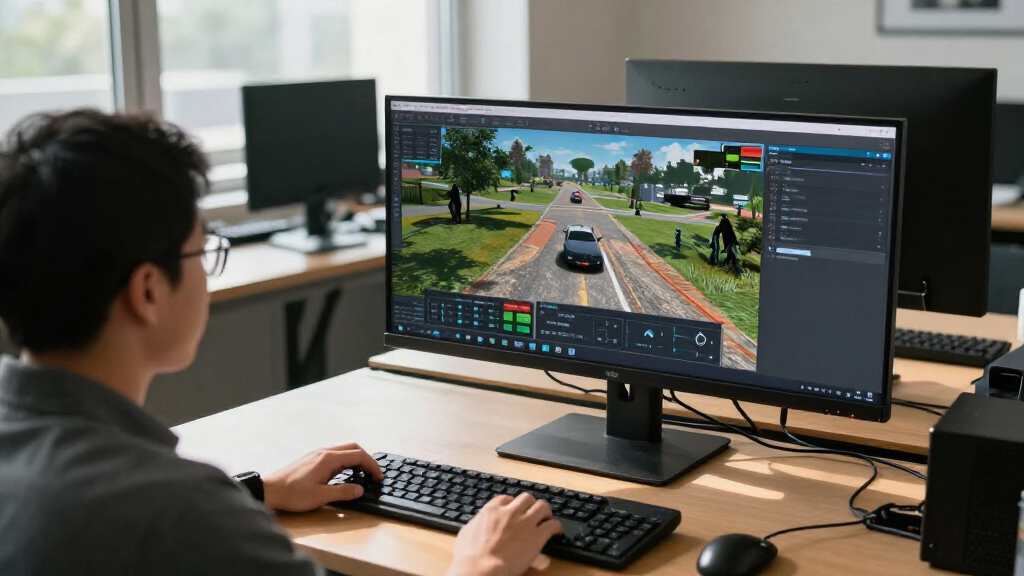
Transfer-Auto generates synchronized driving scenes across up to 11 camera views, including fisheye views, and can produce RGB video and LiDAR together. Developers can specify scene structure and traffic motion with per-camera World Scenario Map controls, while text prompts guide appearance. Sim-Auto builds on this approach to generate successive chunks of camera and LiDAR observations from generated history and updated driving controls. NVIDIA says closed-loop use also needs a simulation runtime and renderer to update those controls.
The remaining checkpoints target other parts of simulation. Sim-Transfer turns spatial controls from a physics simulator, together with a text prompt, into RGB observations; the simulator continues to manage physical state. Sim-Bimanual predicts scene changes in response to two-arm robot or camera actions, with support described for YAM and AgiBot embodiments. These are different approaches to generating observations, not replacements for every part of a simulation system.
NVIDIA Cosmos 3 Nano Open Models for Simulation
Four open-weight checkpoints generate or predict observations for driving and robotics simulation. Their value for policy training and evaluation still needs to be measured.
Four models, different roles
The checkpoints cover driving data generation, simulator rendering and robot action prediction.
Transfer-Auto
Generates synchronized multi-view camera and LiDAR scenes, guided by controls and text prompts.
Sim-Auto
Generates successive camera and LiDAR observations from history and updated driving controls.
Sim-Transfer
Turns physics-simulator spatial controls into RGB observations; the simulator retains physical state.
Sim-Bimanual
Predicts scene changes from two-arm robot or camera actions, with YAM and AgiBot support described.
From controls to observations
The models connect inputs from a simulator or actions to generated visual and sensor data.
Provide driving controls, simulator spatial information, or robot and camera actions.
A checkpoint produces camera video, RGB observations, LiDAR, or predicted scene changes.
Test sensor consistency and whether generated data helps policies on held-out tasks.
What developers can test
The release provides open weights and materials for adapting and evaluating the checkpoints.
- Vary driving scenes, lighting and traffic conditions.
- Explore how scenes respond to robot or camera movement.
- Adapt models to specific sensors and environments.
- How faithfully do outputs represent camera and LiDAR data?
- Do generated scenes improve policy learning or evaluation?
- How well do models perform across setups and changed conditions?
Access and terms
NVIDIA provides checkpoints, technical material, demonstrations and inference guidance.
From Simulated Scenes to Robot Actions
The release addresses a development problem for driving and robotics teams: building varied training and evaluation observations without relying solely on recordings from real-world runs. For driving work, paired camera and LiDAR generation could let researchers vary weather, lighting, road layouts and traffic signals while retaining multiple sensor views. For robotics, action-conditioned video prediction offers a way to examine how a scene might change as a robot or camera moves.
The streaming design of Sim-Auto is relevant because interactive systems must respond to successive actions, rather than produce only a fixed clip. In principle, generated observations connected to updated driving controls could support longer simulation rollouts. But that is a potential use, not a demonstrated result: its practical value depends on generation speed, observation fidelity and whether synthetic data improves policy learning or evaluation.
Open weights may also give developers a starting point to adapt models to their own sensors and environments. That access does not by itself establish that generated views accurately represent real sensor relationships, or that systems trained with them will perform reliably outside the simulation. The key question for researchers is whether the models add useful, testable coverage rather than merely producing plausible-looking scenes.
Products Worth Considering

DJI Mini 5 Pro Bundle with RC-N3 Controller, 1 50MP CMOS Camera Drone, 4K/120fps HDR, LiDAR Obstacle Sensing, Under 249g, ND Filter Kit (ND8

Anker SOLIX S2000 Portable Power Station, 2,010Wh, 1,500W

Jackery Solar Generator 1000 V2 with 100W Solar Panel, 1024Wh
As an affiliate, we earn on qualifying purchases.
Four Models, Different Simulation Roles
The four checkpoints share the Cosmos 3 Nano foundation but address distinct tasks. Transfer-Auto is described as an offline generator for driving data and a base that developers can adapt to a particular sensor setup or domain. NVIDIA’s material outlines a route from domain adaptation to causal training and few-step distillation for producing Sim-Auto, which generates successive observation chunks using a rolling history.
Sim-Transfer takes spatial information from a physics simulator—such as depth, segmentation, edges or a coarse layout—and renders color observations from it. In this arrangement, the simulator remains responsible for the physical state. Sim-Bimanual instead conditions video on robot and camera controls. The supplied material notes that it expects actions in a defined representation and describes a timing convention in which the sequence includes one more observation than transitions.
Together, the models are presented as complementary components for research rather than one self-contained simulation environment. The release includes open checkpoints and post-training material intended to support adaptation and comparison. The source material does not provide independent evaluations or direct comparisons with other simulation systems.
“These problems remain hard: the work ahead is to measure where the models faithfully support policy learning and evaluation, understand their limits, and improve where they fall short.”
— NVIDIA, in the supplied Hugging Face model material
Performance and Fidelity Still Open
The supplied material reports no independent performance results, benchmark comparisons or evidence that using generated data improves real-world performance. It also gives no quantified generation speed, visual or sensor fidelity, or results for scenes outside the models’ training and adaptation data. The value of these checkpoints for policy learning and evaluation therefore remains unverified.
Specific technical questions include whether synchronized camera and LiDAR outputs preserve the relationships downstream systems require, and how reliably the models handle different sensor rigs and environments. Sim-Auto’s interactive use depends on a runtime and renderer, while adapting a driving model to a new setup begins with Transfer-Auto. The release describes these dependencies and conventions but does not report robustness across deployments.
Researchers Must Test Real Use
Researchers and developers can download the checkpoints and consult NVIDIA’s technical report, demonstrations and inference instructions. A next step is to adapt the driving model to specific sensors or environments, then test both offline generation and streaming simulation against measured observations. Those evaluations can establish how closely generated outputs match relevant sensor data and whether the models remain useful as conditions change.
Further testing will also need to examine whether policies trained or assessed with the generated observations behave reliably under changed conditions. Until such results are available, NVIDIA’s release establishes access to the models and describes their intended roles; it does not settle their performance or impact on real-world driving and robotics systems.
Key Questions
What did NVIDIA release?
NVIDIA released four open-weight Cosmos 3 Nano checkpoints for driving and robotics simulation: Transfer-Auto, Sim-Auto, Sim-Transfer and Sim-Bimanual.
What can the driving models generate?
Transfer-Auto can generate synchronized driving observations across up to 11 camera views and produce RGB video with LiDAR. Sim-Auto generates successive camera and LiDAR observation chunks based on generated history and updated controls.
Do the models prove that synthetic data improves robotics or driving policies?
No. The supplied material does not report independent results showing improved policy training or evaluation. That remains an area for testing.
Can Sim-Auto run as a complete closed-loop simulator on its own?
NVIDIA says interactive closed-loop use also requires a simulation runtime and renderer to update driving controls.
What is not yet known about the release?
The supplied source does not quantify generation speed or fidelity, compare the models with other simulation systems, or establish how well they work across unfamiliar environments and sensor setups.
Primary source: Hugging Face · via ThorstenMeyerAI.com