
TL;DR

Get business pricing on monitors, keyboards and dev gear
- Business-only prices and quantity discounts
- Tax-exempt purchasing
- Multiple users, one account, clear invoices
Brennen Puth published an essay on Oct. 24 arguing that websites should offer a better experience when printed. He describes using print-specific CSS to adjust type, remove page elements and improve links, then says feedback led him to simplify the stylesheet.
Software developer Brennen Puth published an essay on October 24 arguing that websites should be designed to print legibly, after finding that his own page produced an awkward printout without changes. He outlined CSS adjustments for printed text and page elements, then wrote in an October 26 update that reader feedback had led him to simplify the stylesheet.
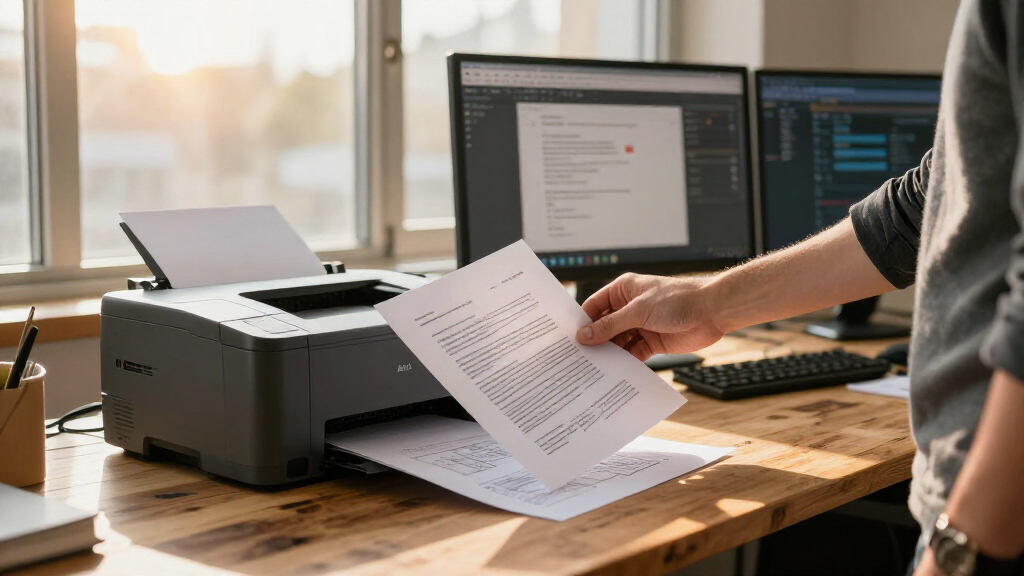
Puth says he reads many papers in print and finds that marking up a physical document helps him engage with the material. When he tried printing his own website using the browser’s usual print command, he found the text too large, the header unattractive on paper and links difficult to distinguish in grayscale. He said the page’s content remained visible, but the result fell short of what he wanted readers to receive.
His proposed fix uses CSS print styles, which let a site apply different rules when a browser renders a page for printing. In the example he shared, a “noPrint” class hides elements such as the site header, while an “onlyPrint” class shows content intended for paper. The stylesheet also sets print-specific font sizes and changes link color to black.
Puth said he set body text at 12 points and made headings larger, with separate rules for code blocks. He acknowledged that code blocks remained difficult because they can be treated as a single chunk and may not fit cleanly across page breaks. In an update dated October 26, he said feedback on Hacker News and Lobsters had exposed things he had missed and that he was simplifying his stylesheet.
Print Styles Expand Reader Choice
The post makes a practical case for treating printing as one way people use websites, rather than assuming every reader will stay on a screen. For pages that are primarily text and reference material, print-specific styling can remove navigation or decorative elements that take up paper while keeping the main content readable.
Puth frames the work as a small act of consideration for users, not a claim that most people print webpages. He acknowledges that he does not know how many readers regularly do so and allows that he may be unusual. The point is that a site can accommodate different reading preferences, including annotation on paper, without changing the version shown on screen.
The example also shows that the feature may require extra design and testing. Puth says adjusting his own relatively simple site took a substantial part of his morning. That trade-off matters to web developers deciding how much effort to put into a less common use case: his argument is that even an occasional reader may benefit from a page that prints cleanly.
Products Worth Considering

Amazon Kindle Paperwhite Signature Edition (12th Generation, 2024), 32 GB, Metallic Black

Sonos Era 100 Wireless Smart Speaker, Black

Bose QuietComfort Wireless Noise-Cancelling Over-Ear Headphones, Black
As an affiliate, we earn on qualifying purchases.
A Print Layout for the Web
Web browsers have long offered a way to print HTML pages, and CSS includes rules for styling content specifically for print. Puth’s essay is not an announcement of a new browser feature or a formal study of printing habits. It is a personal report about trying those existing tools on his own site and explaining why the default output did not satisfy him.
His sample stylesheet focuses on a few visible changes: hide the site header, add an author attribution intended only for print, set more consistent type sizes and make links black for monochrome printing. He also adjusts the appearance of code blocks. Puth invites readers to reuse the CSS, but notes that the code-block treatment still needs work.
The post was updated on October 26 after Puth said it had reached the front page of Hacker News and Lobsters following submissions to those communities. He credited feedback from readers and a friend with prompting him to revisit the stylesheet. The report does not give traffic totals or quantify how many people printed the page.
“I would personally love to experience more webpages that think about how printing works.”
— Brennen Puth
Printing Habits and CSS Issues
The essay does not establish how common it is for people to print webpages, or whether print-specific styling changes reader behavior. Puth explicitly says he is unsure how many people regularly print pages and allows that he may be the only one among his readers who does so frequently. No survey, usage data or broader industry response is included.
It is also unclear what changes Puth made after the October 26 update, beyond his statement that he was simplifying the stylesheet. He does not publish a final revised version in the supplied material. The handling of code blocks across page breaks remains an open issue in his account, and he does not identify a solution.
A Revised Stylesheet to Come
Puth said he was simplifying his print CSS after receiving comments from readers on Hacker News and Lobsters. The post does not set a date for another update or specify which suggestions he plans to adopt. Readers can test the current page through their browser’s print preview, but the final appearance may also depend on browser, printer and print settings.
The broader outcome remains open: the essay is a personal appeal, not evidence that websites are changing their practices. Puth’s next stated step is to refine his own stylesheet; whether other developers adopt similar print rules is not reported.
Key Questions
What is Puth asking website developers to do?
He argues that developers should use print-specific CSS so webpages remain readable on paper, with unnecessary elements hidden and text styled for print.
What did Puth change on his own site?
His example hides the site header in print, adds an attribution intended for paper, adjusts font sizes and changes links to black for grayscale printing. It also includes styling for code blocks.
Did Puth say many people print webpages?
No. He said he does not know how many people regularly print webpages and acknowledged he may be unusual in doing so. The post provides no usage statistics.
What remains difficult in the print layout?
Puth said code blocks were still awkward because they tend to appear as one chunk and may not break well across pages. He did not provide a final solution.
Why did Puth update the post?
He said feedback from readers on Hacker News and Lobsters, along with comments from a friend, pointed out issues he had missed. On October 26, he said he was simplifying the stylesheet.
Source: hn