
📊 Full opportunity report: Keep Creator And Agency Social Media Projects In Sync on IdeaNavigator AI — validation score, market gap, and execution plan.

Get business pricing on monitors, keyboards and dev gear
- Business-only prices and quantity discounts
- Tax-exempt purchasing
- Multiple users, one account, clear invoices
TL;DR
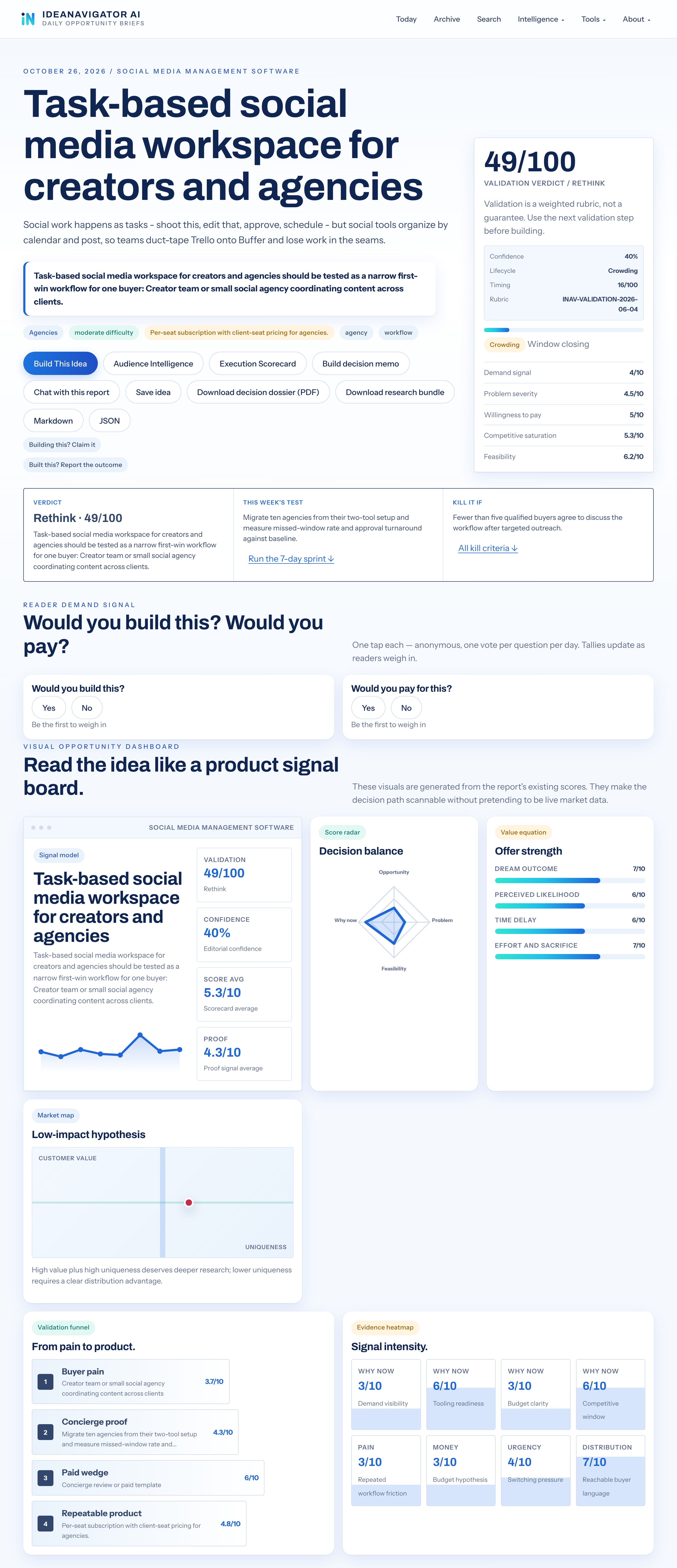
IdeaNavigator AI has outlined a product opportunity for a social media workspace that tracks each post from brief through approval and scheduling. The proposal is to test it with 10 agencies and compare missed publishing windows and approval turnaround with their current two-tool setups; no product launch or test results are reported.
IdeaNavigator AI has proposed testing a task-based social media workspace for creator teams and small agencies, designed to track posts from brief and asset preparation through editing, client approval and scheduling. The proposal identifies a workflow gap between social scheduling platforms and general project-management tools, but it does not announce a product launch or report that the concept has been tested.
The suggested first customers are creator teams or small social agencies coordinating posts across multiple clients. The problem described is that production work unfolds through tasks—such as shooting, editing and getting approval—while social tools often organize work around calendars and individual posts. Teams may combine a scheduling product with a separate project tool, creating handoffs between systems.
The proposed minimum viable product would make each post a task with stages for brief, asset, edit, approval and scheduling. It would include client-facing approval links and asset versioning, then connect approval to native scheduling. The intended workflow is a single pipeline from an idea to publication, rather than a claim that an existing product already provides those features.
For validation, IdeaNavigator AI recommends moving 10 agencies from their current two-tool setups and measuring missed publishing windows and approval turnaround against a baseline. The proposal also suggests a per-seat subscription, with pricing for agency client seats. No participating agencies, baseline figures, pricing, test duration or results are specified.
Aiming to Close Workflow Gaps
The proposal focuses on the work between deciding what to publish and getting a post live. If briefs, files, revisions and approvals sit in different tools, teams may have to track status manually and repeat information across systems. A workspace that ties those steps to each post could make responsibility and approval status easier to follow, particularly when an agency handles several clients.
Those benefits remain product hypotheses, not demonstrated outcomes. The suggested test measures two practical indicators: missed-window rate and approval turnaround. Comparing them with agencies’ existing workflows could show whether consolidation improves day-to-day coordination enough to support a paid product. Without results, the proposal does not establish that teams would save time, publish more reliably or switch from their current tools.
The idea also targets a distinction in software design: scheduling tools are built around publishing, while general project-management products can track tasks but may not be organized around the particulars of social posts. A focused workflow might reduce that gap, though its value would depend on how well it handles clients, revisions and the scheduling systems teams already use.
Products Worth Considering

Bose QuietComfort Ultra Earbuds (2nd Gen), Deep Plum

Logitech MX Mechanical Wireless Illuminated Keyboard, Tactile Quiet, Graphite

Bose TV Speaker (2nd Gen) Compact Soundbar with Bluetooth and HDMI Connectivity
As an affiliate, we earn on qualifying purchases.
From Calendars to Production Tasks
The opportunity is framed within the social media management software market. Many teams plan content on calendars and use scheduling tools to publish it, while production involves a sequence of work that starts before a post is ready. The proposal argues that teams can end up combining these publishing tools with generic project software to coordinate production.
Its timing rationale is that expectations for content volume have increased the number of workflows teams must manage, while scheduling-tool providers have left much of the work-management layer to general-purpose tools. These are the proposal’s market assumptions; it provides no industry statistics, named competitors, customer interviews or independent evidence to quantify the trend.
The recommended approach is deliberately narrow: start with one buyer group—creator teams or small agencies—rather than building for every type of social media department. A 10-agency trial would test whether a combined pipeline addresses a specific coordination problem before broader product investment. No company, working software or trial has been identified in the proposal.
No Pilot or Product Results Yet
The proposal does not identify a product team, company, launch schedule or agencies willing to participate. It also gives no evidence that the described workflow has been built or that the suggested features can connect reliably with existing social platforms.
Key details of the test remain open, including what counts as a missed publishing window, how approval turnaround would be measured, which baseline period would be used and how results would account for differences among agencies. The proposal gives no prices or evidence of willingness to pay for seat-based or client-seat subscriptions.
It is also unclear whether agencies would replace their existing tools or continue using them alongside the proposed workspace. Until a test is conducted and its methods and results are reported, claims about improved coordination or publishing performance remain unverified.
Testing the Agency Workflow
The next step described is a 10-agency validation test. It would begin by documenting each participant’s existing two-tool workflow and establishing baseline measures for missed publishing windows and approval turnaround. The agencies would then move their work into the proposed pipeline so those measures could be compared.
No timeline or test protocol has been announced. A useful report of any future trial would specify the duration, participating agency profiles, measurement definitions and whether results varied across teams. It would also need to show how client approvals, asset versions and scheduling performed in practice, and whether users found the combined workflow worth adopting.
Until those details or results are available, the development is best understood as a product opportunity and validation plan, rather than news of a launched service. The proposal’s next meaningful milestone would be evidence from agencies using a working version of the workspace.
Source: IdeaNavigator AI
Key Questions
Has a task-based social media workspace launched?
No launch is reported. IdeaNavigator AI has outlined a product concept and a way to test it, but the proposal does not identify a finished product or release date.
Who is the proposed workspace for?
The proposed first users are creator teams and small social agencies that coordinate content across clients.
What features would the proposed product include?
The suggested MVP would track each post through brief, asset, edit, approval and scheduled stages, with client approval links, asset versioning and scheduling after approval.
How would the idea be validated?
IdeaNavigator AI recommends testing the workflow with 10 agencies moving from two-tool setups, then comparing missed publishing windows and approval turnaround with baseline measures. No test results are available.
How would the product make money?
The proposal suggests a per-seat subscription and separate client-seat pricing for agencies. Prices and customer demand have not been established.
Source: IdeaNavigator AI