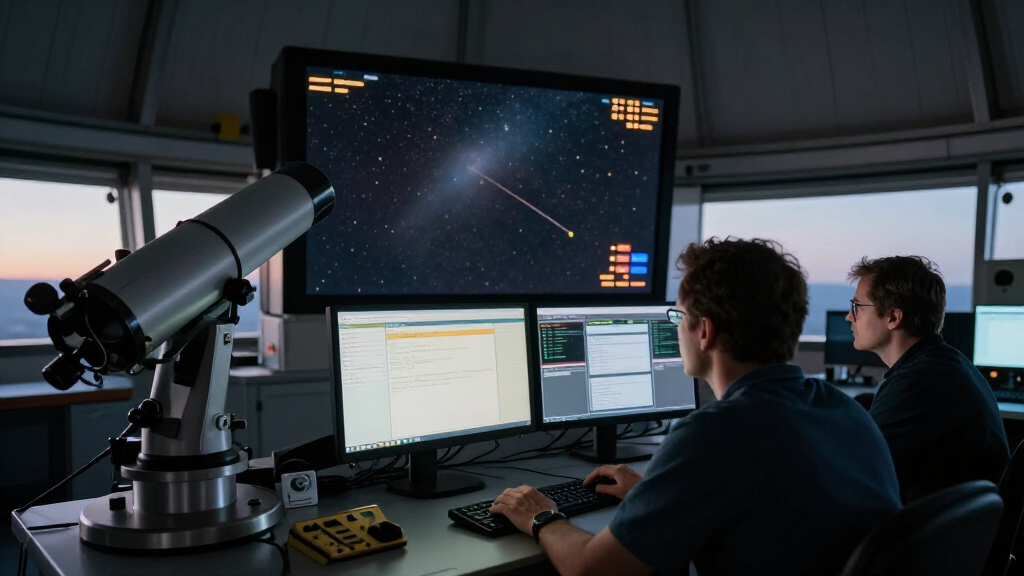

🔍 Read the full analysis: Why The Held-Light Approach Suits “OORT — Comet Vigil For P/2043 K1 Vesper” on ThorstenMeyerAI.com

Get business pricing on monitors, keyboards and dev gear
- Business-only prices and quantity discounts
- Tax-exempt purchasing
- Multiple users, one account, clear invoices
TL;DR
OORT — Comet Vigil for P/2043 K1 Vesper is an AI-built exhibition about a fictional comet, presented as an interactive observatory. Its star trails accumulate while a visitor stays, and scrolling moves the comet through an imagined orbit; the work records attention rather than suggesting a real astronomical discovery.
OORT — Comet Vigil for P/2043 K1 Vesper, an AI-built web exhibition, makes a visitor’s time on the page part of its artwork: seeded stars form curved trails that grow as the visit continues, as explored in the original analysis. The observatory and comet are fictional, so the piece is not reporting an astronomical observation; it uses simulated instruments and a record of attention to explore how a website can represent waiting.
The exhibition’s central device is what its description calls “held light.” A canvas draws star trails around a point below the visible screen, extending their arcs over time. A repeatable seed keeps the field consistent on the same device, while local storage preserves elapsed time so the sky can resume when a visitor returns. The effect makes duration visible rather than treating it as time spent before reaching the main content.
Other elements give the page the feel of an observatory log. A scroll-linked inline SVG moves the imagined comet through its orbit, with an ion tail shown pointing away from the sun and a dust tail bending along the orbit. The geometry, distance and year share a progress value. A range control changes a defocus view and its associated brightness estimate. Visitors can also hold a control to open a simulated shutter; the site records a timestamp, but does not claim that the comet has been seen.
The design description says the animation stops when the page is hidden and that people using reduced-motion settings receive a still version. Its visual system uses a dark observatory palette: cyan marks the ion tail and readings, amber-red indicates instructions and actions, and pale dust-colored text carries longer passages. Display lettering and monospaced coordinates reinforce the impression of an instrument panel and field log.
FABLE/175 · Room 170 · Interactive Web Art
Why the Held-Light Approach Suits “OORT — Comet Vigil for P/2043 K1 Vesper”
An AI-built exhibition turns a visitor’s time on the page into part of the artwork. A fictional comet, simulated instruments and growing star trails make waiting visible while keeping the work distinct from a real astronomical report.
01 / How the page makes time visible
Attention becomes the artwork’s exposure
OORT changes through duration rather than through a race to a destination. Its interface behaves like an observatory: simulated instruments and a continuing sky make the act of waiting part of the experience.
Trails grow
A canvas draws curved star trails around a point below the visible screen. The arcs extend as the visit continues.
A persistent sky
A repeatable seed keeps the field consistent on the same device. Local storage preserves elapsed time so the sky can resume later.
Shutter without proof
Holding a control opens a simulated shutter and records a timestamp. It does not claim to capture or reveal the comet.
02 / A visitor’s path through the simulation
One progress value connects the imagined instruments
03 / Signals in the instrument panel
Color and controls reinforce the observatory mood
The visual language separates readings, actions and long-form notes. A range control changes a defocus view and its associated brightness estimate; that estimate belongs to the simulation, and its scientific validity is not established by the source.
Built into the experience
- Scrolling links the diagram to an imagined orbit.
- Animation is described as pausing when the page is hidden.
- A still version is described for reduced-motion settings.
Specified in the brief
- Keyboard focus styles, readable contrast and responsive layouts.
- Capped animation work and visuals made from code.
- Long exposure, two comet tails, invented logs and an ephemeris table.
04 / The idea in one line
“The page makes duration part of the artwork instead of treating it as time spent before the content.”
OORT exhibition description05 / Fiction, evidence & limits
An observatory mood, not an astronomical announcement
What the source says
P/2043 K1 Vesper and its observatory are fictional. OORT is an artwork about waiting and attention, not a report of a comet discovery. Its shutter logs participation; it does not provide evidence that the comet was observed.
What remains unverified
The supplied material does not establish the room’s launch date, current live behavior, browser support, or independent accessibility and performance test results. References to historical sightings and vigil logs are fictional brief content, not verified records.
06 / Key questions
Quick answers for visitors
Is P/2043 K1 Vesper real?
No. The source describes the comet and observatory as fictional; the exhibition is an artwork.
What changes while I stay?
A seeded field draws longer curved trails. According to the description, local storage lets the same device resume the elapsed exposure.
Does the shutter show an image?
No. It simulates opening a shutter and records a timestamp. The comet remains unseen and in transit.
Are accessibility goals independently verified?
The description gives behaviors and goals, including reduced motion and pausing hidden-page animation, but provides no independent test results.
How the Page Makes Time Visible
OORT matters as a small but clear example of interactive web art in which the interface is not merely a frame around the content. A conventional page often rewards a visitor for clicking through or reaching a destination. Here, the principal visual change comes from staying: the trails accumulate, and returning to the same local sky gives that time a continuing record.
The simulated shutter extends the idea without pretending to offer evidence. By logging a timestamp while leaving the comet unseen, the work distinguishes participation from observation. That restraint is relevant because the title and scientific language could otherwise be mistaken for an astronomy report. The source explicitly identifies both the observatory and P/2043 K1 Vesper as fictional.
The project also presents a practical design proposition: motion, stored state and scrolling can carry meaning when their behavior supports the subject. Its notes describe pausing animation when a tab is hidden and simplifying it for reduced-motion preferences. Those choices frame the piece not just as a visual concept but as a browser experience intended to account for different viewing conditions.
As an affiliate, we earn on qualifying purchases.
Inside FABLE/175’s Observatory Room
OORT is identified as room 170 of 175 in the FABLE/175 series of AI-built exhibition pieces. The source says the room’s footer links to the art-direction prompt that shaped it, and points visitors to a separate design guide for the build notes. It describes the work as an exhibition and a reproducible technical study, though the supplied material does not independently verify how the site was built or tested.
The prompt calls for a single-page experience using HTML, CSS and JavaScript, with visuals made from code rather than image assets. It specifies a long-exposure effect, an animated comet with two distinct tails, invented observing logs and an ephemeris table. It also sets accessibility and performance goals, including keyboard focus styles, readable contrast, responsive layouts and capped animation work. These are requirements in the brief; the source material does not provide independent test results for every requirement.
““The page makes duration part of the artwork instead of treating it as time spent before the content.””
— OORT exhibition description
As an affiliate, we earn on qualifying purchases.
What the Exhibition Does Not Verify
The source identifies P/2043 K1 Vesper as fictional and gives no evidence of a real comet, observatory or observing community behind the premise. The references to decades of watching, a last sighting in 1608, and amateur vigil logs appear in the art-direction brief as fictional content ideas, not verified historical or astronomical records.
It is also unclear from the supplied material when the room went live, whether the live site currently behaves exactly as described, or whether its accessibility and performance targets have been independently tested. The description reports that trails use local storage and that motion pauses under certain conditions, but provides no browser support details, test data or independent review. The stated brightness estimate is part of the simulation; its method and scientific validity are not established by the source.
As an affiliate, we earn on qualifying purchases.
The Room and Its Design Guide
The source directs readers to visit the live OORT room and consult its design guide for further details on the seeded exposure, SVG orbit, palette and typography. It also invites visitors to explore the other rooms in the 175-room FABLE/175 project. No additional release, scientific milestone or future update is specified, so the next step described is exploration of the existing exhibition rather than a forthcoming comet event.
As an affiliate, we earn on qualifying purchases.
Key Questions
Is P/2043 K1 Vesper a real comet?
No. The source describes the comet and its observatory as fictional; OORT is an artwork, not an announcement of an astronomical discovery.
What changes while a visitor stays on the page?
A seeded field of stars draws longer curved trails as time passes. According to the description, local storage preserves elapsed time on the device so the same sky can continue when a visitor returns.
Does the shutter interaction show a real image?
No. Holding the control opens a simulated shutter and records a timestamp. The exhibition says the comet remains unseen and in transit.
How does the comet diagram respond to visitors?
Scrolling moves the imagined comet through an inline SVG. The described diagram keeps the ion tail directed away from the sun and curves the dust tail along the imagined orbit; both respond to the same progress value.
What is confirmed about accessibility and performance?
The source describes goals and behaviors including pausing animation when the tab is hidden and providing a still version for reduced-motion settings. It does not include independent test results confirming that every accessibility or performance target has been met.
Source: ThorstenMeyerAI.com
Fall Picks
fall essentials
As an affiliate, we earn on qualifying purchases.