
TL;DR

Get business pricing on monitors, keyboards and dev gear
- Business-only prices and quantity discounts
- Tax-exempt purchasing
- Multiple users, one account, clear invoices
A 10-minute documentary made by artist Prune Nourry, director Vincent Lorca and Google Arts & Culture uses archival research and generative AI to recreate the studios of women sculptors who worked in Paris. The film accompanies Nourry’s “Visionaries” exhibition at the Petit Palais, running from October 20, 2026, to January 30, 2027.
Prune Nourry and Google Arts & Culture have produced a 10-minute documentary that uses generative AI to recreate the Paris studios of historical women sculptors, accompanying Nourry’s “Visionaries” exhibition at the Petit Palais. The exhibition opened October 20 and presents monumental plaster portraits of 18 women artists. The film and exhibition focus on the artists’ work and historical visibility.
The documentary was made with film director Vincent Lorca after a year of research by three art historians. The research drew on letters, journals and photographic portraits of women sculptors who lived and worked in Paris. According to Google’s account, surviving photographs of the artists’ actual workspaces are scarce, so the film uses AI-generated reconstructions rather than presenting the studios as fully documented photographic records.
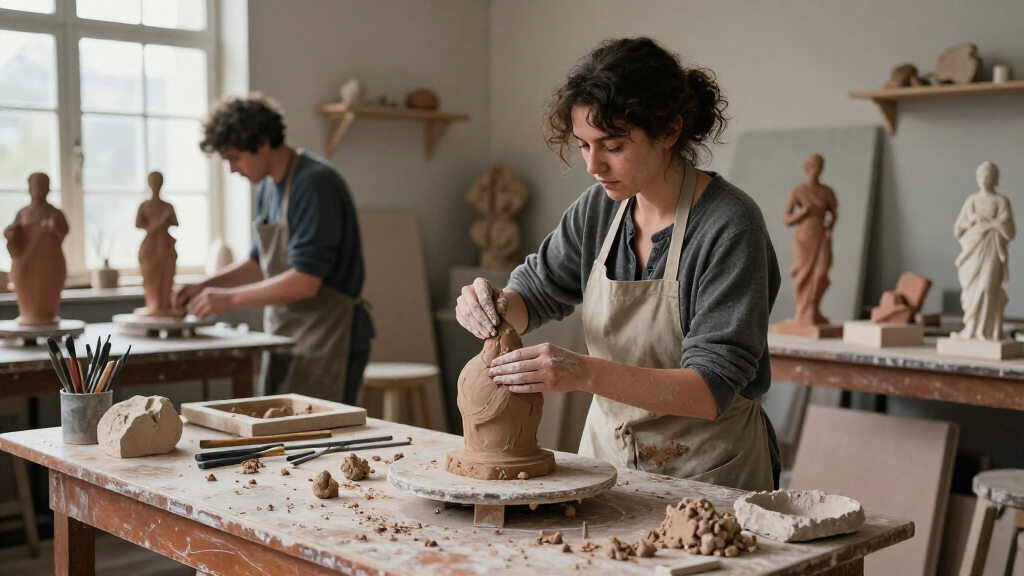
Lynn Cherny, a creative technologist-in-residence at the Google Arts & Culture Lab, used Google’s generative AI and image-editing models to create scenes associated with sculptors including Nancy Elizabeth Prophet, Jane Poupelet and Camille Claudel. A custom tool built with Google Gemini turned archival photographs into 3D models, which the team used to animate camera paths and give viewers a virtual walk-through of reconstructed rooms.
A separate sequence, conceived by Nourry and Lorca, edits an archival photograph of Antoine Bourdelle’s studio so that female students gradually fade from view, leaving the men in the image. The film presents the effect as a depiction of women’s marginalization in accounts of art history. Google says the documentary is installed in the museum galleries alongside the exhibition; a behind-the-scenes trailer is available online through Google Arts & Culture.
Making Women Sculptors Visible
Google’s report says women in the late 19th and early 20th centuries worked in Paris despite social restrictions and limited access to artistic training, but were often remembered as models or muses rather than as artists. The exhibition’s portraits and the documentary’s focus on working spaces draw attention to their creative practice and legacies.
The project uses AI to create virtual interpretations of settings for which direct visual documentation is limited. The resulting rooms are not primary historical evidence; their interpretation depends on distinguishing archival material from generated imagery.
As an affiliate, we earn on qualifying purchases.
Research Behind the Reconstructions
“Visionaries” centers on 18 historical female sculptors through monumental plaster portraits made by Nourry. It opened at the Petit Palais on October 20, 2026, alongside Art Basel Paris, according to Google’s announcement. The exhibition is scheduled to remain on view until January 30, 2027, with the film installation presented in the museum galleries.
The film’s production began with a year of research by three art historians, who gathered written and photographic records. Google describes the lack of photographs showing the artists’ actual studios as a reason for using generative tools. The reconstructions are based on available archival material and AI-assisted modeling; the source does not provide a detailed account of how each architectural or decorative element was verified.
““Because few historical photos of their actual workspaces exist,” the team used generative AI and image-editing models to bring the studios to life.”
— Google Arts & Culture’s announcement
As an affiliate, we earn on qualifying purchases.
Limits of the Studio Evidence
The source does not specify which features of each reconstructed studio come directly from archival records and which were inferred or generated. It also does not provide an independent evaluation of the reconstructions’ historical accuracy or details about how historians reviewed the AI-generated settings. The film is therefore an interpretive reconstruction, not a definitive record of what every studio looked like.
Google’s announcement describes the tools used but does not report technical performance measures or explain whether the models were trained or adjusted specifically for this project. The article also gives no attendance figures or audience response, and it does not detail how the museum labels generated imagery for visitors.
As an affiliate, we earn on qualifying purchases.
Exhibition Runs Through January
The “Visionaries” exhibition and its accompanying film installation are scheduled to remain at the Petit Palais through January 30, 2027. Google Arts & Culture has also published a behind-the-scenes trailer online. The source does not announce further screenings, touring plans or additional project releases, so any presentation beyond the Paris exhibition remains unconfirmed.
art restoration and preservation supplies
As an affiliate, we earn on qualifying purchases.
As an affiliate, we earn on qualifying purchases.
Key Questions
What is the documentary about?
It uses archival research and Google AI tools to create virtual reconstructions of studios associated with women sculptors who lived and worked in Paris, including Nancy Elizabeth Prophet, Jane Poupelet and Camille Claudel.
Where can visitors see the project?
The film installation accompanies Prune Nourry’s “Visionaries” exhibition at the Petit Palais in Paris. Google says a behind-the-scenes trailer is also online through Google Arts & Culture.
How were the studios recreated?
The team used archival photographs and other research materials. A custom tool built with Google Gemini helped turn archival photos into 3D models, which were used to animate virtual camera paths.
Are the reconstructed studios historical photographs?
No. They are AI-assisted reconstructions made because few historical photographs of the sculptors’ actual workspaces exist. The source does not specify how every reconstructed detail was verified.
How long is the exhibition on view?
The Petit Palais exhibition opened October 20, 2026, and is scheduled to close January 30, 2027.
Source: rss
Evergreen bestsellers Picks
bestsellers
As an affiliate, we earn on qualifying purchases.