

Get business pricing on monitors, keyboards and dev gear
- Business-only prices and quantity discounts
- Tax-exempt purchasing
- Multiple users, one account, clear invoices
Key Takeaways
- Postman remains the dominant force for rapid prototyping and team collaboration, but code-based frameworks like Playwright offer better version control integration.
- AI-driven testing guides, such as AI Testing with Python, signal a shift toward intelligent test generation, though they require strong foundational Python skills.
- Specialized guides like FastAPI Testing with Pytest provide niche value for specific tech stacks, outperforming generic tools for Python-native developers.
- Beginner-focused resources like API Testing for Beginners bridge the gap between manual exploration and automated CI/CD pipelines effectively.
- Documentation quality is as critical as the tool itself; guides that teach design-first approaches yield more maintainable test suites than those focusing solely on execution.



More Details on Our Top Picks
Practical Postman: Testing, Documenting, and Automating APIs Like a Pro
Practical Postman is the clearest fit for readers who want to build API tests and automation around one widely used tool rather than assemble a code-first framework. Its coverage connects testing, documentation, and automation, which can help developers keep those tasks within a single workflow. Compared with Postman for API Developers: Design, Test, and Automate APIs, this title puts testing and automation more directly in the foreground; the other book gives API design a more explicit place. The tradeoff is that the guidance is Postman-specific, so readers seeking Python-based suites or Playwright-driven API checks should choose a different path. The listing promises practical examples and suitability across skill levels, but gives no edition or technical detail with which to judge how current its instructions are.
Pros:- Covers API testing, documentation, and automation together
- Practical examples and tips are part of the stated focus
- A Postman-centered approach may suit readers who prefer a unified tool workflow
Cons:- The material focuses solely on Postman
- The listing provides no edition, technical specifications, or detail on feature coverage
Best for: Developers and testers who want practical guidance for automating API checks within a Postman-centered workflow.
Not ideal for: Teams standardizing on Python, Robot Framework, or Playwright who need examples tied to those tools rather than Postman.
- Format:Book
- Primary tool:Postman
- Main focus:API testing
- Additional topics:Documentation and automation
- Stated audience:Developers of all skill levels
- Example style:Practical examples and tips
Our verdict“Choose this book if you want a practical Postman-focused route into API testing and automation, not a language-specific framework guide.”
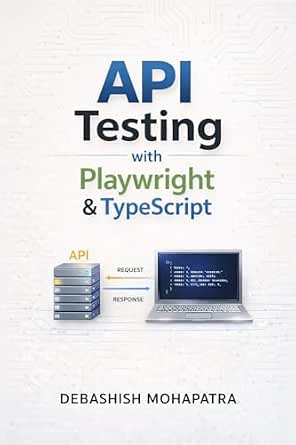
API Testing with Playwright & TypeScript: A Practical Guide from Zero to Expert
This is the most direct match for readers who want API testing inside a Playwright and TypeScript workflow. The stated progression from beginner to expert makes it a candidate for teams adopting the stack as well as testers building on existing skills. Compared with Practical Postman, it points toward code-based tests rather than a Postman-centered process; that can better suit projects where API checks live alongside automated application tests, but it also ties the learning path to a particular language and framework. The description promises real-world examples and best practices, though it gives no chapter list, prerequisites, or edition information. That lack of detail makes it harder to judge depth, especially for readers who need advanced coverage of authentication, test data, or CI pipelines.
Pros:- Focuses specifically on API testing with Playwright and TypeScript
- Claims a learning path from beginner to expert
- Includes practical examples and real-world testing guidance
Cons:- The framework and language focus may not fit teams using other stacks
- The listing gives no prerequisites or chapter-level detail
- The available description does not clarify coverage of CI, security, or advanced API scenarios
Best for: Test engineers and TypeScript developers who want to add API checks to a Playwright-based automated testing workflow.
Not ideal for: Readers who need a language-neutral introduction or teams whose API automation is built around Postman or Python.
- Format:Book
- Primary framework:Playwright
- Programming language:TypeScript
- Main focus:API testing
- Stated level range:Beginner to expert
- Coverage:Concepts, best practices, and real-world examples
Our verdict“Pick this guide if your team wants API tests written in TypeScript with Playwright; choose a Postman or Python title for a different stack.”
API Testing with Python and Robot Framework
API Testing with Python and Robot Framework gives readers a distinct alternative to the TypeScript route in API Testing with Playwright & TypeScript: it centers API automation on Python and Robot Framework. That combination may suit teams that want structured, readable tests and already work within Python-based tooling. The book is described as covering core techniques and best practices, with practical examples for different experience levels. However, the description does not say how Robot Framework is used, what Python knowledge is assumed, or whether the examples address CI integration and test data. Compared with The Complete API Testing Handbook, this title is more clearly defined by its automation framework, while the handbook explicitly adds validation and security. Choose this one for a framework-led learning path, not broad coverage of the API testing lifecycle.
Pros:- Pairs Python with the specifically named Robot Framework
- Focuses on automating API tests
- The description promises practical examples and guidance for different skill levels
Cons:- Prerequisites and assumed Python knowledge are not specified
- The description does not clarify framework depth or CI coverage
- Its framework-specific approach may not transfer directly to other automation stacks
Best for: Python teams and QA engineers who want to learn API automation through Robot Framework and practical examples.
Not ideal for: Readers seeking a broad API testing reference with stated security coverage, or teams committed to Postman or TypeScript.
- Format:Book
- Programming language:Python
- Automation framework:Robot Framework
- Main focus:API testing automation
- Coverage:Testing techniques and best practices
- Example style:Practical examples
- Stated audience:Beginners and experienced testers
Our verdict“Choose this book when Python and Robot Framework are the intended tools for your API automation work.”
Postman for API Developers: Design, Test, and Automate APIs
Where Practical Postman emphasizes testing, documentation, and automation, this book gives API developers a more explicit design-to-testing workflow. That makes it the more natural choice for readers who create APIs as well as validate them, especially if they want Postman techniques to support both activities. Its automation focus keeps it relevant to this roundup, but the description does not name particular examples, Postman features, or edition details. That leaves some uncertainty about how deeply it treats automated test execution rather than general workflow advice. Compared with The Complete API Testing Handbook, it is more narrowly tied to Postman and does not advertise Python-based security testing. The tradeoff is focus: developers committed to Postman may value the integrated scope, while framework-oriented testers will get less from it.
Pros:- Connects API design with testing and automation
- Uses Postman as a consistent workflow tool
- The stated audience includes both beginner and experienced developers
Cons:- The listing does not provide specific examples or technical coverage details
- Postman focus may not suit teams using code-first test frameworks
- Edition and feature currency are not specified
Best for: API developers who want one Postman-oriented guide spanning API design, testing, and automation.
Not ideal for: Testers who need detailed Python automation, security-testing instruction, or a guide centered on a non-Postman framework.
- Format:Book
- Primary tool:Postman
- Main topics:API design, testing, and automation
- Stated audience:API developers
- Stated level range:Beginner and experienced developers
- Approach:Practical techniques and workflow guidance
Our verdict“Choose this title if you develop APIs in Postman and want design and automated testing covered in one workflow.”
The Complete API Testing Handbook: A Practical Guide to REST API Validation, Automation, and Security Testing Using Python
The Complete API Testing Handbook has the broadest stated scope among these five: it combines REST API validation, Python automation, and security testing. That makes it a stronger fit for readers who want more than a tool-specific introduction. Compared with API Testing with Python and Robot Framework, it names a wider set of testing concerns but does not identify a dedicated automation framework. Compared with Practical Postman, it trades a focused, single-tool workflow for Python-based guidance across several areas. The description promises step-by-step instruction, yet it does not list prerequisites, example libraries, or the security techniques covered. Readers should choose it for breadth of subject matter, while those seeking detailed Playwright or Robot Framework instruction may prefer the books built around those tools.
Pros:- Covers REST API validation, automation, and security testing
- Uses Python as the stated language for hands-on testing
- Promises practical, step-by-step instruction
Cons:- The listing does not identify a specific Python test framework
- Prerequisites and detailed security topics are not specified
- Its broad scope may offer less framework-specific depth than the Robot Framework or Playwright titles
Best for: Python developers and QA engineers seeking a step-by-step guide that combines REST validation, automated tests, and security testing.
Not ideal for: Readers who need a Postman walkthrough or explicit instruction for Playwright or Robot Framework.
- Format:Book
- Series:Hands-On Tech Professional Series
- Series number:Book 4
- Programming language:Python
- API type:REST APIs
- Testing topics:Validation, automation, and security testing
- Instruction style:Practical, step-by-step guide
Our verdict“Choose this handbook for broad Python-based REST testing coverage, especially if security testing matters alongside automation.”
AI Testing with Python: Build Intelligent Test Automation Using Python, Selenium, APIs, PyTest, LLMs & AI-Powered Testing Tools
This book is the broadest fit here for readers who want to connect API automation with Python and AI-assisted testing. Its coverage spans PyTest, Selenium, APIs, and large language models, making it a wider-ranging guide than API Testing and Development with Postman, which centers on one API platform. That breadth may help QA engineers building a mixed web-and-API workflow, but it also means readers seeking a focused, step-by-step Postman manual may prefer the latter. The practical Python and Selenium examples offer a route from concepts to test automation, while the AI emphasis speaks to newer approaches rather than a single established tool. The tradeoff is technical scope: newcomers to Python or test design may need background material before they can apply the examples.
Pros:- Connects API testing with Python, PyTest, and browser automation
- Covers large language models and AI-powered testing approaches
- Includes practical examples using Python and Selenium
Cons:- Broad coverage may leave readers wanting more depth on a single API testing tool
- Python and automation concepts may be challenging for newcomers
Best for: QA engineers and Python developers who want to combine API checks, browser automation, PyTest, and AI-assisted testing in one learning path.
Not ideal for: Readers seeking a beginner-first introduction to API testing or a focused guide to Postman workflows.
- Primary focus:AI-enhanced test automation
- Programming language:Python
- API testing:Covered
- Test framework:PyTest
- Browser automation:Selenium
- AI topics:Large language models and AI-powered testing tools
Our verdict“Choose this book if you want a wide Python-based testing toolkit that includes APIs and AI, rather than a focused Postman primer.”
API Testing and Development with Postman: A Practical Guide to Creating, Testing, and Managing APIs for Automated Software Testing
For buyers who want one tool at the center of their API workflow, this guide focuses on creating, testing, and managing APIs with Postman. That makes it a more targeted choice than AI Testing with Python, whose scope spans Python, browser testing, and AI techniques. The practical emphasis may suit developers and testers who want to connect API development with automated checks instead of treating testing as a separate activity. Its coverage of managing APIs also gives it a broader workflow angle than API Testing for Beginners, which introduces both Postman and Rest Assured. The drawback is that the available description gives no specific technical detail about supported Postman features or example depth, and its stated audience may find the material demanding if they are new to APIs.
Pros:- Keeps Postman at the center of API testing and development
- Addresses API creation, testing, and management in one guide
- Uses practical examples intended for real-world workflows
Cons:- Available details do not specify particular Postman automation features or technical requirements
- May be too advanced for readers new to API concepts
Best for: Developers and QA testers who already work with APIs and want a practical Postman-centered guide to testing and management workflows.
Not ideal for: Absolute beginners who need a gentle introduction, or readers who want examples centered on Python, PyTest, or another coding framework.
- Primary tool:Postman
- Primary focus:API testing and development
- API creation:Covered
- API testing:Covered
- API management:Covered
- Automation focus:Automated software testing workflows
Our verdict“Pick this guide for a Postman-centered development and testing workflow; choose API Testing for Beginners for a more introductory entry point.”
API Testing for Beginners: Using Postman and Rest Assured
This is the clearest starting point in this group for readers learning API testing through both Postman and Rest Assured. The combination introduces a graphical tool alongside a framework-oriented approach, giving learners more than one way to think about automated checks. Compared with API Testing and Development with Postman, this book promises more beginner-oriented framing and adds practice questions and interview preparation. That makes it a plausible fit for aspiring testers building foundational skills, though the available description offers limited detail about the exercises and how deeply each tool is covered. It also cannot match the Python-and-AI breadth of AI Testing with Python. Buyers should choose it for an introductory learning path, not assume it provides advanced framework recipes without checking the book’s contents.
Pros:- Introduces API testing with both Postman and Rest Assured
- Includes practice questions and interview preparation
- Covers automation and framework development
Cons:- Available content details do not show the depth of its examples or exercises
- Two tools may offer less depth than a focused guide such as API Testing and Development with Postman
Best for: New API testers, career changers, and learners preparing for entry-level testing interviews who want exposure to Postman and Rest Assured.
Not ideal for: Experienced automation engineers seeking detailed framework architecture or readers who want a single-tool, advanced Postman reference.
- Primary focus:Introductory API testing
- Tools covered:Postman and Rest Assured
- Automation:Covered
- Framework development:Covered
- Practice material:Practice questions
- Career preparation:Interview preparation
Our verdict“Choose this book to build beginner-level API testing skills across Postman and Rest Assured, especially if interview preparation is part of your goal.”
API Testing and Development with Postman
This guide suits readers who want Postman for more than sending test requests: its stated coverage includes creating, testing, debugging, and managing APIs. The debugging emphasis gives it a distinct role beside the longer-titled API Testing and Development with Postman: A Practical Guide, which highlights automated testing workflows and practical guidance. Both are Postman-centered, so buyers should choose based on whether they want explicit debugging and API-development coverage or a guide framed around managing automation processes. Compared with API Testing for Beginners, this title appears less focused on interview practice and more on developer and tester workflows. Its main limitation is the lack of detail about specific techniques, examples, or automation capabilities, so readers who need a clearly scoped framework manual may want a more specialized book.
Pros:- Covers API creation, testing, debugging, and management
- Uses Postman as a consistent tool across development and testing tasks
- Includes practical examples for developers and testers
Cons:- Available details do not identify specific automation methods or framework integrations
- May be technical for readers without API development experience
Best for: Developers and testers who use Postman to build, debug, and test APIs and want those activities covered together.
Not ideal for: New learners seeking explicit interview exercises, or automation specialists looking for detailed code-based framework guidance.
- Primary tool:Postman
- Primary focus:API testing and development
- API creation:Covered
- API testing:Covered
- API debugging:Covered
- API management:Covered
Our verdict“Choose this title for a Postman guide that pairs API testing with debugging and development, rather than a beginner-focused or code-framework manual.”
Web Automation Testing Using Playwright: End-to-end, API, accessibility, and visual testing using Playwright (English Edition)
This book is the strongest fit here for teams that want API checks within a wider Playwright web-testing workflow. Its scope includes end-to-end, accessibility, and visual testing alongside APIs, so it offers a broader view of application quality than the Postman-centered guides. Compared with API Testing with Playwright & TypeScript: A Practical Guide from Zero to Expert, this title explicitly extends beyond API testing into accessibility and visual checks; that breadth can help web teams connect API behavior with user-facing results. The tradeoff is focus: readers who only need API automation may find the additional test types less relevant, and the provided details do not specify programming-language depth or particular examples. It is better suited to developers and testers working across the web stack than to API-only specialists.
Pros:- Includes API testing within a broader Playwright automation guide
- Covers end-to-end, accessibility, and visual testing
- Connects API checks with wider web application testing
Cons:- Broader web-testing coverage may be unnecessary for API-only workflows
- Available details do not specify language requirements or the depth of API examples
Best for: Web developers and QA engineers who want Playwright guidance spanning API checks, browser end-to-end tests, accessibility, and visual testing.
Not ideal for: API-only testers who want a narrowly focused Postman or code-based API automation manual.
- Primary tool:Playwright
- Primary focus:Web automation testing
- API testing:Covered
- End-to-end testing:Covered
- Accessibility testing:Covered
- Visual testing:Covered
- Edition:English Edition
Our verdict“Choose this book if your API tests need to sit alongside Playwright browser, accessibility, and visual checks.”
FastAPI Testing with Pytest and HTTPX: A Practical Guide to Unit Testing, API Testing, Database Testing, Authentication Testing, Mocking, and Production-Ready Test Suites
This guide is the most focused choice here for developers building or maintaining FastAPI services in Python. Its coverage of Pytest and HTTPX, along with database, authentication, and mocking tests, points readers toward a practical suite that can check more than endpoint responses alone. Compared with Testing Web APIs, which is presented as a broader guide to API testing, this book centers its instruction on a specific framework and toolchain; that focus may make examples easier to apply in an existing FastAPI project. The tradeoff is limited reach: teams using other frameworks or seeking a tool-neutral overview may get less from it. The description also does not specify a book edition or depth of coverage for performance testing, so buyers should not assume those topics are included.
Pros:- Directly addresses FastAPI testing with Pytest and HTTPX.
- Covers API, unit, database, and authentication testing.
- Includes mocking techniques for isolating service behavior.
- Aims to help readers build production-ready test suites.
Cons:- Its FastAPI-specific focus offers less guidance for teams using other frameworks.
- The available description does not identify edition details or clarify coverage of performance testing.
Best for: Python developers and QA engineers testing FastAPI applications who want examples spanning endpoint, database, authentication, and mocked behavior.
Not ideal for: Teams working mainly with Node.js, Java, or non-FastAPI services, or buyers seeking a tool-neutral survey of API testing platforms.
- Format:Book
- Primary framework:FastAPI
- Test framework:Pytest
- HTTP client:HTTPX
- Testing topics:Unit, API, database, and authentication testing
- Additional techniques:Mocking
- Suite focus:Production-ready test suites
Our verdict“Choose this guide if your team tests FastAPI services with Python and wants framework-specific examples rather than a broad API testing overview.”
Testing Web APIs
Testing Web APIs is the broader-reading pick in this pair: its description covers API testing techniques and reliability and performance practices without tying the material to FastAPI. That makes it a plausible fit for developers and testers who need a general foundation before choosing a tool or framework. By comparison, FastAPI Testing with Pytest and HTTPX offers a clearer path for Python teams ready to write framework-specific tests, while this title appears less prescriptive about implementation. That flexibility is also its main limitation for buyers seeking hands-on automation guidance: the provided details do not name particular tools, languages, or a current edition. The description mentions practical examples, but offers no detail about their scope, so readers should treat this as a general guide rather than a confirmed step-by-step resource for a specific testing stack.
Pros:- Covers general API testing techniques and best practices.
- Addresses API reliability and performance.
- Aims at both developers and testers.
- Includes practical examples, according to the product description.
Cons:- The available details do not identify specific testing tools or languages.
- No updated edition is mentioned, leaving version currency unclear.
Best for: Developers and software testers seeking a general introduction to API reliability and performance testing before committing to a specific framework or tool.
Not ideal for: FastAPI teams wanting Pytest and HTTPX examples, or buyers who need verified guidance for a named tool and current software version.
- Format:Book
- Subject:Web API testing
- Audience:Developers and testers
- Testing focus:API reliability and performance
- Coverage:Testing techniques and best practices
- Examples:Practical examples
Our verdict“Choose this book for broad API testing concepts, but pick the FastAPI-specific guide if you need a defined Python automation workflow.”

How We Picked
I evaluated these twelve options based on their ability to accelerate test creation while maintaining maintainability in long-term projects. Key criteria included the learning curve for new team members, integration capabilities with existing CI/CD pipelines, and the depth of automation features beyond simple request sending. I prioritized resources that offer practical, actionable strategies over theoretical overviews, ensuring that each pick provides tangible value for developers and QA engineers. The ranking reflects a balance between immediate usability for small teams and scalability for enterprise-level environments.Factors to Consider When Choosing Automated API Testing Tools
Choosing an API testing solution is not just about picking a tool; it is about selecting a workflow that aligns with your team’s skills and infrastructure. This guide breaks down the critical factors that should drive your decision.Code-Based vs. Low-Code Approaches
The first major decision is whether to adopt a low-code platform or a code-based framework. Low-code tools like Postman allow non-developers to create tests quickly, which speeds up initial feedback loops. However, code-based solutions using Python or TypeScript offer superior version control, allowing tests to be reviewed and merged like any other code artifact. If your team struggles with merge conflicts in JSON test collections, a code-based approach might reduce friction. Conversely, if your QA team lacks strong programming skills, a low-code interface lowers the barrier to entry. Consider your team’s existing tech stack and skill set before committing to either paradigm.Integration with CI/CD Pipelines
Automated API testing delivers value only when it runs automatically within your continuous integration and continuous deployment pipelines. Tools that offer headless runners or command-line interfaces are essential for this integration. Some guides focus heavily on GUI-based testing, which is great for exploration but harder to automate in a pipeline without additional scripting. Look for resources that explicitly teach how to trigger tests via Jenkins, GitHub Actions, or GitLab CI. A tool that cannot easily run in a headless mode will become a bottleneck in your release process. Ensure the chosen tool has robust CLI support or API triggers to fit your DevOps workflow.Support for Complex Scenarios and Chaining
Real-world APIs rarely operate in isolation; they require authentication tokens, pagination handling, and data chaining between requests. Basic tools might handle simple GET requests well but struggle with dynamic data dependencies. Advanced guides often demonstrate how to extract variables from responses and inject them into subsequent requests. This capability is necessary for testing stateful applications like e-commerce checkout flows. If your API involves OAuth flows or multi-step transactions, prioritize tools that offer strong variable management and assertion libraries. Simple request senders will force you to write excessive custom glue code, negating the benefits of automation.Documentation and Collaboration Features
API testing is not just about finding bugs; it is about documenting the contract between frontend and backend teams. Tools that auto-generate documentation from test cases reduce the drift between code and docs. Some platforms allow you to share collections and environments, making it easier for new hires to onboard. Guides that emphasize design-first approaches encourage creating the API contract before writing code, which prevents integration issues later. Look for features that support versioning and change logs within the testing tool itself. Poor documentation leads to confusion and repeated questions, slowing down the entire development cycle.Learning Curve and Community Support
The time it takes for your team to become productive is a hidden cost of any tool selection. Niche frameworks might offer powerful features but have smaller communities and fewer tutorials. Popular tools like Postman or Playwright have extensive community support, Stack Overflow threads, and official documentation. If you choose a less common stack, be prepared to solve problems without external help. Beginners should look for guides that start from zero and build up complexity gradually. Advanced users might prefer concise references that assume prior knowledge. Match the resource’s depth to your team’s current expertise level to avoid wasted time.Frequently Asked Questions
Is Postman still relevant for automated API testing in 2027?
Yes, Postman remains highly relevant due to its extensive ecosystem and ease of use. It has evolved from a simple client into a full collaboration platform that supports automated tests via its Newman CLI runner. Many teams use it for the initial design and exploration phase because the UI is unmatched for visualizing requests and responses. While code-based tools offer more flexibility for complex logic, Postman’s speed in creating and sharing test collections is a significant advantage. It serves as an excellent bridge between manual testing and fully automated CI/CD pipelines.Should I use Playwright or Python for API testing?
The choice depends on your existing tech stack and team expertise. Playwright is ideal if your team already works with JavaScript or TypeScript and needs to combine API testing with UI end-to-end tests in a single framework. Python offers a simpler syntax and a vast library ecosystem for data manipulation and backend logic. If you are building microservices in Python, using Pytest and HTTPX provides native integration and easier mocking. Choose the language that aligns with your backend services to minimize context switching for developers.How do AI tools change the API testing workflow?
AI tools primarily accelerate test generation and maintenance by suggesting test cases based on API schemas. They can help identify edge cases that human testers might miss, such as boundary conditions in input parameters. However, AI is not a replacement for understanding the business logic; it requires human oversight to validate the relevance of generated tests. Guides focusing on AI testing emphasize using LLMs to write boilerplate code or refactor existing tests rather than autonomously running them. This approach boosts productivity but still requires a strong foundation in traditional testing principles.What is the best way to handle authentication in automated tests?
Handling authentication requires a strategy that mimics real user flows without compromising security. Most tools support environment variables to store tokens securely, ensuring they are not hardcoded in the repository. You can automate the login process to fetch a token and inject it into subsequent requests automatically. For complex OAuth flows, using a dedicated helper function or a library that manages token refresh is recommended. Avoid sharing valid production tokens in test environments; instead, use mock servers or sandbox accounts provided by the API provider.Can I automate testing for GraphQL APIs with these tools?
Yes, most modern API testing tools support GraphQL, though the approach differs from REST. Postman has native GraphQL support, allowing you to write queries and mutations directly in the interface. Code-based frameworks like Python and TypeScript treat GraphQL as HTTP requests with specific JSON bodies, so standard HTTP clients work fine. The challenge lies in validating the response schema and asserting specific fields within nested JSON structures. Look for tools that offer GraphQL-specific assertion libraries or schema validation features to simplify this process.Conclusion
To wrap up, the right choice depends on your team’s specific needs and technical constraints. Practical Postman is the best overall pick for teams needing a balance of ease of use and automation power. For those seeking best value and deep customization, API Testing with Python and Robot Framework offers robust capabilities without licensing complexities. Beginners should start with API Testing for Beginners to build foundational knowledge before moving to complex frameworks. If your focus is on modern web applications with mixed UI and API needs, API Testing with Playwright & TypeScript is the superior premium choice. Finally, for Python-native shops, FastAPI Testing with Pytest provides the most streamlined experience. Evaluate your current pipeline and team skills to make the final decision.Fall Picks
fall essentials
As an affiliate, we earn on qualifying purchases.