
TL;DR

Get business pricing on monitors, keyboards and dev gear
- Business-only prices and quantity discounts
- Tax-exempt purchasing
- Multiple users, one account, clear invoices
Diraq says it has advanced to Stage C, the final phase of DARPA’s Quantum Benchmarking Initiative, where an independent team will assess its silicon-based quantum-computing system. The company says an initial $51 million tranche will fund work over the next year; selection does not itself establish that the technology can reach utility scale.
Diraq has advanced to Stage C, the final stage of the U.S. Defense Advanced Research Projects Agency’s Quantum Benchmarking Initiative, the company announced October 8. DARPA’s independent verification and validation team is to examine Diraq’s silicon-based system design, performance and manufacturing economics, while an initial $51 million tranche will support the next year of demonstrations and development, according to the company.
Stage C is intended to test whether Diraq’s approach can meet technical and economic requirements associated with a utility-scale quantum computer. Diraq said the review will cover its system design and performance, along with critical capabilities needed for a fault-tolerant platform. The company described the initiative’s goal as evaluating whether quantum-computing approaches can achieve utility-scale operation by 2033. DARPA’s independent team, rather than Diraq alone, will conduct the assessment.
The company said it will deliver technical demonstrations, system updates and design work over the coming months. It also plans to use the funding to expand specialized research infrastructure and testing environments. The $51 million is described as an initial tranche supporting the next year of work, not as the total value of all potential funding or a guarantee that Diraq will meet its technical milestones.
Diraq’s move follows its completion of Stage B. The company said that phase involved developing a research and development plan, identifying technical risks and mitigation strategies, and preparing prototypes intended to reduce those risks. The announcement does not provide DARPA’s detailed Stage B evaluation or specify the measurements and pass criteria that will determine the Stage C outcome.
DARPA Will Test Scale and Cost
For Diraq, entry into the final stage brings its approach into a more demanding assessment of whether laboratory progress can translate into a system that is useful and economically practical. Manufacturability and cost are central to that question: a quantum processor may show technical promise yet still fall short if it cannot be produced, operated and scaled at a viable cost.
The review also matters because Diraq’s strategy rests on using silicon spin qubits made with processes compatible with conventional chip manufacturing. That compatibility is a company-stated rationale for scaling; it is not, by itself, independent proof that large, reliable quantum systems can be manufactured economically. DARPA’s assessment is intended to examine the claim alongside technical performance.
The funding gives Diraq resources for demonstrations and infrastructure, while the independent evaluation offers a way to test the company’s roadmap against external scrutiny. For readers tracking quantum computing, the development is a program milestone rather than evidence that a utility-scale machine has already been built or that the field’s broader technical barriers have been resolved.
silicon quantum computing hardware
As an affiliate, we earn on qualifying purchases.
As an affiliate, we earn on qualifying purchases.
From Stage B to Final Review
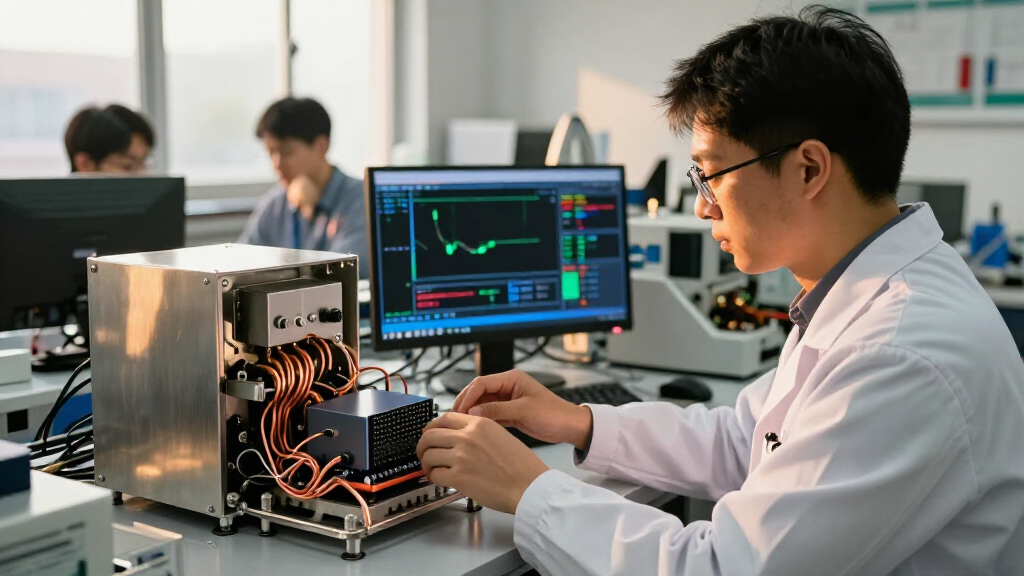
Diraq is developing quantum computers based on silicon spin qubits. The company says these devices can be made using 300-millimeter CMOS-compatible manufacturing, the kind of industrial process used to produce conventional chips. Diraq has reported high-fidelity silicon spin qubits and coherent operation of an eight-qubit array fabricated using that process. Those are company-reported technical achievements; the announcement does not include independent test results or detailed performance data.
Diraq has set out more ambitious future targets: it says it aims to reach 150,000 qubits by 2029 and utility scale by 2031, with more than two million physical qubits on a single chip. These are projections, not outcomes established by the Stage C selection. The company also said it plans to deploy a silicon spin quantum computer in a shared commercial data centre with Equinix in Sydney before the end of 2026.
The announcement places the DARPA progression alongside Diraq’s U.S. expansion, including offices and laboratories in several cities, and a company-reported letter of intent for $38 million from the U.S. Department of Commerce under the CHIPS and Science Act. A letter of intent is not the same as a confirmed grant payment. These developments describe the company’s plans and funding prospects, separate from the technical verdict DARPA’s Stage C review is expected to produce.
“Advancing to Stage C of the QBI program represents a crucial independent validation that our path to utility-scale quantum computing holds up under rigorous technical scrutiny.”
— Andrew Dzurak, Diraq founder and CEO
As an affiliate, we earn on qualifying purchases.
Performance and Cost Still Unproven
The announcement does not disclose the specific Stage C benchmarks, the schedule for individual reviews, or the standards DARPA will use to judge success. It also does not report a completed assessment, a final technical verdict or a DARPA statement independently confirming the funding details.
It remains unclear how the independent team will quantify manufacturing economics, what performance thresholds Diraq must meet, and whether the company’s projected qubit counts and dates can be achieved. The reported eight-qubit result and manufacturing compatibility do not, on their own, establish that a much larger fault-tolerant system will work at utility scale. The company’s targets and claims should be distinguished from the results of the ongoing evaluation.
quantum computing research infrastructure
As an affiliate, we earn on qualifying purchases.
As an affiliate, we earn on qualifying purchases.
Demonstrations Will Shape the Review
Diraq says it will provide a series of technical demonstrations, system updates and design activities over the coming months, with the initial funding tranche supporting the next year of work. Those activities are intended to test capabilities needed for the company’s planned fault-tolerant platform and to support expanded research and testing facilities.
The next meaningful development will be results or milestones that clarify what the independent team has tested and whether Diraq meets the program’s criteria. The company has also said its planned Equinix data-centre deployment in Sydney is due before the end of 2026. The announcement does not give a date for a Stage C decision, so the timing and findings of DARPA’s final assessment remain pending.
As an affiliate, we earn on qualifying purchases.
Key Questions
What does Diraq’s move to Stage C mean?
It means Diraq has entered the final stage of DARPA’s Quantum Benchmarking Initiative. An independent verification and validation team is expected to assess the company’s system design, performance, manufacturing economics and other capabilities relevant to utility-scale quantum computing.
Does Stage C mean Diraq has built a utility-scale quantum computer?
No. The selection begins a further evaluation; it is not a finding that Diraq has already built a utility-scale system. The company’s future scale and performance milestones remain targets.
What is the $51 million for?
Diraq says the initial funding tranche will support the next year of technical demonstrations, infrastructure and development of its fault-tolerant quantum-computing platform. The announcement does not describe the tranche as the total value of all possible program funding.
What is DARPA expected to assess?
According to Diraq, the independent team will assess its silicon-based system design and performance, as well as manufacturing economics and critical capabilities needed to reach utility scale. Specific thresholds and a decision date were not disclosed in the announcement.
When will the Stage C assessment be complete?
Diraq said demonstrations and related work would take place over the coming months and that the initial tranche supports the next year. It did not announce a date for completion or publication of DARPA’s assessment.
Source: rss
Halloween Picks
halloween
As an affiliate, we earn on qualifying purchases.