📊 Full opportunity report: The Advantages Of Camera-Based Gauge Monitoring In Industrial Settings on IdeaNavigator AI — validation score, market gap, and execution plan.

Get business pricing on monitors, keyboards and dev gear
- Business-only prices and quantity discounts
- Tax-exempt purchasing
- Multiple users, one account, clear invoices
TL;DR
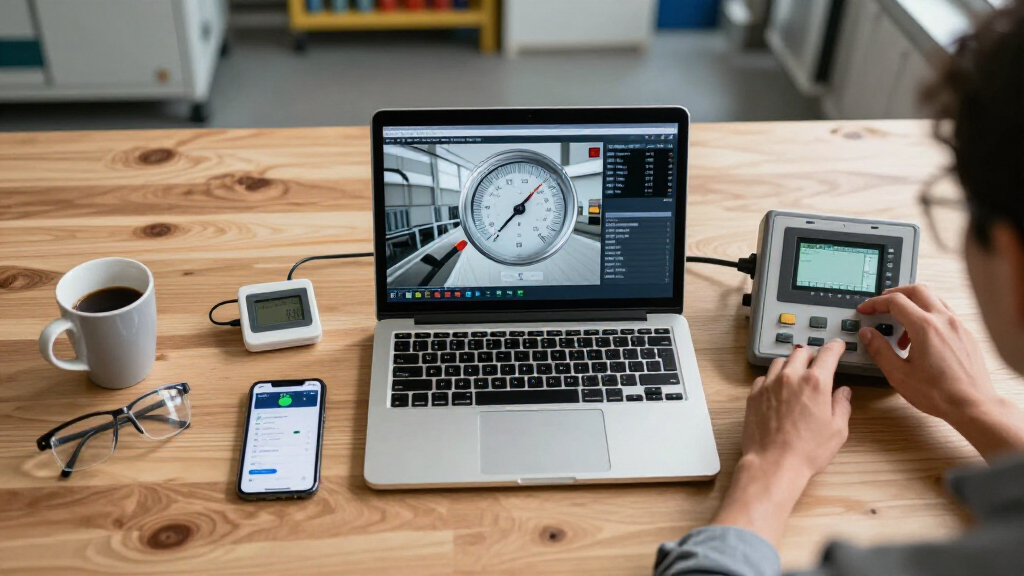
A new approach uses phone photos and AI to read analog gauges in industrial facilities, replacing manual transcription and enabling real-time trend analysis. This method improves accuracy and reduces costs.
Industrial facilities are piloting a phone-photo gauge reading system that uses artificial intelligence to automatically capture, interpret, and log analog gauge data, replacing manual transcription methods. This technology aims to improve accuracy, enable real-time trend analysis, and reduce operational costs, making it a significant development for legacy equipment management.
The system involves technicians photographing gauges during their routine rounds using a smartphone app. The app employs vision models to accurately read the gauge values from the photos, compare them to expected ranges, and log the data with timestamps and location information.
Initial trials are being conducted at three facilities over a month, comparing error rates and early anomaly detection between traditional clipboard rounds and the new photo-based approach. The goal is to demonstrate that the phone-photo system can reliably replace manual transcription, which often introduces errors and fails to provide trend data.
According to sources familiar with the project, the system can flag anomalies immediately, allowing maintenance teams to respond faster. The approach offers a low-cost alternative to retrofitting legacy equipment with IoT sensors, which can be expensive or impractical in older facilities.
Potential Impact on Industrial Maintenance Processes
This development could revolutionize how industrial facilities monitor their equipment, especially legacy systems that lack digital interfaces. By providing a cost-effective, scalable, and accurate data collection method, the phone-photo gauge reading system can enhance predictive maintenance, reduce downtime, and lower operational costs.
Experts suggest that if the pilot proves successful, widespread adoption could follow, transforming manual rounds into automated, data-driven processes. This would also enable facilities to build detailed trend histories, improving failure prediction and resource planning over time.
industrial gauge photo reading app
As an affiliate, we earn on qualifying purchases.
As an affiliate, we earn on qualifying purchases.
Legacy Equipment and the Need for Affordable Monitoring Solutions
Many industrial facilities rely on analog gauges, sight glasses, and counters that are difficult to integrate into modern digital monitoring systems. Retrofitting these systems with IoT sensors is often cost-prohibitive, especially for older or smaller operations.
Recent advances in AI vision models have made it possible to interpret analog readings from simple phone photos reliably. This approach offers a practical, low-cost alternative that leverages existing equipment without requiring hardware upgrades.
The concept gained traction after initial research indicated that AI models can read gauge values with high accuracy, even under varying lighting conditions and gauge types. Pilot programs are now testing how well this technology performs in real-world settings.
AI gauge reading smartphone device
As an affiliate, we earn on qualifying purchases.
As an affiliate, we earn on qualifying purchases.
Unverified Performance and Adoption Challenges
It is not yet confirmed how the system will perform across diverse gauge types, lighting conditions, and operational environments. The pilot results are still pending, and scalability remains untested beyond the initial facilities.
Questions also remain about long-term reliability, integration with existing maintenance systems, and how quickly facilities will adopt this technology at scale.
As an affiliate, we earn on qualifying purchases.
Next Steps: Pilot Evaluation and Broader Deployment
The pilot programs at three facilities will conclude after one month, with results analyzed to assess accuracy, anomaly detection, and operational benefits. If successful, plans for broader deployment and integration into maintenance workflows are expected to follow.
Further research may explore expanding the system to different gauge types and environments, as well as developing features like automated reporting and predictive analytics.
analog gauge scanner for industrial use
As an affiliate, we earn on qualifying purchases.
As an affiliate, we earn on qualifying purchases.
Key Questions
How accurate is the phone-photo gauge reading system?
The system is currently being tested in pilot programs, with initial indications suggesting high accuracy comparable to manual readings, but comprehensive validation results are pending.
Can this system replace all manual gauge readings?
It is designed as a cost-effective solution for legacy analog gauges, but its effectiveness across all types of gauges and conditions is still being evaluated.
What are the cost savings associated with this approach?
By avoiding expensive hardware retrofits and enabling real-time data collection, facilities could significantly reduce maintenance errors and improve operational efficiency, though specific savings depend on implementation scale.
How does the system handle anomalies or failures?
The app flags readings outside expected ranges immediately, allowing maintenance teams to respond quickly and build trend histories for predictive maintenance.
When will this technology be widely available?
Following successful pilot testing and validation, broader deployment could begin within the next year, depending on industry adoption rates and further development.
Source: IdeaNavigator AI
Fall Picks
fall essentials
As an affiliate, we earn on qualifying purchases.