📊 Full opportunity report: How Technology Is Changing Public Benefits Access Through Benefit Check Bots on IdeaNavigator AI — validation score, market gap, and execution plan.
Listen free for 30 days with Audible
Thousands of audiobooks and originals — cancel anytime.
Start your free trialAs an affiliate, we earn on qualifying purchases.
TL;DR
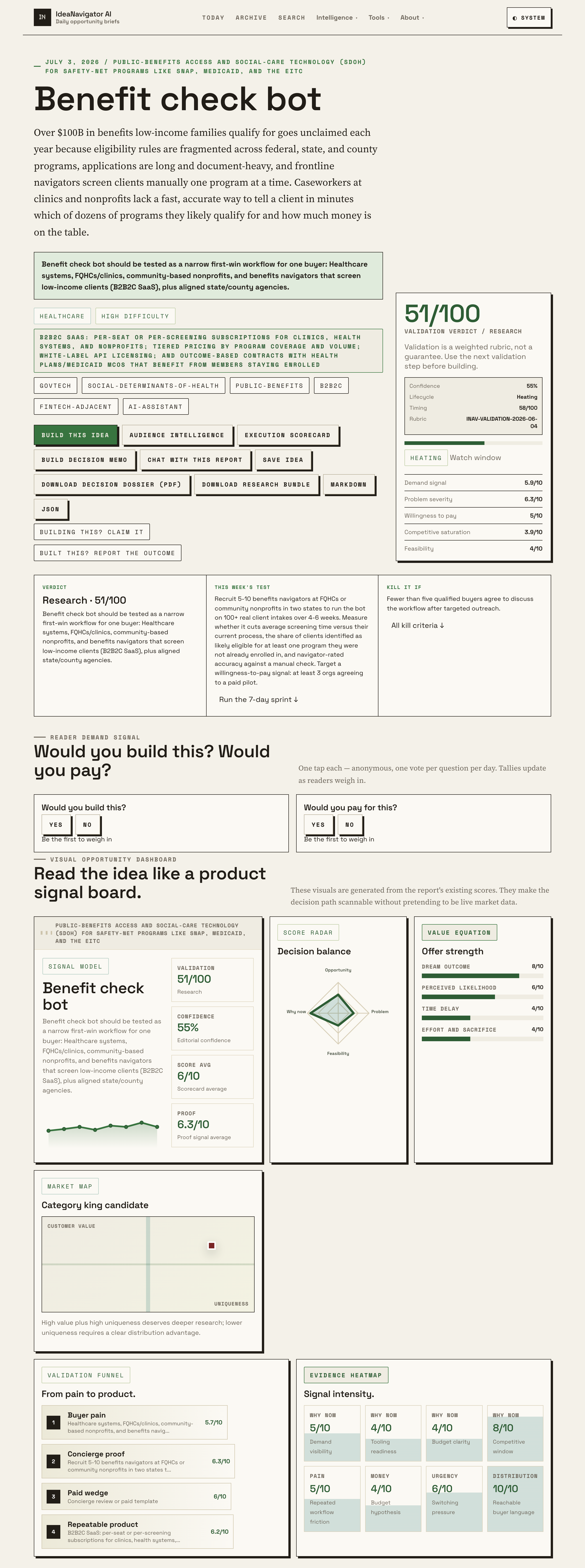
Benefit check bots are emerging as a key tool to improve access to public benefits for low-income families. They automate eligibility screening, reduce manual work, and could significantly increase benefit uptake. This development responds to recent nonprofit closures and the surge in Medicaid redeterminations.
Benefit check bots are being tested as a new tool to automate eligibility screening for public benefits, aiming to help low-income families access over $100 billion in unclaimed assistance annually. These AI-driven tools are designed for healthcare providers, community nonprofits, and state agencies, offering a faster, more accurate alternative to manual screening processes that currently hinder benefit access.
The benefit check bot is a white-label conversational AI platform that can be embedded into clinic websites or used via SMS. It asks clients a series of simple yes/no and multiple-choice questions to determine likely eligibility for programs such as SNAP, Medicaid, EITC/CTC, WIC, and LIHEAP. After screening, it provides an estimated benefit amount and next steps, including application links and document checklists.
This initiative responds to a significant gap in benefits access caused by the recent shutdown of Benefits Data Trust, a nonprofit that previously handled screening for multiple states. Additionally, the post-pandemic Medicaid redeterminations have increased the volume of eligibility checks, creating a need for scalable, low-cost solutions. The conversational AI approach leverages near-zero marginal cost technology, making it feasible to offer multilingual, multi-program screening at scale.
Early pilots involve 5-10 benefits navigators at Federally Qualified Health Centers (FQHCs) and community nonprofits across two states. These pilots aim to measure whether the bots reduce screening time, identify additional eligible clients, and improve accuracy compared to manual processes. The model is a B2B2C SaaS, with revenue generated through subscriptions, API licensing, and outcome-based contracts with health plans and Medicaid managed care organizations.
Why Automated Benefit Screening Matters Now
This development is significant because it addresses a critical bottleneck in public benefits access: the manual, fragmented, and time-consuming screening process. With over $100 billion in benefits going unclaimed annually, automating eligibility checks could dramatically increase benefit uptake among low-income populations, reducing hardship and improving health outcomes. The technology also reduces the workload for frontline staff, allowing them to serve more clients efficiently and accurately.
Furthermore, the closure of Benefits Data Trust and the surge in Medicaid redeterminations have created a pressing need for scalable, cost-effective screening solutions. The use of conversational AI could transform social service delivery, making benefits more accessible and reducing disparities in access, especially for multilingual and underserved communities. If successful, this model could be adopted widely across states and agencies, reshaping how public benefits are delivered.
benefit eligibility screening software
As an affiliate, we earn on qualifying purchases.
As an affiliate, we earn on qualifying purchases.
Recent Developments in Benefits Access Technologies
In 2024, the nonprofit Benefits Data Trust, which had been a major provider of benefits screening services across seven states, shut down, leaving a gap in capacity for benefits enrollment. Meanwhile, the end of pandemic-era Medicaid redeterminations has led to millions of eligibility reviews, creating a surge in demand for screening tools.
Traditional methods involve manual, document-heavy applications and one-by-one eligibility checks by caseworkers, which are slow and prone to errors. The emergence of conversational AI and chatbots offers a new approach, enabling rapid, multilingual, and automated screening processes that can be integrated into existing health and social service workflows.
Several pilot programs are now testing these bots in real-world settings, with early results indicating reductions in screening times and increases in identified benefits. These efforts are part of a broader trend toward leveraging AI to improve social determinants of health (SDOH) and streamline access to safety-net programs.
As an affiliate, we earn on qualifying purchases.
Uncertainties Around Adoption and Effectiveness
It is still unclear how widely these benefit check bots will be adopted beyond initial pilots, and whether they will consistently outperform manual screening in accuracy and client engagement. The long-term impact on benefit uptake and whether they can fully replace human navigators remains to be seen. Additionally, questions about data privacy, integration with existing systems, and language support are still being addressed by developers and agencies.
As an affiliate, we earn on qualifying purchases.
Next Steps for Scaling and Validation
The next phase involves expanding pilot programs to include more clinics and nonprofits, with a focus on measuring real-world effectiveness across diverse populations. Validation metrics include reductions in screening time, increased identification of eligible clients, and user satisfaction. If results are positive, developers plan to seek broader adoption through tiered pricing, API licensing, and outcome-based contracts with Medicaid managed care plans. Policymakers and agencies are also watching for regulatory and privacy considerations to ensure compliance and trust.
multilingual benefits screening platform
As an affiliate, we earn on qualifying purchases.
As an affiliate, we earn on qualifying purchases.
Key Questions
How does the benefit check bot improve eligibility screening?
The bot automates screening by asking clients simple questions and providing an estimate of benefits they may qualify for, reducing manual effort and errors.
Will the benefit check bot replace human benefits navigators?
It is intended to complement existing staff by handling routine screening tasks, allowing navigators to focus on complex cases and application support.
Is the benefit check bot available in multiple languages?
Early pilots include multilingual capabilities, but full language support is still under development and testing.
What are the main barriers to wider adoption?
Challenges include integration with existing systems, data privacy concerns, and ensuring accuracy across diverse populations and programs.
How soon could this technology impact benefits access nationwide?
If pilots demonstrate success, broader rollout could occur within 1-2 years, depending on funding, policy support, and technical development.
Source: IdeaNavigator AI
Flea & tick season Picks
flea and tick prevention
As an affiliate, we earn on qualifying purchases.