
📊 Full opportunity report: The Expanding World Of VR Training For Manufacturing And Industrial Sectors on IdeaNavigator AI — validation score, market gap, and execution plan.

Get business pricing on monitors, keyboards and dev gear
- Business-only prices and quantity discounts
- Tax-exempt purchasing
- Multiple users, one account, clear invoices
TL;DR
Manufacturing companies are beginning to implement VR training modules to address skills gaps and safety concerns. A pilot program focusing on high-risk procedures is underway, with promising early results. The trend is driven by hardware cost drops and urgent workforce needs.
Manufacturers are increasingly adopting virtual reality (VR) training solutions to address critical workforce challenges, including skills gaps and safety risks. A new pilot program focusing on high-risk procedures, such as lockout/tagout and forklift safety, is currently underway at mid-sized manufacturing plants. This development reflects a broader shift toward immersive training technologies driven by declining hardware costs and urgent labor shortages.
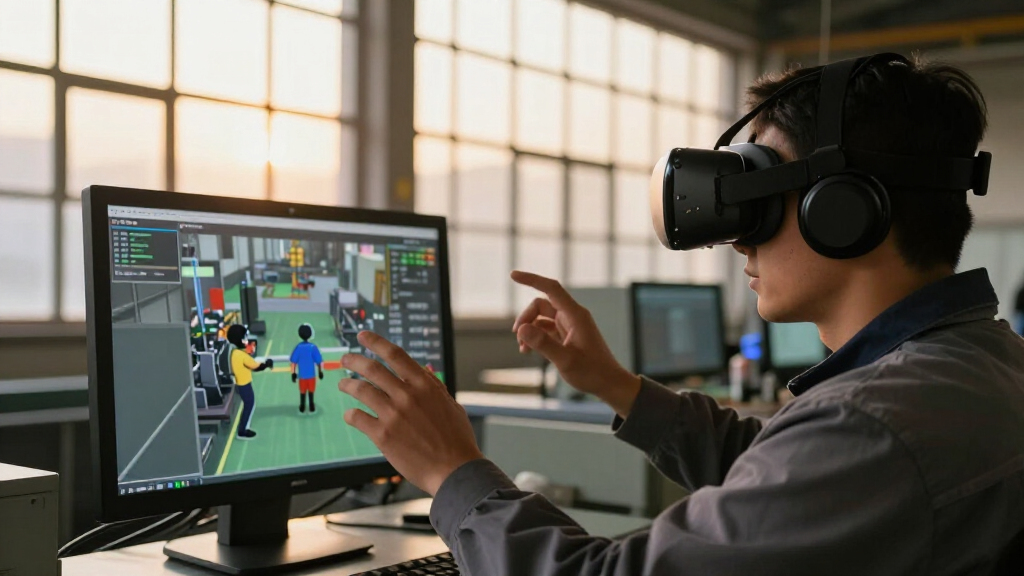
The initiative involves deploying standalone VR headsets, such as Meta Quest devices, equipped with focused training modules designed for specific high-value, high-risk procedures. The pilot includes a cloud-based dashboard that tracks completion rates, hazard recognition accuracy, and quiz scores for each worker, enabling real-time assessment of training effectiveness. The goal is to compare VR training outcomes with traditional classroom methods, measuring metrics such as time-to-competency and hazard detection skills.
According to industry sources, the pilot aims to demonstrate that VR can accelerate onboarding, improve retention, and reduce safety incidents. Manufacturers face a severe labor shortage, with the U.S. manufacturing sector reporting approximately 409,000 unfilled positions as of August 2025, and projections indicating a need for 3.8 million new workers by 2033. Traditional training methods are slow, inconsistent, and pose safety risks on live equipment, prompting a search for scalable, effective solutions.
The hardware cost barrier has diminished significantly, with standalone headsets now available at a fraction of previous prices, making VR deployment feasible for mid-to-large manufacturing plants. The immersive training market is growing at an estimated 20% compound annual growth rate, reflecting increasing industry confidence in digital solutions for workforce development.
Why VR Training Could Transform Manufacturing Onboarding
This shift toward VR training is significant because it offers a scalable, consistent, and safer alternative to traditional methods. Early pilot results suggest VR can reduce time-to-competency, improve hazard recognition, and lower safety incidents — all critical factors amid ongoing labor shortages. If successful, it could reshape workforce development strategies across the manufacturing sector, enabling faster onboarding, reducing costs, and enhancing safety compliance.
Products Worth Considering

Bose TV Speaker (2nd Gen) Compact Soundbar

DJI Mini 5 Pro Fly More Combo with DJI RC 2

Bose QuietComfort True Wireless Earbuds with Active Noise Cancellation, Bluetooth 5.3, USB-C Charging, IPX4, Black
As an affiliate, we earn on qualifying purchases.
Growing Adoption of Immersive Tech in Industrial Training
Over the past few years, advances in XR hardware and software have lowered costs and increased accessibility for enterprise applications. The manufacturing sector, facing a projected shortfall of millions of workers, is exploring digital solutions to bridge skills gaps. Previous efforts focused on classroom and on-the-floor training, which proved slow, inconsistent, and risky. The current push for VR-based modules aligns with broader industry trends toward digital transformation and safety innovation.
Early adopters have reported promising results in pilot programs, with some companies noting faster onboarding times and improved hazard recognition. The market for immersive enterprise training was valued at approximately USD 14.55 billion in 2025, with manufacturing representing a significant segment. The COVID-19 pandemic accelerated interest in remote and virtual training tools, further boosting industry investment and experimentation.
What Aspects of VR Training Are Still Developing?
It is not yet clear how scalable and cost-effective the VR training approach will be across diverse manufacturing environments. Long-term impacts on safety incident reduction and skill retention require further validation through extended pilots. Additionally, the integration of VR modules with existing learning management systems and operational workflows remains an ongoing challenge, with some uncertainty about how quickly and smoothly these integrations can be achieved at scale.
Next Steps for Widespread VR Manufacturing Training Adoption
Manufacturers are expected to conduct 60-90 day pilot programs, measuring outcomes such as time-to-competency, hazard recognition accuracy, and supervisor assessments. Successful pilots could lead to broader rollouts across multiple plants, with some companies planning to develop custom scenarios for different procedures. Industry stakeholders will also monitor cost-benefit analyses and integration efforts to determine long-term viability. As evidence accumulates, more manufacturers are likely to adopt VR training as a core component of their workforce development strategies.
Key Questions
How cost-effective is VR training compared to traditional methods?
Initial hardware costs are decreasing, and pilot programs aim to demonstrate that VR can reduce onboarding time and safety incidents, potentially lowering overall training costs. However, comprehensive cost-benefit analyses are still underway.
What procedures are most suitable for VR training?
High-risk, high-value procedures such as lockout/tagout, forklift safety, and machinery operation are considered ideal candidates for initial VR modules due to their safety importance and training complexity.
Are there any safety concerns with using VR headsets in manufacturing environments?
VR headsets are used in controlled environments, typically away from live machinery, minimizing safety risks. The technology aims to improve safety awareness before workers operate actual equipment.
When will VR training be widely adopted in manufacturing?
Widespread adoption depends on pilot outcomes, cost reductions, and integration success. Industry experts expect broader rollout within the next 1-3 years if initial pilots prove effective.
Source: IdeaNavigator AI