
📊 Full opportunity report: Revolutionizing Surgical Robotics With AI-Powered Real-Time Generative Simulations on ThorstenMeyerAI.com — validation score, market gap, and execution plan.
TL;DR
NVIDIA has launched Cosmos-H-Dreams, an AI-powered, real-time surgical simulation system that generates video from robot commands. While promising for faster testing, its clinical reliability remains unverified.
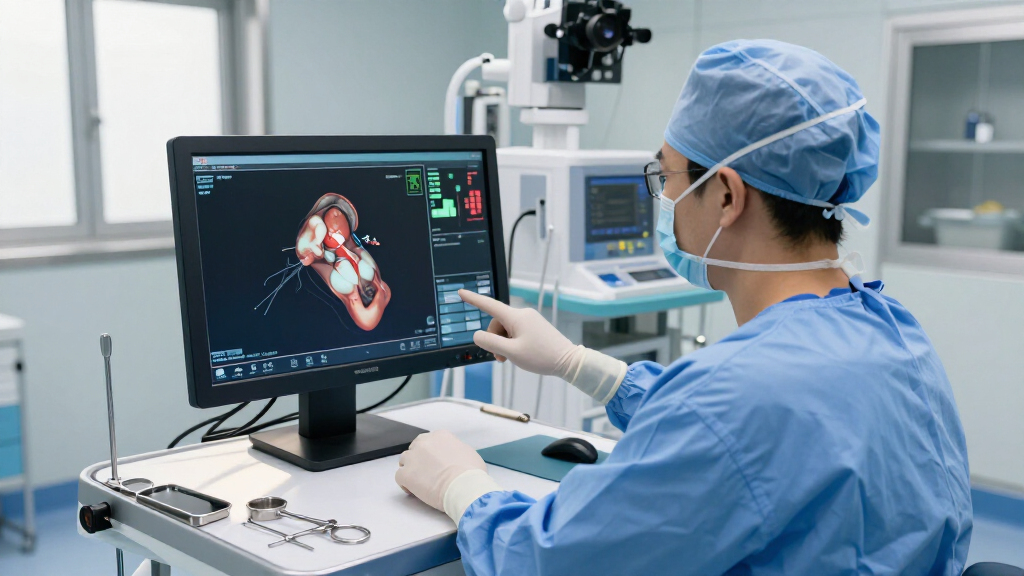
NVIDIA has introduced Cosmos-H-Dreams, a real-time, AI-powered surgical simulator that generates surgical videos from live robot commands on a single RTX PRO 6000 GPU. For more details, see the original analysis. The system aims to enable faster, more cost-effective testing of control policies in surgical robotics, but its clinical validity has not yet been established.
Cosmos-H-Dreams is a distilled version of NVIDIA’s earlier Cosmos-H-Surgical-Simulator, based on Cosmos-Predict2.5-2B, designed to process actions sequentially and generate the next video frames while receiving ongoing commands. NVIDIA claims it can operate in real time on a single RTX PRO 6000 GPU, supporting closed-loop control without physical instruments or biological material.
The system was specialized for da Vinci Research Kit tabletop suturing, trained on a mixture of successful demonstrations and failed attempts, including needle drops and missed knots, to better simulate real-world surgical scenarios. This approach aligns with recent advances in generative simulation for surgical robotics. NVIDIA states that including unsuccessful episodes helps the model learn the consequences of poor actions, not just ideal outcomes. The model uses a combination of causal attention, streaming key-value caches, and self-forcing distillation, with training involving a teacher-student pipeline where the student conditions on its own generated history.
While the simulator’s ability to generate visual scenes quickly suggests potential for faster testing and development of surgical control policies, NVIDIA has not provided performance metrics such as frame rate, latency, or image quality. The system’s performance on hardware other than the RTX PRO 6000 and its physical or clinical accuracy remain unverified, and there are no peer-reviewed validations or independent studies confirming its safety or effectiveness in real surgical settings.
Potential Impact on Surgical Robotics Development
The introduction of Cosmos-H-Dreams could significantly accelerate the development and testing of surgical robots by providing fast, visual simulation of surgical procedures. This may reduce costs, improve safety, and enable more iterative control policy improvements without risking damage to physical instruments or biological tissues. However, the lack of validated clinical data and performance benchmarks means its immediate application in real surgeries remains uncertain.

Surgery Simulation and Soft Tissue Modeling: International Symposium, IS4TM 2003. Juan-Les-Pins, France, June 12-13, 2003, Proceedings (Lecture Notes in Computer Science, 2673)
- Condition: Used Book in Good Condition
As an affiliate, we earn on qualifying purchases.
As an affiliate, we earn on qualifying purchases.
Advances in AI-Driven Surgical Simulation
Prior to Cosmos-H-Dreams, NVIDIA’s Cosmos-H-Surgical-Simulator supported offline policy evaluation and synthetic data generation, relying on offline batch processing. The new streaming version moves this process into real-time, enabling dynamic control and faster feedback loops. The development aligns with ongoing efforts in AI to improve surgical automation, with collaborations like those with CMR Surgical and Cambridge Consultants demonstrating integration with existing surgical platforms. Despite these advances, no system has yet been clinically validated or widely adopted for patient care, and the current system remains a research tool.
“Cosmos-H-Dreams is a real-time, action-conditioned generative simulator for surgical robotics.”
— NVIDIA spokesperson
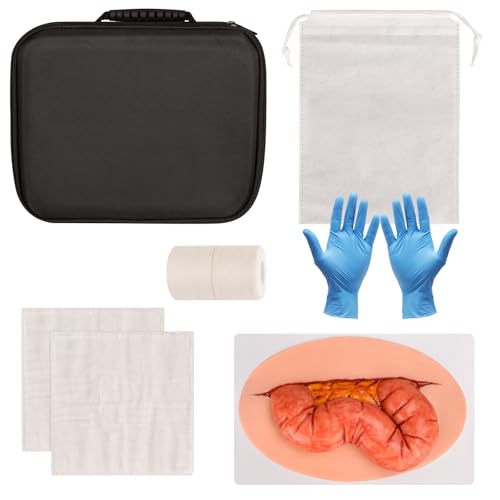
MedEduQuest Wound Packing Trainer, Intestine Simulator, Large
- Realistic Silicone Intestine: Feels like real human tissue
- Detailed Design: Accurate shape and texture
- Reusable and Easy to Clean: Disinfectable and portable
As an affiliate, we earn on qualifying purchases.
As an affiliate, we earn on qualifying purchases.
Unverified Performance and Clinical Validation
Details about the system’s latency, image quality, and stability are not publicly available. The system’s ability to maintain coherent and accurate simulations over extended periods, as well as its transferability from simulated to real-world surgical environments, remains unconfirmed. No peer-reviewed or independent validation studies have been published, and its safety and efficacy in clinical settings are still unproven.
surgical robot control training tools
As an affiliate, we earn on qualifying purchases.
As an affiliate, we earn on qualifying purchases.
Next Steps for Validation and Deployment
Future developments will likely include rigorous testing in controlled clinical scenarios, including closed-loop trials on physical surgical robots. Independent validation studies are expected to assess the system’s accuracy, stability, and safety. NVIDIA may also release more detailed hardware requirements and access terms, as well as expand testing to other robot platforms and surgical tasks.

Bioengineering for Surgery: The Critical Engineer Surgeon Interface
As an affiliate, we earn on qualifying purchases.
As an affiliate, we earn on qualifying purchases.
Key Questions
What is NVIDIA Cosmos-H-Dreams?
It is an action-conditioned, real-time generative simulator that produces surgical videos from robot commands, aiming to accelerate surgical robotics development.
Can Cosmos-H-Dreams operate on real surgical robots autonomously?
No, the current system generates visual simulations based on robot commands; it is not designed for autonomous clinical operation.
What hardware does the simulator require?
NVIDIA states it runs in real time on a single RTX PRO 6000 GPU, but performance on other hardware remains untested.
Is Cosmos-H-Dreams validated for clinical use?
No, the system is still in research phase, with no peer-reviewed validation or clinical testing publicly confirmed.
What are the limitations of this technology?
Current limitations include lack of performance benchmarks, unverified physical accuracy, and no demonstrated safety or efficacy in live surgical environments.
Source: ThorstenMeyerAI.com