

Understanding how SDLC and STLC connect helps you integrate QA effectively into your project. SDLC guides your entire development process, while STLC focuses on testing activities throughout. In Agile, QA teams work from the start, enabling early defect detection, whereas Waterfall delays testing until the end. By aligning these cycles, you can guarantee quality and efficiency. Keep exploring to discover how choosing the right methodology impacts your testing and development success.
Key Takeaways
- SDLC outlines the overall software development phases, while STLC focuses on specific testing activities within those phases.
- QA integrates into SDLC to ensure quality throughout development, with testing conducted in STLC during each phase.
- In Agile, QA is involved early and continuously, whereas in Waterfall, QA testing often occurs after development completion.
- Proper alignment of SDLC and STLC enhances defect detection, reduces costs, and improves overall software quality.
- Understanding methodology differences helps optimize QA efforts to fit development and testing lifecycles effectively.
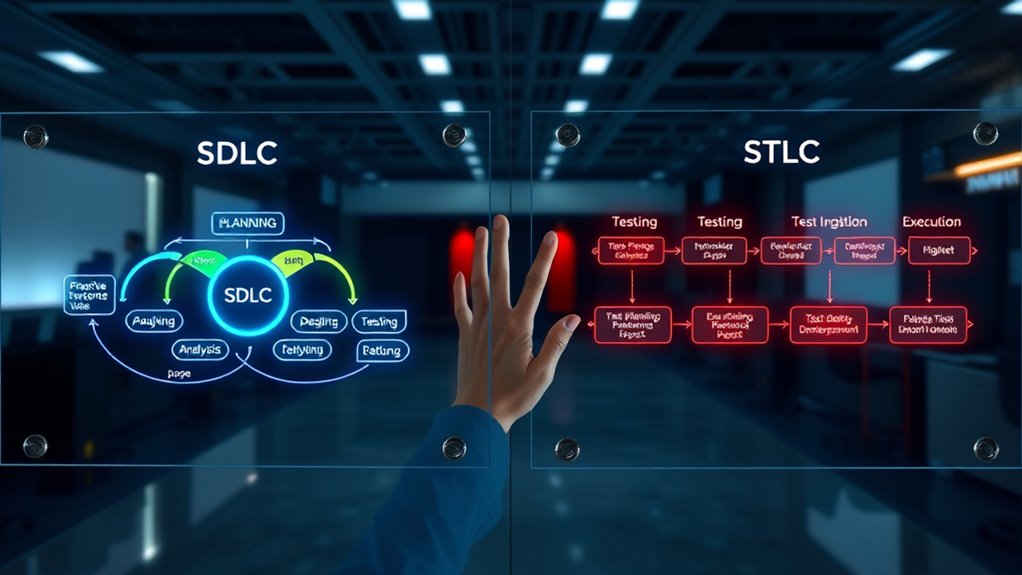
Understanding the differences between SDLC (Software Development Life Cycle) and STLC (Software Testing Life Cycle) is essential for successful software projects. These processes work hand-in-hand to ensure that your software not only meets requirements but also performs reliably. When you’re exploring SDLC, you’ll notice that different development methodologies influence how the lifecycle unfolds. For example, Agile methodologies promote iterative development, allowing teams to adapt quickly and incorporate feedback throughout the project. This flexibility means testing activities can happen concurrently with development, making STLC an ongoing process that aligns closely with Agile’s rapid cycles. On the other hand, Waterfall processes follow a linear, sequential approach, where each phase completes before the next begins. In this model, testing is typically reserved for the final stages, which can sometimes lead to delayed detection of issues and increased costs for fixes.
SDLC and STLC are vital; Agile promotes continuous testing, while Waterfall reserves testing for later stages.
In traditional Waterfall processes, the SDLC emphasizes detailed planning and documentation upfront, setting a clear path for development. Testing, within the STLC, is then executed after the build phase, meaning bugs or flaws might not be identified until late in the project. This approach can be less flexible but offers predictability and control, which some teams prefer for projects with well-defined requirements. Conversely, Agile methodologies challenge this rigidity by promoting continuous testing and integration, where QA teams are involved from the earliest stages. This integration helps catch defects early, reducing the risk of major setbacks later.
The choice between Agile and Waterfall influences how you coordinate SDLC and STLC activities. In Agile environments, you’ll find testing is integrated into each sprint, making QA an ongoing partner rather than a separate phase. This collaboration enables quicker feedback loops and more adaptive development. In contrast, Waterfall’s step-by-step model often isolates testing as a distinct phase, which can sometimes cause delays if issues surface late. Regardless of the methodology, understanding these differences helps you align testing efforts with development, ensuring quality is built-in rather than tacked on at the end.
Ultimately, whether you’re working within Agile or Waterfall frameworks, knowing how SDLC and STLC interact allows you to optimize your workflows. Agile promotes continuous testing and frequent adjustments, while Waterfall offers a structured, predictable path. Recognizing these differences ensures QA activities support your project’s goals, whether by catching bugs early or maintaining a clear, linear process. This awareness helps you deliver reliable, high-quality software that meets user expectations and project deadlines.

BDD in Action: Behavior-driven development for the whole software lifecycle
As an affiliate, we earn on qualifying purchases.
As an affiliate, we earn on qualifying purchases.
Frequently Asked Questions
How Do SDLC and STLC Overlap During Project Execution?
During project execution, SDLC and STLC overlap through integration points where development and testing phases intersect. You’ll notice process overlaps, like testing activities beginning during development or feedback loops refining both workflows. This synergy guarantees quality is built in early, reducing bugs later. You actively coordinate these phases, enabling smoother handoffs and faster defect resolution, ultimately delivering a reliable product efficiently.
What Are the Key Challenges in Integrating QA Into SDLC?
You face challenges like integrating Test Automation smoothly into the SDLC, which requires aligning automation efforts with development stages. Communication gaps often hinder collaboration between developers and QA teams, leading to misunderstandings and delays. To overcome these, establish clear communication channels and involve QA early in planning. Automate testing where possible, and ensure teams stay aligned throughout the cycle for seamless integration.
How Does Agile Influence the SDLC and STLC Processes?
Like a river constantly changing course, Agile transforms your SDLC and STLC processes by emphasizing flexibility and adaptability. You integrate QA early through Agile transformation, enabling continuous testing and development. This approach fosters continuous feedback, allowing you to identify and fix issues swiftly. It keeps your project aligned with user needs, accelerates delivery, and enhances quality, making your development cycle more responsive and efficient.
What Skills Are Essential for QA Professionals in These Lifecycles?
You need strong communication skills to effectively collaborate with developers and stakeholders, ensuring requirements are clear and issues are addressed promptly. Test automation skills are essential for efficiently executing tests, reducing manual effort, and increasing coverage. Being proficient in both areas helps you adapt to agile environments, streamline testing processes, and deliver high-quality software faster. These skills enable you to actively contribute throughout the development and testing lifecycle.
How Is Risk Management Addressed Differently in SDLC and STLC?
Did you know 70% of project failures relate to insufficient risk management? In SDLC, you focus on risk assessment early, integrating quality assurance to prevent issues from the start. Conversely, in STLC, risk management is ongoing, with QA continuously identifying and addressing potential risks during testing. This proactive approach helps ensure product quality and reduces costly errors, making risk management a critical part of both lifecycles.
SDLC and STLC process management software
As an affiliate, we earn on qualifying purchases.
As an affiliate, we earn on qualifying purchases.
Conclusion
Ultimately, understanding how SDLC and STLC intertwine shows that quality isn’t just a phase—it’s built into every step. When you realize that testing naturally follows development, it’s like two sides of the same coin, perfectly aligned. Coincidentally, this seamless integration guarantees your project’s success, proving that quality and development are truly two halves of the same story. Embrace this harmony, and you’ll see how smooth and efficient your software journey becomes.

The Art of Agile Development
As an affiliate, we earn on qualifying purchases.
As an affiliate, we earn on qualifying purchases.

Technology Project Management: A Quick, Practical, and Handy Guide: Featuring Agile, Waterfall, and Hybrid Lifecycles, Along with Smarter Project Management with AI (only 60 Pages)
As an affiliate, we earn on qualifying purchases.
As an affiliate, we earn on qualifying purchases.